Voice science stands at a definitive historical crossroads. For centuries, the human voice has served as our most fundamental instrument of art, culture, and personal identity. Today, however, it is undergoing an unprecedented analytical transformation. Artificial intelligence (AI) and machine learning are fundamentally reshaping how researchers conduct studies, how clinicians analyze physiological data, and how medical professionals care for patients.
At the epicenter of this technological and medical convergence is The Voice Foundation and its premier peer-reviewed publication, the Journal of Voice. Far from being a recent bandwagon, the integration of artificial intelligence into voice science boasts a surprisingly deep history. Thirty-one years ago—long before modern consumer AI entered the public consciousness—the Journal of Voice published pioneering neural network research.
Now, this trajectory has shifted from a slow burn to an exponential explosion. In the last three years alone, the volume of AI-related research has skyrocketed, redefining the voice not merely as a vehicle for speech and song, but as a complex, non-invasive digital biomarker for systemic health. From detecting early-stage neurological disorders like Parkinson’s disease to mapping psychological health and respiratory conditions, AI is allowing researchers to decode physiological data previously imperceptible to the human ear.
This comprehensive report examines the historical foundation, the statistical surge, landmark studies, expert perspectives, and ethical considerations guiding this extraordinary paradigm shift in voice science.
Detailed Chronology: A Legacy of Innovation and Early AI Adoption
The Foundations of Interdisciplinary Voice Care
To understand the current technological leap, one must look back to the origins of modern voice care. In 1969, Dr. Wilbur James Gould founded The Voice Foundation in New York City. At a time when interdisciplinary care for the human voice was virtually nonexistent, Dr. Gould possessed the groundbreaking foresight to bridge distinct professional silos. He brought together physicians, scientists, speech-language pathologists, performing artists, and educators to share knowledge and expertise, specifically focusing on the care of professional voice users.
This multidisciplinary mission materialized quickly. In 1972, the Foundation hosted its first Annual Symposium—Care of the Professional Voice—followed by its inaugural Gala (later christened Voices of Summer) in 1973. For over five decades, the Foundation has successfully built a bridge between art and science, and between the sterile environment of the clinic and the vibrant energy of the stage.
Since 1989, the Foundation has operated under the leadership of Dr. Robert Thayer Sataloff, an internationally renowned otolaryngologist, professional singer, and conductor. Having authored more than 1,200 publications, including 79 textbooks, Dr. Sataloff spearheaded the relocation of the Foundation to Philadelphia. Under his guidance, the institution expanded its footprint through rigorous scientific research, educational programming, and the stewardship of the Journal of Voice. Today, the annual Philadelphia symposium draws hundreds of medical professionals, academics, and artists from around the world.
Thirty-One Years of Artificial Intelligence in Voice Science
While contemporary media often frames artificial intelligence as a brand-new phenomenon born out of the 2020s generative AI boom, the scholarly record tells a very different story.
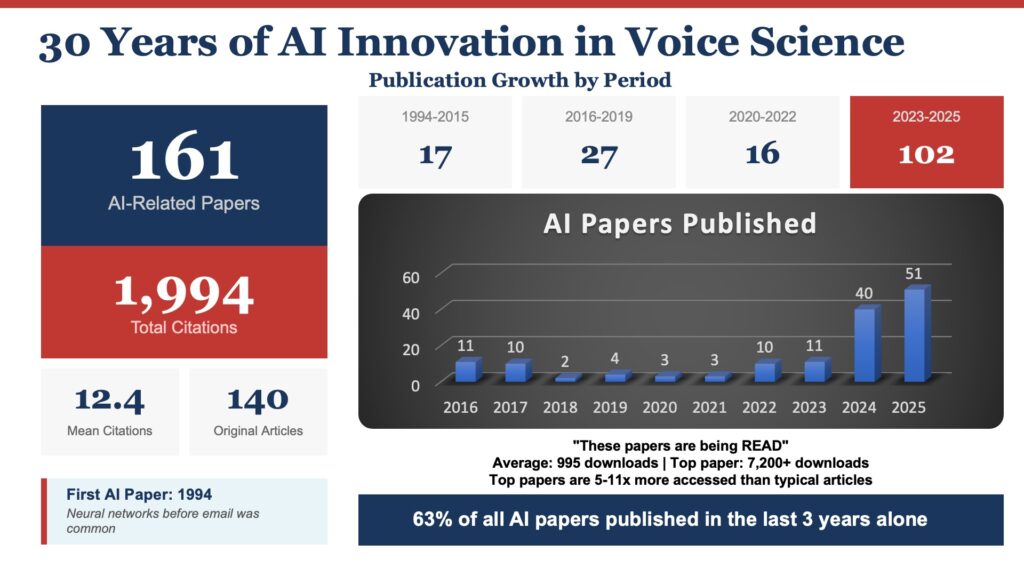
In 1994—the exact same year the World Wide Web was emerging into public consciousness, and when sending an email was still a novelty for many—the Journal of Voice published a paper by Rihkanen and colleagues titled "Spectral Pattern Recognition of Improved Voice Quality." This foundational study utilized early neural networks to analyze acoustic voice characteristics.
The Journal of Voice was publishing peer-reviewed AI research in voice science decades before machine learning became a household term. However, the timeline of subsequent publications reveals a dramatic acceleration over the last decade:
1994–2015: 17 papers (The formative early era)
2016–2019: 27 papers (The machine learning expansion)
2020–2022: 16 papers (Steady developmental phase)
2023–2025: 102 papers (The exponential explosion)
In the year 2025 alone, the journal published 51 AI-related papers—surpassing the total output of the entire first two decades combined. This is no longer gradual scientific growth; it is an exponential transformation that is actively rewriting the diagnostic and therapeutic rulebooks of otolaryngology and speech pathology.
Supporting Context & Metrics: Beyond Citations to Real-World Impact
Numbers alone do not tell the full story of academic progress; practical application is the true metric of scientific success. The AI-focused papers published in the Journal of Voice are not sitting idly in digital archives—they are being actively downloaded, shared, and implemented by clinicians and researchers worldwide.
Global Engagement and Access Metrics
The average AI-related paper published in the journal has been downloaded nearly 1,000 times, reflecting an immense appetite for computational tools among practitioners.
Furthermore, exceptional studies have shattered standard academic reach thresholds:
Machine Learning for COVID-19 Detection: The journal’s most-accessed AI paper has garnered over 7,200 downloads, a staggering figure that represents eleven times the median download rate for articles in its respective issue.
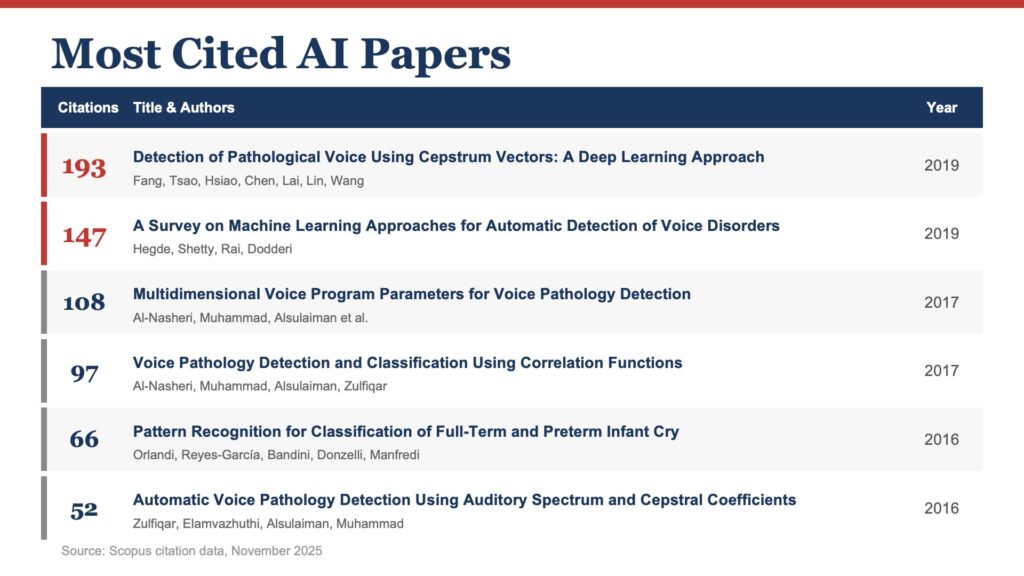
Deep Learning for Voice Pathology: A landmark deep learning study by Fang and colleagues has amassed 193 citations and nearly 5,000 downloads.
Machine Learning Surveys: A comprehensive survey on automatic detection of voice disorders by Hegde and colleagues secured 147 citations and nearly 5,000 downloads, instantly establishing itself as essential reading for new entrants to the field.
These downloads do not represent casual web traffic. They represent clinicians, researchers, and speech-language pathologists actively seeking practical, data-driven frameworks to improve patient care outcomes.
Landmark Research Shaping the Field
The evolution of computational methodologies in the journal can be traced through several critical milestones:
Deep Learning for Pathology Detection: Fang et al. (2019) demonstrated that deep neural networks could identify pathological voices with remarkable precision using fine-grained cepstrum vectors—acoustic features entirely imperceptible to the human ear.
Advanced Neural Architectures: Research rapidly progressed from traditional machine learning classifiers to sophisticated architectures. Studies by Chen and Chen (2022) explored deep neural networks for voice classification, Fujimura introduced one-dimensional convolutional neural networks (CNNs), and Cho and Choi utilized CNN models to accurately analyze complex laryngoscopic imagery.
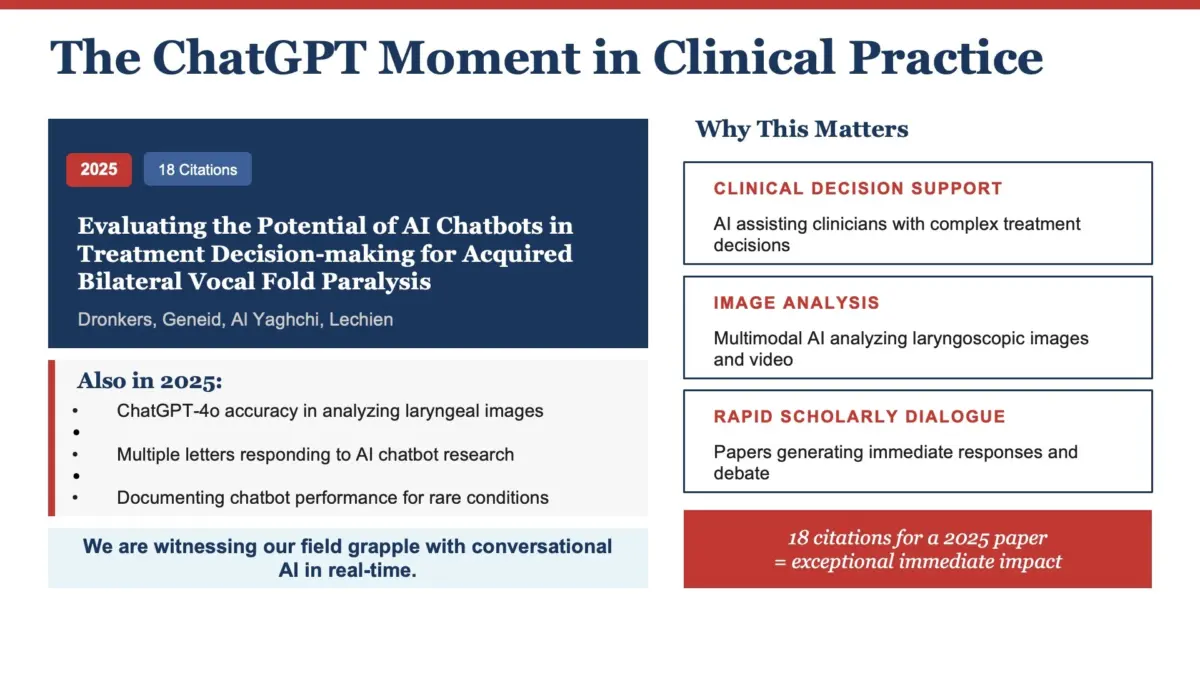
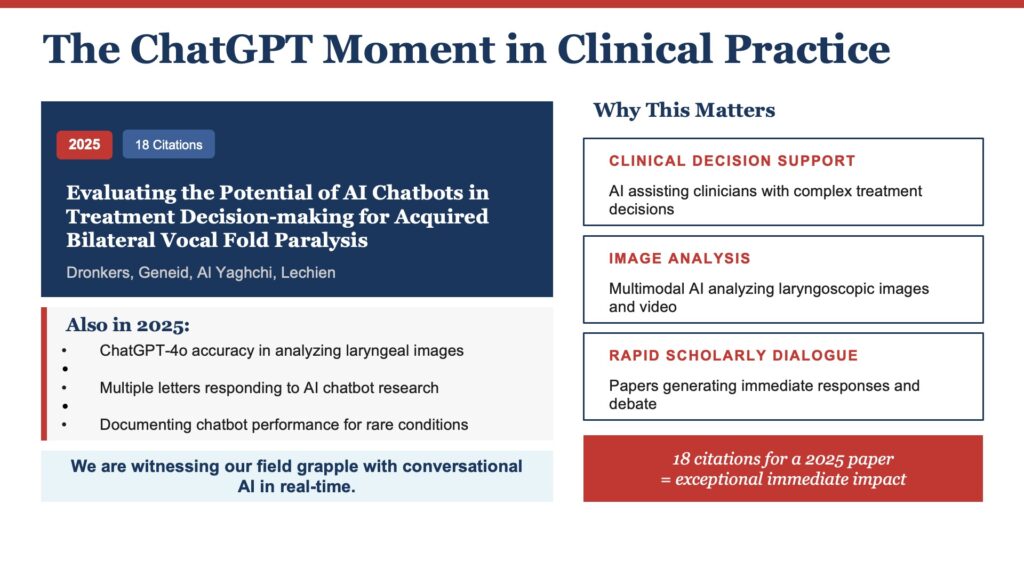
Clinical Chatbots and Conversational AI: Expanding beyond audio signal processing, recent 2025 publications have begun evaluating the role of AI chatbots in complex clinical decision-making. Notably, Dronkers and colleagues published a study on evaluating AI chatbots for treatment decisions in acquired bilateral vocal fold paralysis, quickly accumulating 18 citations and sparking active debate regarding conversational AI in medicine.
The Voice as a Digital Biomarker
Perhaps the most profound conceptual leap in recent voice science is the recognition of the human voice as a digital biomarker—a non-invasive, continuous window into an individual’s systemic health.
Neurological Disorders: Groundbreaking papers by Hemmerling and Wójcik-Pędziwiatr (2022) have utilized voice signals to predict the severity and progression of Parkinson’s disease, garnering widespread academic attention and pushing the field toward reliable clinical screening tools.
Mental Health and Psychiatric Screening: Systematic reviews exploring voice quality as a digital biomarker for depression and bipolar disorder suggest a future where routine acoustic monitoring could flag mental health shifts early, reducing the immense diagnostic burden on overstretched psychiatric healthcare systems.
Respiratory Sentinel Systems: Machine learning models trained on vocal characteristics during the COVID-19 pandemic have proven that minor alterations in phonation can act as early warning indicators for respiratory distress and systemic infection.
Official Statements and Expert Perspectives
To contextualize this computational revolution, leading voices within the scientific community have offered vital insights regarding both the immense potential and the operational challenges of integrating AI into medical workflows.
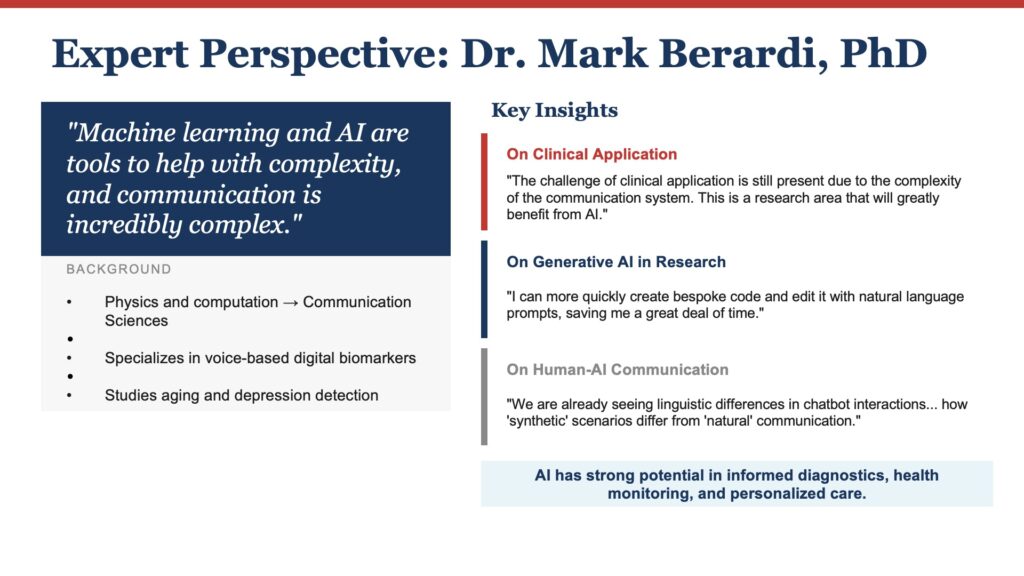
Dr. Mark Berardi: Managing Complexity and Synthetic Communication
Dr. Mark Berardi brings a unique interdisciplinary lens to voice science, having transitioned from physics and computation into the medical study of communication. To Dr. Berardi, artificial intelligence is fundamentally a management tool for extreme physiological complexity.
"Machine learning and AI are tools to help with complexity, and communication is incredibly complex in its neurobiological and physiological processes. So I think the application is warranted," Dr. Berardi notes.
Focusing his research on voice-based digital biomarkers for aging and depression, Dr. Berardi points out that while acquiring voice signals has become remarkably easy, interpreting the underlying biological mechanics remains difficult—making AI an ideal analytical partner.
Furthermore, Dr. Berardi highlights how generative AI has transformed everyday research logistics. By utilizing natural language prompts to write, test, and debug bespoke code, researchers can bypass traditional computational bottlenecks.
Looking forward, Dr. Berardi’s lab is exploring an entirely new frontier: human-AI communication. As society increasingly relies on Zoom calls, synthetic interfaces, and conversational agents, human linguistic patterns are visibly shifting. Voice science must now expand to understand not just the human voice in isolation, but the human voice in direct conversation with machines.
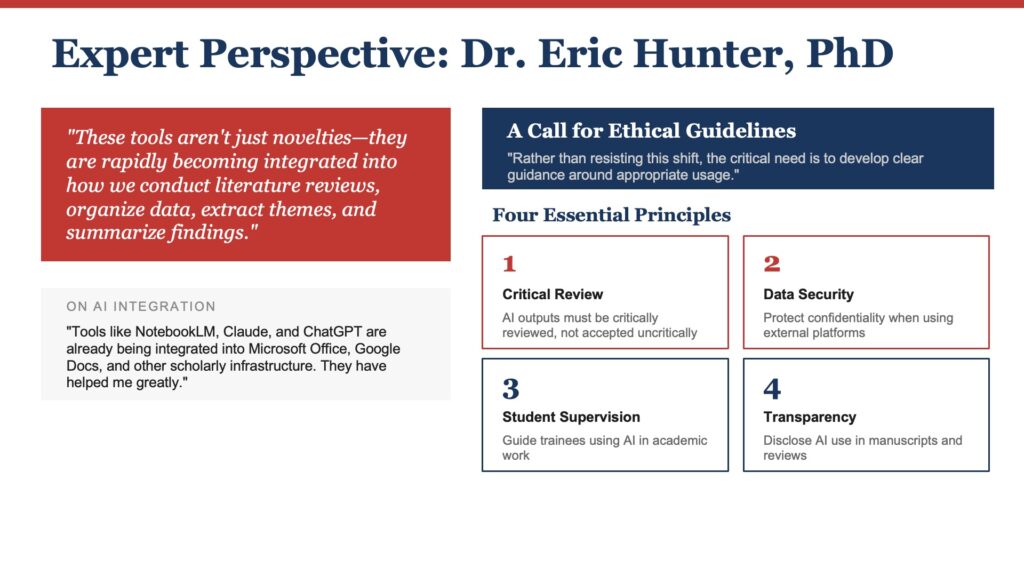
Dr. Eric Hunter: Embracing Change with Ethical Clarity
Dr. Eric Hunter approaches the AI transition from an institutional and structural perspective, urging academic communities to confront the reality of technological integration head-on.
"These tools aren’t just novelties," Dr. Hunter observes. "They are rapidly becoming integrated into how we conduct literature reviews, organize data, extract themes from large bodies of text, and even summarize findings."
As large language models become natively embedded within standard academic software suites—from Microsoft Office and Google Docs to specialized reference managers—resistance is futile. Dr. Hunter issues a clear call to action: rather than fighting the shift, the academic community must establish clear, transparent guidance regarding appropriate usage for both authors and reviewers.
Dr. Hunter advocates for a balanced framework that embraces the massive productivity gains offered by modern AI tools while fiercely preserving academic integrity, intellectual ownership, and scientific accountability.
Future Outlook: A Global Research Community and the Path Forward
The acceleration of voice science is driven by a vibrant, highly collaborative global community. Leading contributors to the Journal of Voice span the globe, including prolific researchers such as Jérôme René Lechien, Dimitar Deliyski, Stephanie Zacharias, Ahmed Yousef, Paavo Alku, Leonardo Wanderley Lopes, and Maryam Naghibolhosseini, alongside dozens of international laboratories spanning every continent.
As the field looks toward the next decade, three critical imperatives must guide the scientific community:
Thoughtful Engagement with Complexity: Researchers and clinicians must learn what AI tools can accomplish, recognize their inherent limitations, and use them strictly to amplify human expertise rather than replace clinical judgment.
Establishment of Shared Ethical Frameworks: As Dr. Hunter emphasizes, developing comprehensive guidelines for AI use in research and publishing requires a unified, community-wide effort that transcends individual institutions.
Continued Open Scientific Discourse: The 161 AI papers published to date represent only the opening chapter. Clinicians, educators, and researchers must continue sharing their empirical findings to build a robust, collective understanding of vocal physiology.
An Extraordinary Moment in Human History
The human voice has served as our primary instrument of connection, emotional expression, and identity for hundreds of thousands of years. It carries the nuances of our health, our moods, and our very humanity in ways that no other biological signal can replicate.
Now, for the first time in history, humanity possesses analytical tools sophisticated enough to truly decode that complexity. By leveraging artificial intelligence, we can extend the reach of expert clinicians, detect subtle pathological changes long before symptoms manifest, and democratize access to high-quality voice care across the globe.
We stand at the center of an extraordinary moment. The next decade promises discoveries that will forever alter our relationship with sound, health, and technology.
About the Author
Ian DeNolfo is Executive Director of The Voice Foundation, which publishes the Journal of Voice. A graduate of The Juilliard School and The Curtis Institute of Music, he formerly performed as a leading tenor at opera houses worldwide before successfully transitioning into arts administration and scientific leadership at The Voice Foundation.