By Ian DeNolfo, Executive Director of The Voice Foundation
Executive Overview
We stand at a profound inflection point in the trajectory of voice science. Today, artificial intelligence (AI) and advanced machine learning are fundamentally reshaping how researchers conduct investigations, how data scientists analyze acoustic patterns, and how clinicians diagnose and care for patients. This technological renaissance is not an abrupt pivot away from tradition, but rather the evolutionary next step in a discipline dedicated to decoding the most complex, personal instrument known to humanity: the human voice.
For more than half a century, The Voice Foundation and its premier publication, the Journal of Voice, have served as the epicenter of this interdisciplinary field. From the earliest days of acoustic analysis to the modern era of deep neural networks and large language models (LLMs), the scientific community has consistently pushed the boundaries of what is possible.
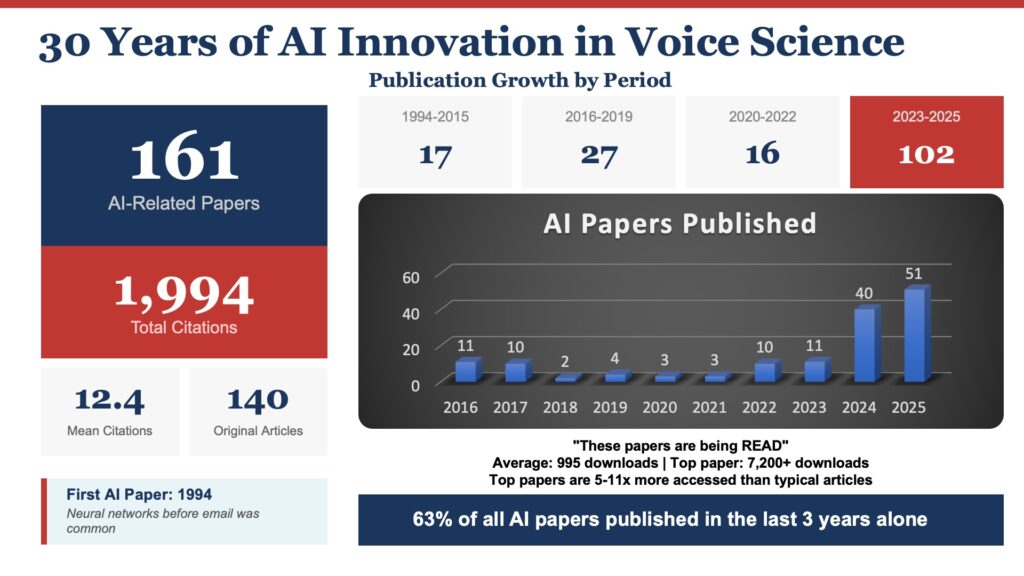
The scope of this transformation is staggering. While the application of computational methods to voice science began decades ago, recent years have witnessed an exponential surge in research output. Of the more than 160 artificial intelligence papers published in the Journal of Voice over its history, 63 percent have appeared within the last three years alone. In 2025 alone, the journal published 51 AI-related studies—surpassing the total output of the field’s first twenty combined years.
This article explores the historical foundations, landmark research, emerging clinical applications, and expert perspectives defining this unprecedented era of voice science.
A Legacy of Innovation: Bridging Art and Science
To understand where voice science is heading, one must appreciate its origins. In 1969, Dr. Wilbur James Gould founded The Voice Foundation in New York City at a time when interdisciplinary care for the human voice was virtually nonexistent. Dr. Gould possessed a groundbreaking foresight: he recognized that true excellence in voice care required breaking down traditional academic silos, bringing together physicians, scientists, speech-language pathologists, performing artists, and vocal pedagogues to share their collective expertise.
The Foundation established its first Annual Symposium—Care of the Professional Voice—in 1972, creating a vital annual gathering for the global voice community. This was followed in 1973 by the first Gala (later known as Voices of Summer). For over five decades, the Foundation has successfully built bridges between art and science, and between the clinical suite and the theatrical stage.
Since 1989, The Voice Foundation has been led by Dr. Robert Thayer Sataloff, an internationally renowned otolaryngologist who is also a professional singer and conductor. Dr. Sataloff has authored more than 1,200 publications, including 79 textbooks. Under his visionary leadership, the Foundation relocated its headquarters to Philadelphia and dramatically expanded its reach, cementing its status as the world’s leading hub for voice research, education, and advocacy. Today, the annual Philadelphia symposium draws hundreds of medical, scientific, academic, and artistic professionals from every corner of the globe, while the Journal of Voice remains the undisputed gold standard in peer-reviewed voice literature.
Detailed Chronology: 30 Years of AI Research in Voice Science
A common misconception in academic circles is that artificial intelligence in medicine is a phenomenon born out of the 2020s. In reality, the Journal of Voice has been publishing pioneering AI research longer than most realize.
The Genesis: 1994
In 1994—thirty-one years ago, concurrent with the public emergence of the World Wide Web—the Journal of Voice published a paper by Rihkanen and colleagues titled "Spectral Pattern Recognition of Improved Voice Quality." This foundational study utilized early neural networks to analyze voice characteristics. The academic community was publishing peer-reviewed AI research in voice science before the vast majority of professionals had ever sent an electronic mail message.
The Slow Build (1994–2015)
For the first two decades, computational voice analysis was characterized by exploratory studies and small-scale neural network applications. During the period spanning from 1994 to 2015, the journal published 17 AI-focused papers. Researchers were primarily laying the mathematical and acoustic groundwork, testing whether machines could reliably classify basic vocal parameters.
The Acceleration (2016–2022)
As computing power expanded and deep learning architectures matured, the pace quickened. Between 2016 and 2019, the journal published 27 AI papers, followed by another 16 papers from 2020 to 2022. During this era, machine learning transitioned from theoretical modeling to sophisticated clinical pathology detection.
The Exponential Explosion (2023–2025)
The last three years have rewritten the metrics of scientific publishing in this field. Out of 161 total AI papers in the journal’s history, 102 were published between 2023 and 2025. In 2025 alone, 51 AI-related papers were released. This represents a literal vertical ascent in publication velocity, reflecting a field transforming at lightning speed.
Supporting Context & Metrics: Real-World Impact
Academic output is frequently measured by citation counts, but the true value of modern voice science research lies in its active, practical application by clinicians and researchers worldwide.
Usage statistics from the Journal of Voice reveal an extraordinary level of engagement:
High Readership: The average AI-related paper published in the journal has been downloaded nearly 1,000 times.
Viral Academic Impact: The journal’s most-accessed AI paper—a landmark study exploring machine learning for COVID-19 detection—has amassed over 7,200 downloads, eclipsing the median article access rate for its issue by elevenfold.
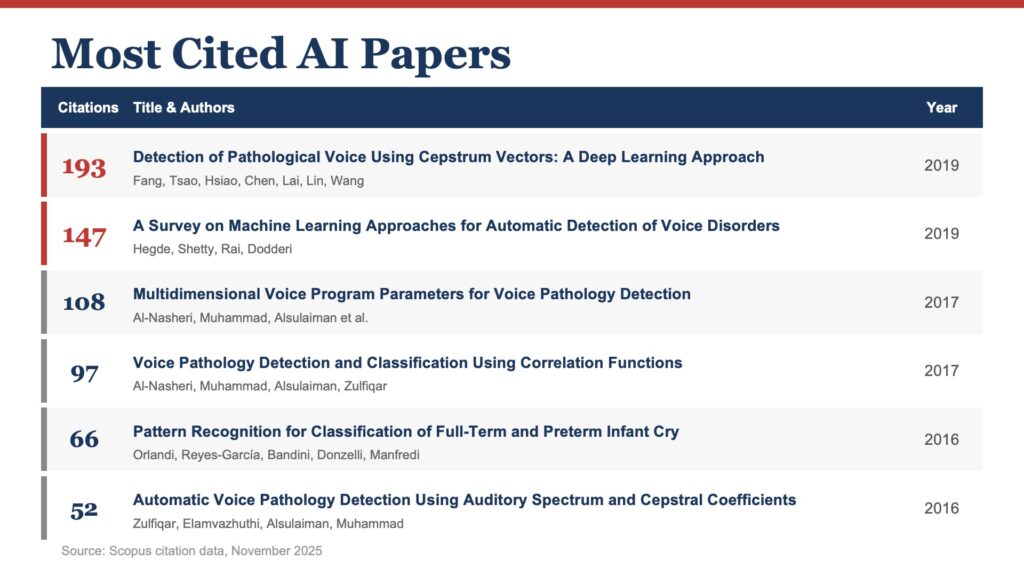
Foundational Citations: The two most-cited papers in the journal’s AI history—Fang and colleagues’ deep learning study (193 citations) and Hegde’s machine learning survey (147 citations)—have each been downloaded nearly 5,000 times.
These metrics demonstrate that otolaryngologists, speech-language pathologists, and computational scientists are actively utilizing these publications as operational manuals to upgrade clinical care.
Landmark Research Reshaping the Field
The theoretical frameworks of yesterday have rapidly manifested into clinical realities. Several landmark studies have defined this evolution:
Deep Learning for Pathology Detection: Fang et al. (2019), in "Detection of Pathological Voice Using Cepstrum Vectors: A Deep Learning Approach," demonstrated that deep neural networks could identify vocal pathologies with exceptional precision by evaluating acoustic features completely imperceptible to the human ear.
Mapping the Landscape: Hegde and colleagues’ comprehensive "Survey on Machine Learning Approaches for Automatic Detection of Voice Disorders" provided an indispensable taxonomy of machine learning methodologies, serving as an onboarding manual for new researchers entering the discipline.
The Rise of Digital Biomarkers: Recent work has positioned the voice not merely as an instrument of speech, but as a critical non-invasive diagnostic window into systemic health. Hemmerling and Wójcik-Pędziwiatr (2022) utilized voice signals to predict the severity of Parkinson’s disease with high fidelity, while parallel systematic reviews have explored voice quality as a digital biomarker for clinical depression, bipolar disorder, and respiratory conditions like COVID-19.
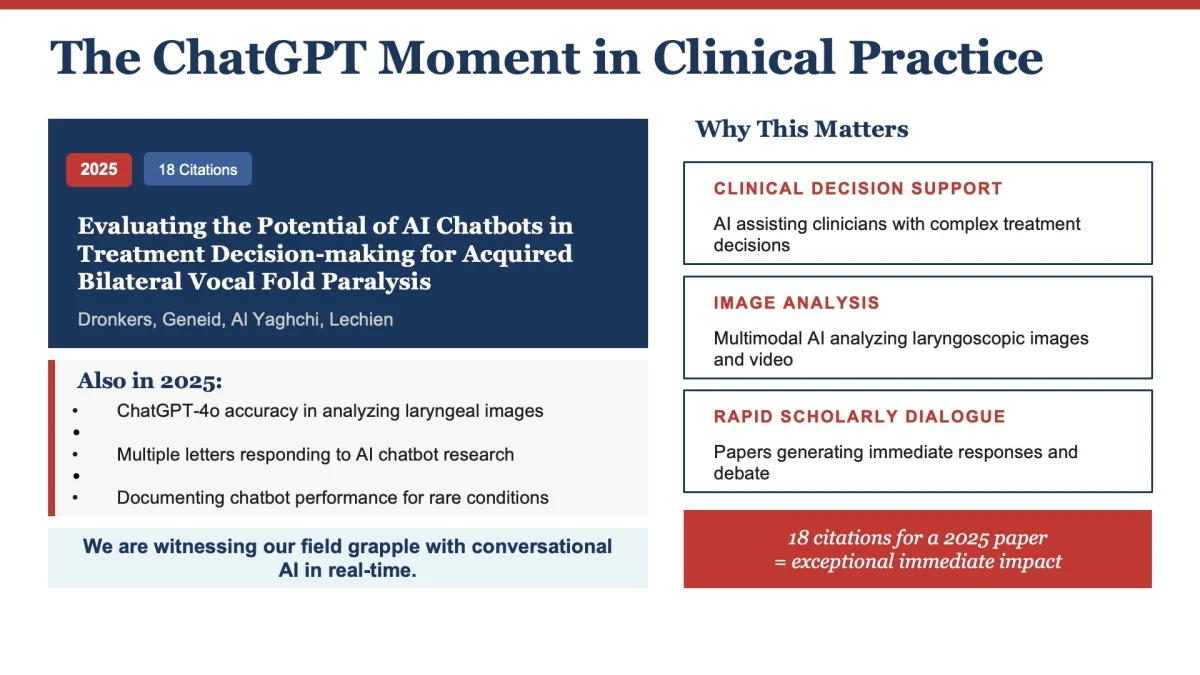
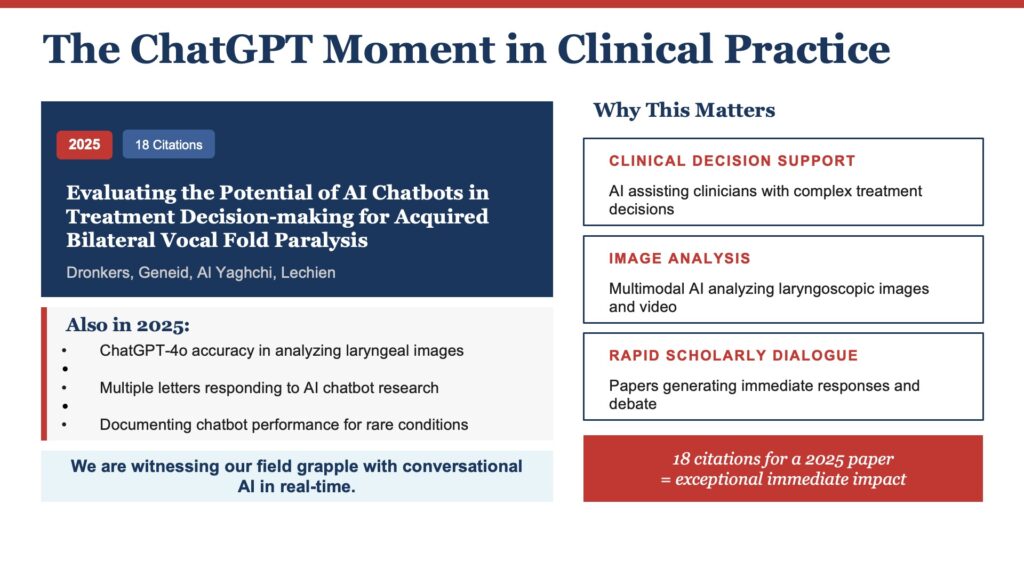
Conversational AI in the Clinic: In 2025, the journal pushed into new territory by publishing research evaluating AI chatbots in clinical decision-making. Dronkers and colleagues’ study on treatment decisions for acquired bilateral vocal fold paralysis generated immediate scholarly debate, forcing the community to confront the ethical and practical realities of conversational AI in medical settings.
Official Statements: Expert Perspectives on AI in Voice Science
To navigate this technological transformation successfully, the voice science community relies on the insights of interdisciplinary leaders who bridge computational physics, clinical practice, and institutional governance.
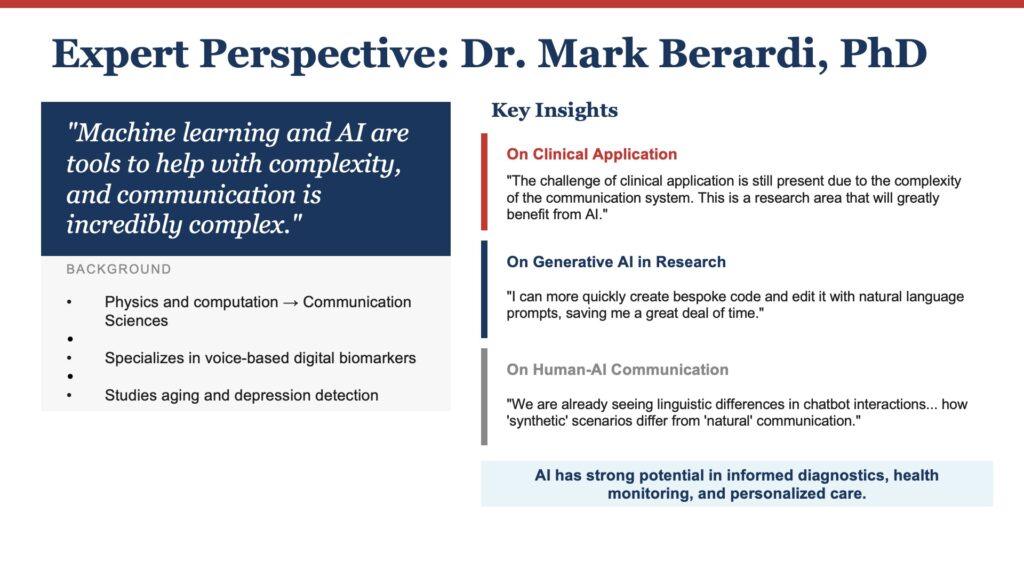
Dr. Mark Berardi: AI as a Tool for Complexity
Dr. Mark Berardi brings a unique perspective rooted in physics and computation. He views artificial intelligence primarily as an indispensable instrument for managing complexity.
"Machine learning and AI are tools to help with complexity, and communication is incredibly complex in its neurobiological and physiological processes. So I think the application is warranted," Dr. Berardi notes.
His research focuses on extracting health information from speech to identify digital biomarkers for aging and depression. While acknowledging that acquiring speech signals has become relatively easy, he notes that the true bottleneck remains the sheer intricacy of human neurobiology—an arena where machine learning excels.
Regarding generative AI, Dr. Berardi offers a pragmatic assessment. While it may not have entirely rewritten the foundational rules of theoretical research yet, it has drastically accelerated day-to-day operations.
"We can now quickly create bespoke code and edit it with natural language prompts," he explains.
Furthermore, Dr. Berardi is currently studying human-AI communication itself—examining how individuals alter their speech patterns when interacting with chatbots versus humans, and how synthetic environments like Zoom calls alter linguistic delivery. The field, he suggests, must now study not just the human voice in isolation, but the human voice in direct dialogue with machines.
Dr. Eric Hunter: Embracing Change with Ethical Clarity
Dr. Eric Hunter focuses heavily on the institutional and structural ramifications of artificial intelligence integration within academia.
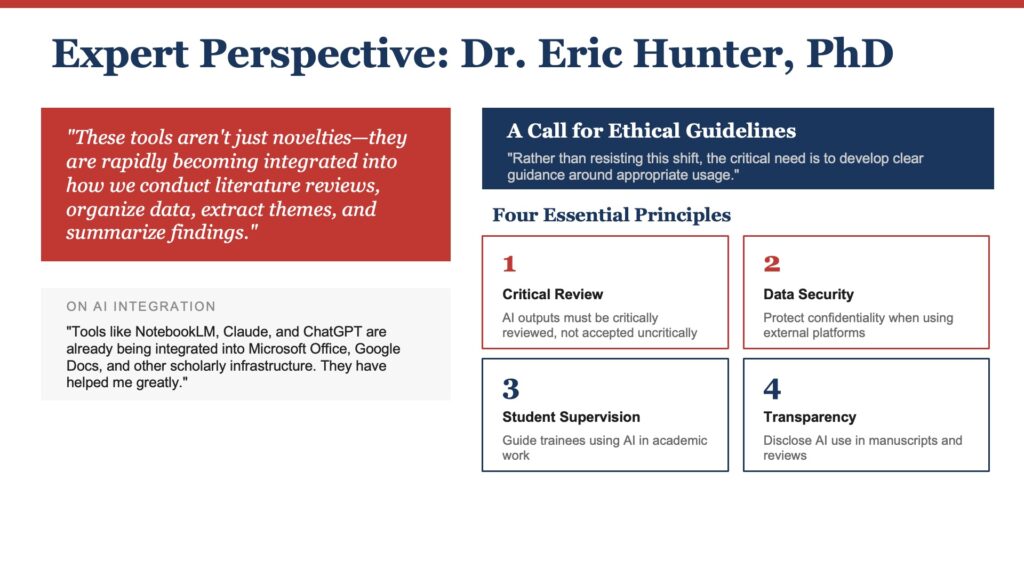
"These tools aren’t just novelties," Dr. Hunter observes. "They are rapidly becoming integrated into how we conduct literature reviews, organize data, extract themes from large bodies of text, and even summarize findings."
Dr. Hunter stresses that large language models and AI platforms are permanent fixtures of the modern academic landscape. They are rapidly embedding themselves into standard scholarly infrastructure, from manuscript drafting and peer review to collaborative grant writing. Rather than advocating for resistance, he issues a clear call to action: the academic community must establish proactive, transparent guidelines for appropriate usage.
To ensure integrity, Dr. Hunter outlines four foundational principles for AI integration in scholarly publishing:
Uncompromising Transparency: Authors must explicitly disclose if and how generative tools were utilized during research conception, data analysis, or manuscript preparation.
Human Accountability: Researchers must retain absolute ownership and editorial responsibility for every word, calculation, and conclusion published under their names.
Data Privacy and Security: Patient voice data must be protected with rigorous ethical oversight, ensuring that proprietary biometric information is never compromised by third-party training models.
Editorial Vigilance: Reviewers and editors must be equipped with the conceptual tools necessary to evaluate AI-assisted submissions for bias, hallucination, and methodological soundness.
"Our field will benefit most," Dr. Hunter concludes, "if we embrace the productivity these tools offer while also building a shared ethical framework for their responsible use."
A Global Research Community
The rapid acceleration of AI voice research is driven by a vibrant, interconnected global network of scientists. Leading contributors to the Journal of Voice span institutions across every inhabited continent. Prominent authors such as Jérôme René Lechien, Dimitar Deliyski, Stephanie Zacharias, Ahmed Yousef, Paavo Alku, Leonardo Wanderley Lopes, and Maryam Naghibolhosseini—alongside dozens of international collaborators—are actively pioneering the intersection of machine learning and vocal physiology.
This is not the isolated endeavor of a single laboratory or university department. It is a synchronized global enterprise united by a shared commitment to unlocking the secrets of human vocal expression through advanced computation.
Future Outlook and the Path Forward
As the Journal of Voice looks toward the next decade, its editorial mission remains resolute: to champion rigorous, boundary-pushing research while upholding the absolute highest standards of scientific integrity.
However, realizing the full potential of AI in voice science requires addressing three core collective imperatives:
Thoughtful Engagement: Researchers and clinicians must treat AI systems as amplifiers of human expertise rather than replacements for clinical judgment. Understanding both the extraordinary capabilities and the inherent limitations of these tools is paramount.
Collaborative Ethics: The establishment of universal ethical frameworks—as championed by leaders like Dr. Hunter—cannot be achieved by a single journal or institution. It demands a unified, interdisciplinary consensus across medicine, engineering, ethics, and the arts.
Continuous Discovery: The 161 AI-focused papers published in the journal to date represent merely the foundation. Every clinician, speech-language pathologist, and engineer possesses unique clinical insights that can enrich our collective understanding.
An Extraordinary Moment for the Human Voice
For hundreds of thousands of years, the human voice has served as our primary instrument of connection, emotional resonance, and identity. It carries the weight of our health, our psychological states, and our very humanity in ways that no other biological signal can replicate.
Today, for the first time in human history, we possess technological tools sophisticated enough to genuinely comprehend that complexity—to decode what acoustic nuances reveal about our brains, our bodies, and our systemic wellbeing. We have entered an era where algorithms can extend the reach of expert clinicians, flag subtle pathologies before they manifest as critical illnesses, and democratize access to world-class voice care for underserved populations everywhere.
This is a truly extraordinary moment. With the Journal of Voice and The Voice Foundation standing proudly at the center of this revolution, the next decade promises discoveries that will forever transform our understanding of the human voice.