
By Ian DeNolfo, Executive Director, The Voice Foundation
Executive Overview
We stand today at a profound inflection point in the history of voice science—a definitive moment where artificial intelligence (AI) and machine learning are fundamentally reshaping how researchers conduct scientific inquiry, how clinicians analyze complex acoustic data, and how practitioners care for patients. For over half a century, the study of the human voice has navigated the intricate bridge between art and science, treating vocal performance as a unique physiological marvel. Today, that bridge is being reinforced and expanded by computational intelligence capable of discerning patterns in vocal cords, respiration, and neurological signaling that escape even the most finely tuned human ear.
This technological revolution did not happen overnight. Far from being a recent bandwagon driven by the contemporary generative AI boom, the integration of computational analysis into voice science has a rich, decades-long pedigree. Through flagship publications like the Journal of Voice, foundational institutions have quietly nurtured computational models of vocal pathology for more than thirty years.
However, the velocity of this evolution has experienced an unprecedented surge. The intersection of deep learning, vast processing power, and the conceptualization of the human voice as a "digital biomarker" has triggered exponential growth. With over sixty percent of all historical AI-related voice publications appearing in just the last three years, the medical and scientific communities are racing to understand, harness, and ethically govern tools that promise to revolutionize diagnostics, expand telemedicine, and redefine what the human voice can tell us about systemic health.
A Legacy of Innovation: The Roots of Modern Voice Care
To understand the magnitude of today’s technological transformation, one must look back at the origins of modern interdisciplinary voice care. In 1969, Dr. Wilbur James Gould founded The Voice Foundation in New York City. At a time when the comprehensive, collaborative care of the human voice was virtually nonexistent, Dr. Gould possessed the visionary foresight to break down traditional academic silos. He brought together otolaryngologists, vocal scientists, speech-language pathologists, performing artists, and singing teachers to share their distinct expertise in the preservation and restoration of the professional voice.

The Foundation established its cultural and academic footprint quickly, hosting its premier Annual Symposium—Care of the Professional Voice—in 1972, followed by its inaugural Gala (later celebrated as the Voices of Summer) in 1973. These gatherings transformed how society viewed vocal health, establishing that the voice of a professional singer, actor, or public speaker required the same rigorous, multidisciplinary scientific attention as any other elite athletic or physiological system.
Since 1989, the Foundation has been under the visionary leadership of Dr. Robert Thayer Sataloff, an internationally renowned otolaryngologist, master clinician, professional singer, and conductor. Having authored more than 1,200 publications, including 79 textbooks, Dr. Sataloff guided the Foundation’s relocation to Philadelphia, where it has expanded its global footprint. Today, the annual Philadelphia symposium draws hundreds of international medical specialists, researchers, academics, and performers, while the Foundation’s premier peer-reviewed organ, the Journal of Voice, remains the definitive international authority on voice science and medicine.
Thirty Years of AI Research: A Hidden Chronology
While public fascination with artificial intelligence has largely peaked over the past few years, the pages of the Journal of Voice reveal a much longer, persistent commitment to computational innovation.
In 1994—thirty-one years ago—the journal published a landmark paper by Rihkanen and colleagues entitled "Spectral Pattern Recognition of Improved Voice Quality." Utilizing early neural network architectures to evaluate voice quality, this research appeared during the exact same calendar year that the World Wide Web was first emerging into public consciousness. Voice scientists were exploring artificial intelligence in acoustic analysis before most professionals had ever sent an electronic mail message.
Publication Timeline of AI-Related Research in the Journal of Voice:
[1994 – 2015]: 17 papers
[2016 – 2019]: 27 papers
[2020 – 2022]: 16 papers
[2023 – 2025]: 102 papers (63% of all historical AI papers)
The trajectory of this research illustrates a paradigm shift from experimental curiosity to exponential transformation. Between 1994 and 2015, the Journal of Voice published 17 AI-related papers. The pace quickened modestly between 2016 and 2019 with 27 publications, followed by 16 papers through the early pandemic years of 2020 to 2022.
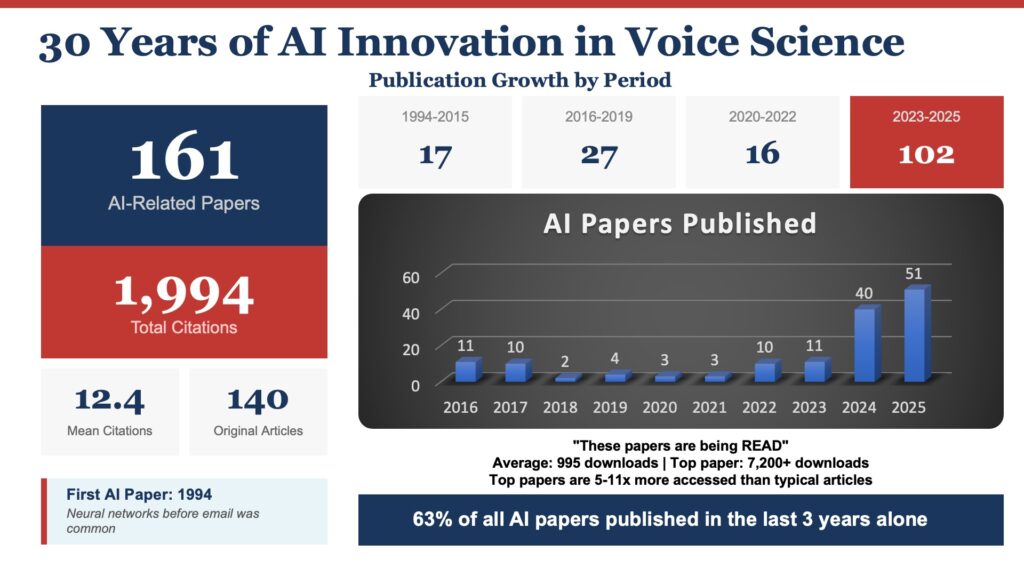
Then came the explosion: 102 AI-focused papers were published between 2023 and 2025 alone. In the year 2025 by itself, the journal featured 51 AI-related publications—surpassing the total output of the field’s entire first twenty years combined. This is not gradual academic progress; it is an exponential leap that mirrors the broader transformation of modern medicine.
Beyond Citations: Real-World Impact and Global Reach
Academic impact is frequently measured in citation counts, but the true value of computational voice research lies in its active, everyday application by clinicians, speech-language pathologists, and biomedical engineers across the globe.
Usage data for the Journal of Voice underscores this real-world engagement. The average AI-related paper published in the journal has been downloaded nearly 1,000 times, a testament to the immense appetite for practical, data-driven diagnostic tools. Furthermore, specialized studies have achieved staggering reach. For example, a pioneering study exploring machine learning applications for COVID-19 detection via acoustic features has been downloaded over 7,200 times—eleven times the median readership for articles in its respective issue.
Similarly, structural foundational papers have captured the imagination of the clinical community. Fang and colleagues’ deep learning study on pathology detection has garnered 193 citations, while Hegde’s comprehensive machine learning survey has accumulated 147 citations. Each of these landmark papers has been downloaded nearly 5,000 times. These statistics do not merely represent passive academic indexing; they reflect clinicians and therapists actively seeking actionable methodologies to enhance patient care.
Landmark Research Reshaping the Field
Deep Learning for Voice Pathology Detection
The integration of deep neural networks into acoustic screening has fundamentally changed how disorders are identified. Fang and colleagues’ 2019 study, "Detection of Pathological Voice Using Cepstrum Vectors: A Deep Learning Approach," demonstrated that deep neural networks could identify subtle vocal pathologies with remarkable accuracy by analyzing acoustic features entirely imperceptible to the human ear.
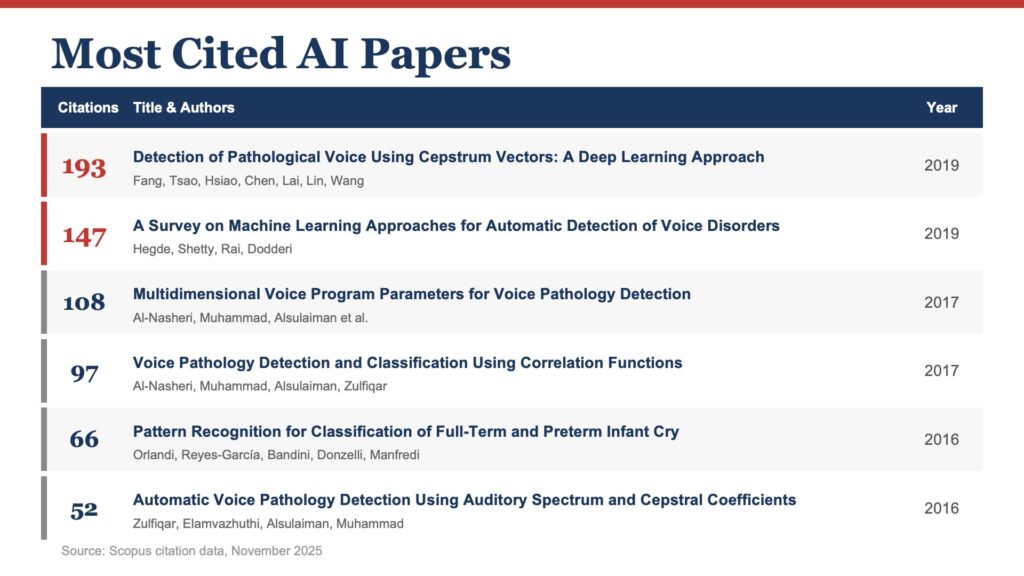
This work was complemented by Hegde’s expansive survey mapping the machine learning landscape for automatic voice disorder detection. Subsequent milestones quickly followed, including Al-Nasheri’s work on multidimensional voice program parameters, Chen and Chen’s deep neural networks for advanced classification, Fujimura’s experimentation with one-dimensional convolutional neural networks, and Cho and Choi’s comparative evaluations of CNN models applied to laryngoscopic imaging.
The Voice as a Digital Biomarker
Perhaps the most conceptually revolutionary shift in modern medicine is the recognition of the human voice as a non-invasive, continuous digital biomarker—a window into systemic health.
In recent years, researchers have leveraged machine learning to track neurological conditions, most notably Parkinson’s disease. Hemmerling and Wójcik-Pędziwiatr’s 2022 research on predicting the severity of Parkinson’s disease from acoustic signals has rapidly accumulated citations, pushing the boundaries toward viable clinical screening tools.
Beyond neurology, systematic reviews have begun exploring voice quality as a digital biomarker for affective disorders such as depression and bipolar disorder. The clinical implications are profound: routine acoustic monitoring could theoretically flag early shifts in mental health, facilitating prompt clinical intervention and alleviating the severe burden on overstretched behavioral health infrastructures. Similar breakthroughs using machine learning to parse COVID-19 and respiratory ailments from vocal characteristics demonstrate the voice’s potential as an early-warning sentinel for pulmonary health.
AI Chatbots and Clinical Decision-Making
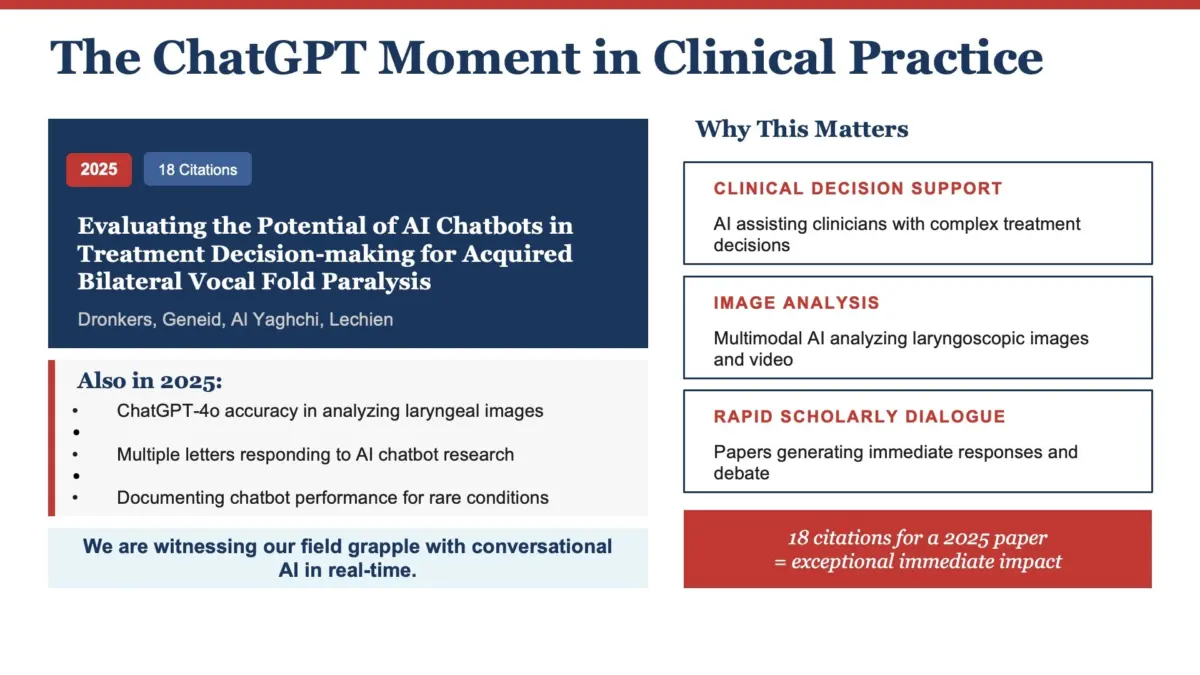
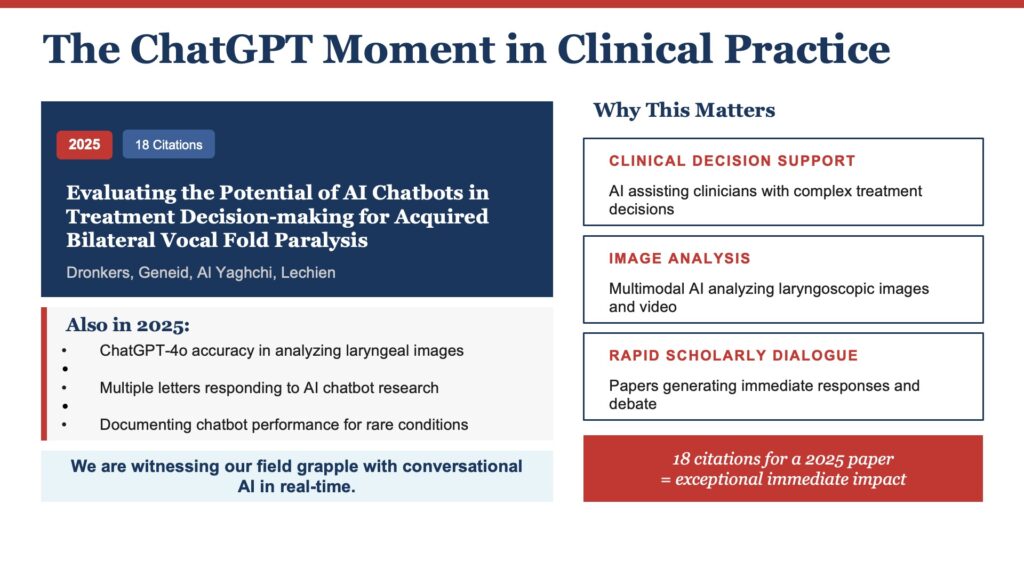
The integration of conversational artificial intelligence into clinical environments has also accelerated dramatically. A prominent 2025 study by Dronkers and colleagues, "Evaluating the Potential of AI Chatbots in Treatment Decision-making for Acquired Bilateral Vocal Fold Paralysis," captured immediate scholarly attention, amassing 18 citations within its first year of publication.

This work sparked robust debate across the field, inspiring multiple letters to the editor and follow-up studies evaluating models like ChatGPT-4o in interpreting complex laryngeal imaging. The voice science community is actively, in real-time, grappling with the ethical, operational, and clinical implications of conversational artificial intelligence in patient care workflows.
Expert Perspectives: Navigating Complexity and Ethics
To fully appreciate the intersection of AI and voice science, one must examine the insights of leaders bridging computational science and clinical practice.
Dr. Mark Berardi on Complexity and Human-AI Communication
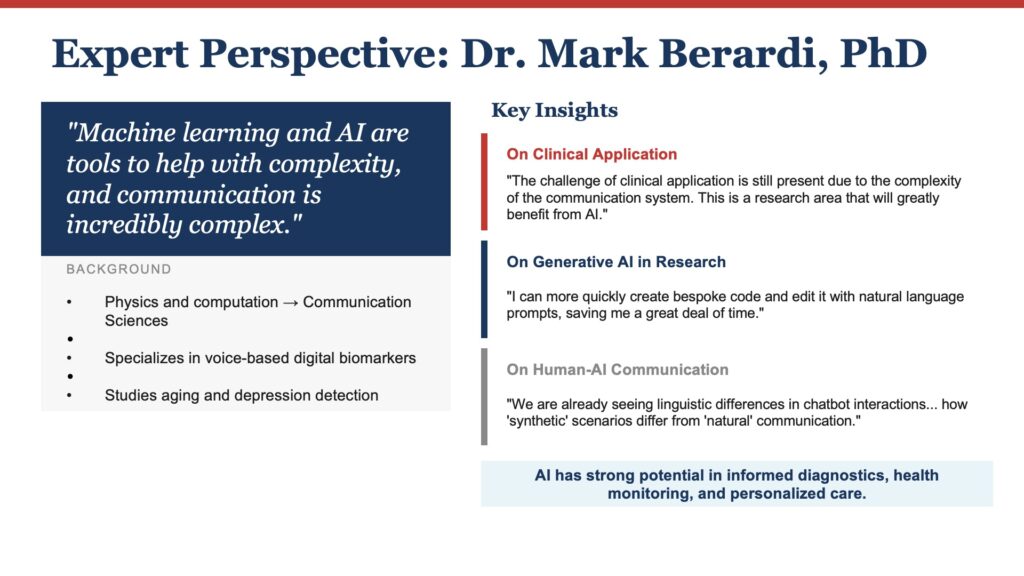
Coming from a background in physics and computation, Dr. Mark Berardi views artificial intelligence primarily as an indispensable instrument for managing complexity.
"Machine learning and AI are tools to help with complexity, and communication is incredibly complex in its neurobiological and physiological processes. So I think the application is warranted."
Dr. Berardi’s research focuses on voice-based digital biomarkers for aging and depression. While noting that acquiring vocal signals has become technologically straightforward, he emphasizes that the true challenge lies within the biological complexity of human communication itself—an arena where machine learning excels.
Regarding generative AI, Dr. Berardi offers a pragmatic assessment. While it may not have entirely rewritten the foundational laws of physics or biology overnight, it has successfully obliterated traditional research bottlenecks, particularly in data processing and coding. Researchers can now rapidly generate and refine bespoke code using natural language prompts.
Intriguingly, Dr. Berardi is also studying human-AI communication dynamics: how humans subconsciously alter their linguistic patterns when conversing with chatbots compared to living interlocutors, and how "synthetic" communication frameworks, such as Zoom conferences, modify face-to-face interaction. As synthetic voices and conversational agents multiply, the field of voice science may soon be tasked with understanding not just the human voice in isolation, but the human voice in continuous conversation with machines.
Dr. Eric Hunter on Embracing Change with Ethical Clarity
Dr. Eric Hunter approaches the AI transition from an institutional and academic governance perspective, emphasizing that technological integration is no longer optional.
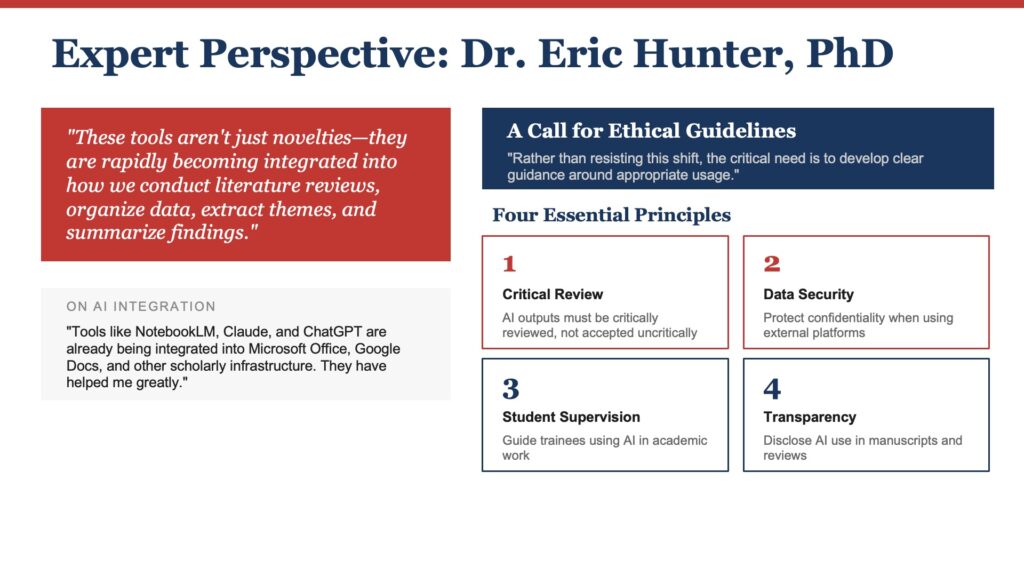
"These tools aren’t just novelties. They are rapidly becoming integrated into how we conduct literature reviews, organize data, extract themes from large bodies of text, and even summarize findings."
Dr. Hunter points out that large language models and machine learning frameworks are permanently embedding themselves into standard academic infrastructure—from manuscript preparation and peer review to collaborative writing and automated data structuring. Software integrations within common office and scholarly suites make these tools ubiquitous.
Rather than advocating for resistance, Dr. Hunter issues a vital call to action for the academic community: to establish clear, transparent guidelines governing appropriate usage for both authors and reviewers. He advocates for a balanced framework built on productivity, transparency, and uncompromising scientific integrity, ensuring that technology serves to amplify human expertise rather than obscure it.
A Global Research Community
The rapid ascent of AI in voice science is sustained by an extensive, international network of laboratories and clinical institutions. Leading contributors to the Journal of Voice represent a truly global community of pioneers. Scholars such as Jérôme René Lechien, Dimitar Deliyski, Stephanie Zacharias, Ahmed Yousef, Paavo Alku, Leonardo Wanderley Lopes, and Maryam Naghibolhosseini—alongside dozens of research teams spanning every inhabited continent—are actively rewriting the parameters of voice analysis.
This cross-pollination of ideas proves that the computational revolution in voice science is not the isolated project of a single Silicon Valley startup or university lab; it is a worldwide, collaborative movement united by a shared dedication to decoding the mysteries of human vocalization through advanced computation.
The Path Forward for Voice Science
As the Journal of Voice moves forward, it remains deeply committed to serving as the primary academic platform for this evolving discipline. However, realizing the full potential of artificial intelligence requires the community to address three core imperatives:
- Thoughtful Engagement with Technology: Researchers and clinicians must master AI tools as instruments for managing complexity. We must thoroughly understand both their immense analytical power and their inherent methodological limitations, ensuring they amplify human clinical judgment rather than replace it.
- Collective Ethical Frameworks: The development of robust ethical standards—as championed by leaders like Dr. Eric Hunter—cannot be achieved by isolated journals or single universities. It demands an inclusive, collaborative consensus across the entire medical, scientific, and artistic communities.
- Open Scientific Communication: The 161 AI-focused papers published in the journal thus far represent merely the foundational chapter of a much longer story. Clinicians, educators, and computational scientists must continue sharing empirical insights to propel collective understanding forward.
An Extraordinary Moment
For hundreds of thousands of years, the human voice has served as our primary instrument of connection, emotional expression, and personal identity. It carries our health, our history, and our inner emotional state in ways that no other biological signal can replicate.
Now, for the first time in human history, we possess computational instruments sophisticated enough to truly decode that complexity—tools capable of revealing what the voice discloses about our brains, our bodies, and our overall well-being. We stand equipped with technologies that can extend the reach of expert clinicians, detect pathological anomalies before symptoms become acute, and democratize access to high-quality voice care across the globe.
We are living through an extraordinary moment in scientific history, and The Voice Foundation and the Journal of Voice remain at its beating heart. The coming decade promises discoveries that will forever transform the landscape of medicine and art. We look forward to sharing every breakthrough with you.