
By Ian DeNolfo, Executive Director of The Voice Foundation
Executive Overview
We stand today at a profound inflection point in the history of voice science. Artificial intelligence (AI) and machine learning are no longer theoretical add-ons or futuristic speculation confined to computer science laboratories; they are fundamentally reshaping how researchers conduct investigations, how clinicians analyze complex data sets, and how healthcare providers care for patients.
This technological renaissance does not occur in a vacuum. It builds upon a rich, decades-long legacy of interdisciplinary cooperation pioneered by institutions dedicated to unraveling the mysteries of the human voice. At the center of this transformation is The Voice Foundation and its flagship peer-reviewed publication, the Journal of Voice.
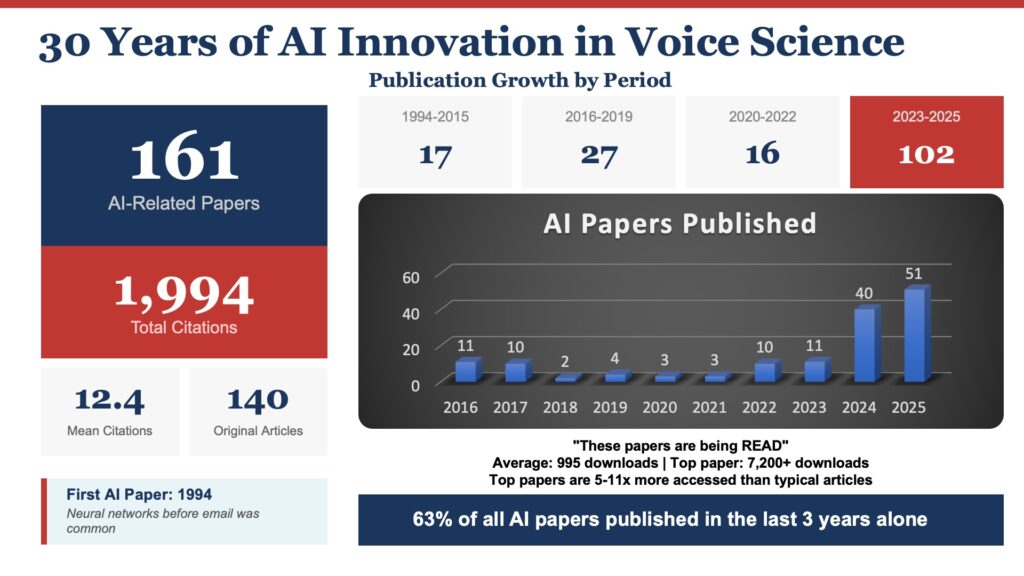
Far from being late arrivals to the technological revolution, voice scientists and medical researchers have leveraged computational models and neural networks for over three decades. Today, we are witnessing an exponential explosion in AI-driven research. Over 60% of all AI-related papers published in the Journal of Voice over the last thirty years have appeared in just the past three years.

As we cross this threshold, voice is increasingly recognized not merely as a vehicle for speech and artistic expression, but as a sophisticated "digital biomarker"—a non-invasive window into systemic health, neurological function, and psychological well-being. This article explores the historical trajectory of AI in voice science, examines landmark research reshaping the field, highlights expert perspectives on the challenges and opportunities ahead, and charts a course for ethical, responsible innovation in the years to come.
The Voice Foundation: A Legacy of Interdisciplinary Innovation
To understand the current momentum of AI in voice science, one must appreciate the foundations upon which modern research is built. In 1969, Dr. Wilbur James Gould founded The Voice Foundation in New York City. At a time when the interdisciplinary care of the human voice was virtually non-existent, Dr. Gould exhibited groundbreaking foresight. He brought together physicians, scientists, speech-language pathologists, vocal performers, and pedagogues to share knowledge and expertise in the care of the professional voice user.
The Foundation established its first Annual Symposium—Care of the Professional Voice—in 1972, followed by its inaugural Gala (later named Voices of Summer) in 1973. For more than five decades, the Foundation has served as a critical bridge between art and science, connecting the clinical examining room with the theatrical stage.
Since 1989, The Voice Foundation has operated under the visionary leadership of Dr. Robert Thayer Sataloff, an internationally renowned otolaryngologist who is also a professional singer and conductor. Having authored more than 1,200 publications, including 79 textbooks, Dr. Sataloff guided the Foundation’s relocation to Philadelphia, where it has continued to elevate the global understanding of voice through rigorous scientific research and educational outreach.
Today, the annual Symposium in Philadelphia draws hundreds of medical, scientific, academic, and speech-language professionals, alongside performing artists from across the globe. Simultaneously, the Journal of Voice maintains its status as the premier peer-reviewed journal dedicated exclusively to voice science and medicine.
Detailed Chronology: Thirty Years of AI Research in Voice Science
A common misconception in academic circles is that artificial intelligence in medicine is a phenomenon born exclusively of the generative AI boom of the 2020s. In reality, the Journal of Voice has been publishing pioneering AI and machine learning research for over three decades.
The historical trajectory unfolds across distinct eras:
- The Genesis (1994): In 1994—thirty-one years ago—the Journal of Voice published a paper by Rihkanen and colleagues titled "Spectral Pattern Recognition of Improved Voice Quality." Utilizing rudimentary neural networks to analyze voice signatures, this publication occurred during the exact year the World Wide Web was emerging into public consciousness. Voice researchers were applying neural networks to acoustic data before the general public had even sent its first electronic mail.
- The Formative Era (1995–2015): During the late 1990s and 2000s, computational power grew, allowing researchers to process larger acoustic datasets. However, research output remained measured, laying foundational blocks for feature extraction and pattern recognition.
- The Acceleration Period (2016–2022): With the advent of deep learning architectures, convolutional neural networks (CNNs), and accessible graphics processing units (GPUs), the volume of AI literature began to climb steadily as researchers sought automated methods to classify vocal pathologies.
- The Exponential Explosion (2023–Present): The current era represents an unprecedented surge in computational voice research. Out of 161 total AI-related papers published in the journal’s history, an astounding 102 papers (63%) were published between 2023 and early 2025. In 2025 alone, the journal published 51 AI-related articles—surpassing the total output of the first two decades combined. This growth curve is not incremental; it is an exponential transformation of the discipline.
Supporting Context and Metrics: Real-World Impact and Access
Academic publications are frequently evaluated by citation counts, but the true measure of a journal’s influence lies in how actively its findings are read, downloaded, and applied by practitioners in the field. Usage statistics for AI-related papers in the Journal of Voice reveal an extraordinary global reach.
On average, an AI-focused paper published in the journal is downloaded nearly 1,000 times. However, standout papers achieve viral distribution across clinical and academic communities. For example:
- A landmark study investigating machine learning applications for COVID-19 detection via voice characteristics has been downloaded over 7,200 times—eleven times the median download rate for articles in its respective issue.
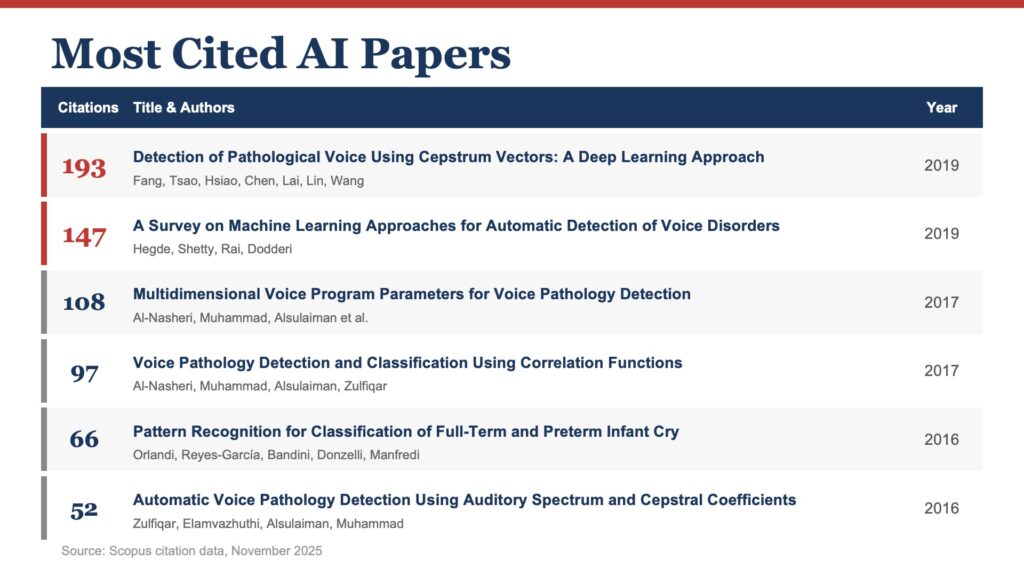
- The two most-cited papers in the journal’s AI history—Fang and colleagues’ deep learning study (193 citations) and Hegde’s comprehensive machine learning survey (147 citations)—have each amassed nearly 5,000 downloads.
These metrics represent active engagement from clinicians, otolaryngologists, researchers, and speech-language pathologists seeking practical, data-driven tools to elevate patient care.
Landmark Research Reshaping the Field
Deep Learning for Voice Pathology Detection
In 2019, Fang and colleagues published "Detection of Pathological Voice Using Cepstrum Vectors: A Deep Learning Approach," which stands as the most-cited AI paper in the journal’s history (193 citations). This research proved that deep neural networks could detect laryngeal and vocal pathologies with remarkable precision, leveraging acoustic features entirely imperceptible to the human ear.
This work was complemented by Hegde and colleagues’ definitive "Survey on Machine Learning Approaches for Automatic Detection of Voice Disorders" (147 citations), which mapped the methodological landscape of machine learning in otolaryngology. Subsequent milestones—such as Al-Nasheri’s multidimensional voice program analyses, Chen and Chen’s deep neural network classifications, Fujimura’s one-dimensional convolutional neural networks, and Cho and Choi’s evaluations of laryngoscopic imaging via CNNs—have continuously pushed the boundaries of diagnostic accuracy.

Voice as a Digital Biomarker for Systemic Health
Perhaps the most paradigm-shifting development in recent voice science is the conceptualization of the human voice as a digital biomarker—a non-invasive, quantifiable indicator of systemic health and disease.
Researchers have made immense strides in monitoring neurodegenerative disorders. Hemmerling and Wójcik-Pędziwiatr’s 2022 paper on predicting the severity of Parkinson’s disease from voice signals garnered 29 citations in its first three years, bridging acoustic analysis with neurological tracking. Beyond neurology, systematic reviews published in the journal explore voice quality as a digital biomarker for mental health conditions, including clinical depression and bipolar disorder. The clinical implications are immense: routine, automated voice screening could flag mental health fluctuations early, reducing the load on overstretched healthcare systems and enabling proactive intervention.
AI Chatbots in Clinical Decision-Making
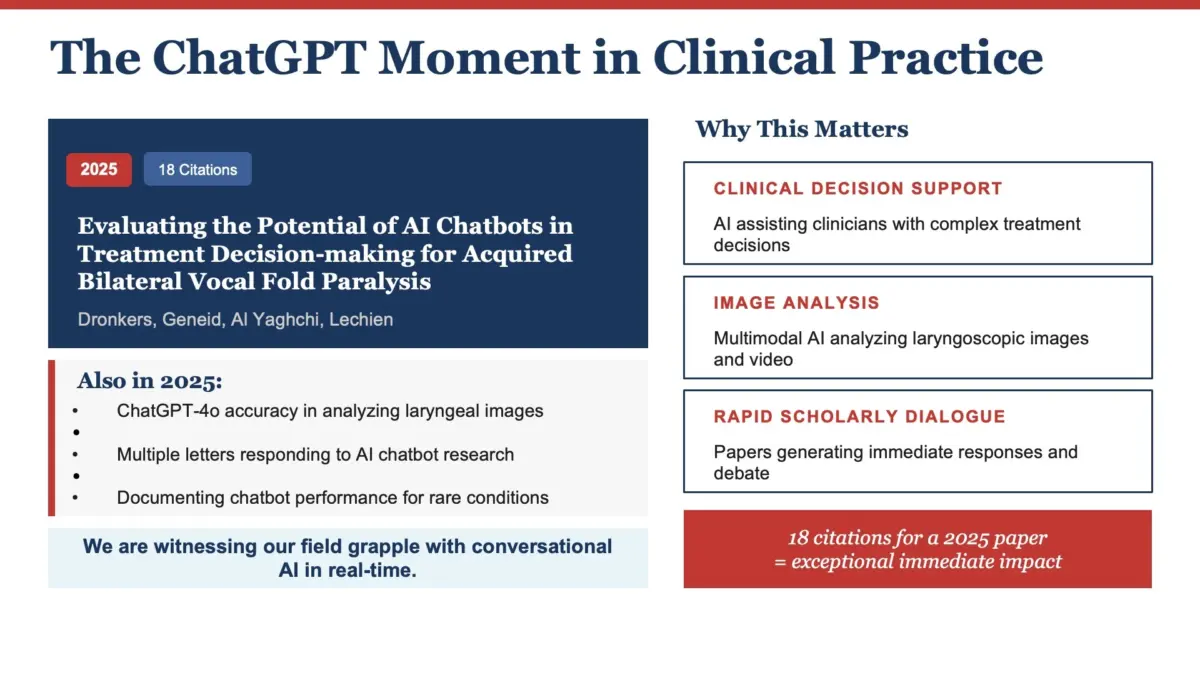
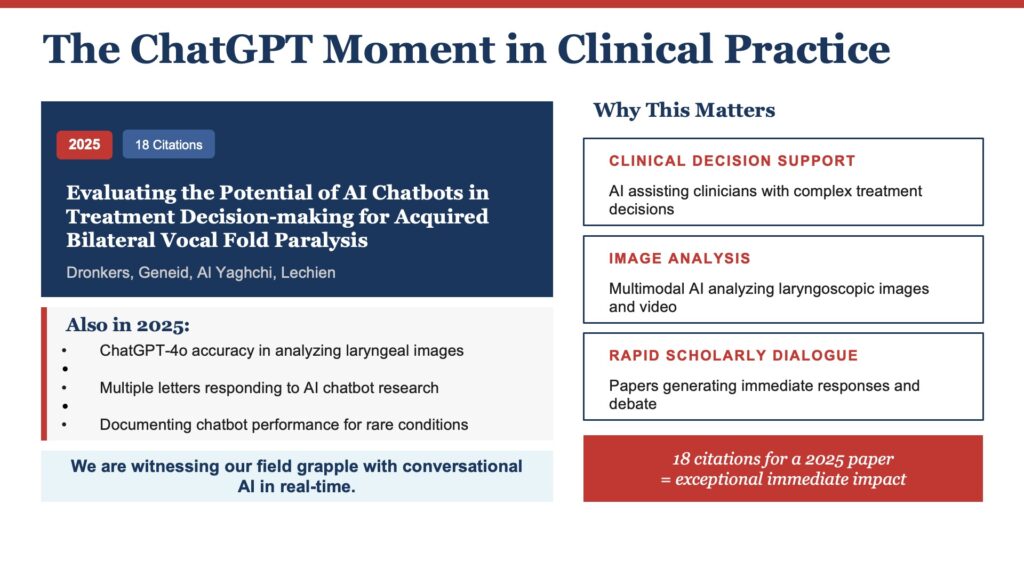
As conversational AI matured, the Journal of Voice expanded its scope to evaluate large language models (LLMs) in direct clinical applications. A 2025 paper by Dronkers and colleagues, "Evaluating the Potential of AI Chatbots in Treatment Decision-making for Acquired Bilateral Vocal Fold Paralysis," accumulated 18 citations almost immediately upon publication. Accompanied by rigorous letters to the editor and investigations into tools like ChatGPT-4o analyzing complex laryngeal images, the academic community is actively interrogating the safety, efficacy, and ethical boundaries of conversational agents in medicine.
Official Statements and Expert Perspectives
To navigate this technological transition responsibly, the voice science community relies on the insights of interdisciplinary leaders who understand both the computational power and the clinical limitations of artificial intelligence.
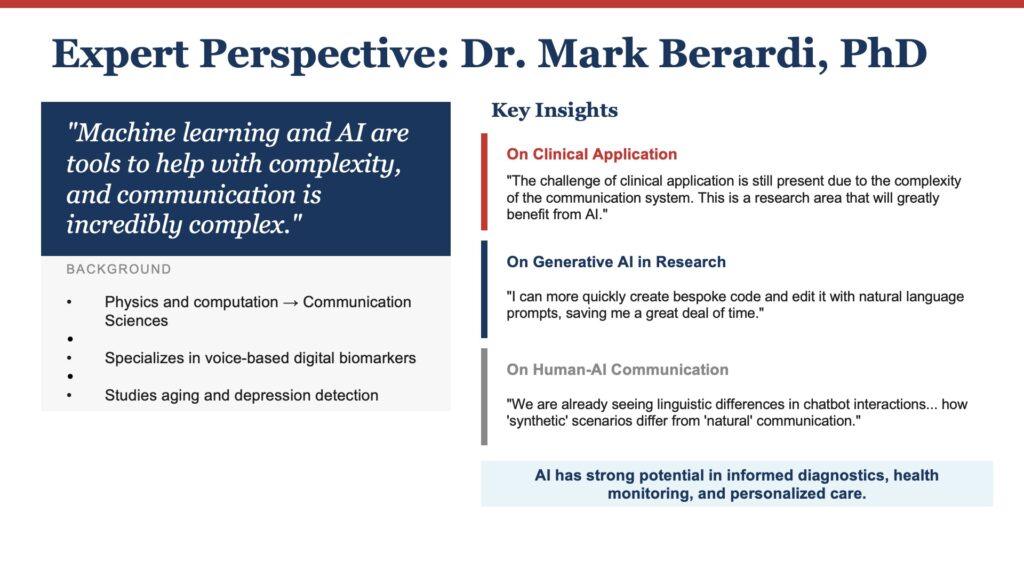
Dr. Mark Berardi: AI as a Tool for Complexity
Dr. Mark Berardi brings a unique perspective rooted in physics and computation. He views artificial intelligence primarily as a mechanism for managing complexity:
"Machine learning and AI are tools to help with complexity, and communication is incredibly complex in its neurobiological and physiological processes. So I think the application is warranted."
Dr. Berardi’s research centers on voice-based digital biomarkers for aging and depression. While noting that acquiring speech signals is relatively straightforward, he emphasizes that the true hurdle lies in the intricate nature of the human communication system itself—precisely the domain where machine learning excels.
Regarding generative AI, Dr. Berardi offers a pragmatic evaluation. While it may not have completely upended theoretical research frameworks overnight, it effectively eliminates operational bottlenecks, particularly in data processing and custom software development: "I can now quickly create bespoke code and edit it with natural language prompts." Furthermore, his current investigations explore human-AI communication dynamics—examining how individuals alter their speech patterns when interacting with synthetic interfaces versus human interlocutors, a rapidly expanding field of study.
Dr. Eric Hunter: Embracing Change with Ethical Clarity
Dr. Eric Hunter focuses on the institutional and academic implications of AI integration. He observes that computational tools have moved far beyond novelty status:
"These tools are rapidly becoming integrated into how we conduct literature reviews, organize data, extract themes from large bodies of text, and even summarize findings."
Large language models and AI-driven platforms are permanently embedding themselves into scholarly infrastructure, from manuscript preparation to peer review. Rather than resisting this inevitable shift, Dr. Hunter issues a definitive call to action: the creation of transparent, shared ethical guidelines for authors and reviewers.
He outlines four essential pillars for academic integrity in the age of AI:
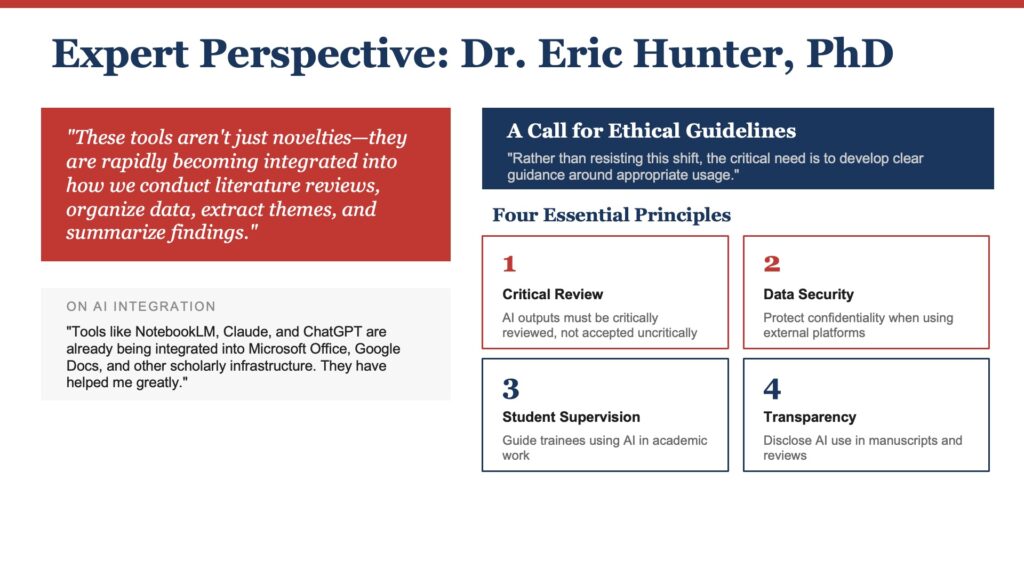
- Absolute Transparency: Full disclosure regarding the use of AI assistance in data analysis, manuscript drafting, or structural organization.
- Human Accountability: Authors must retain total responsibility for the factual accuracy, intellectual integrity, and originality of published works.
- Algorithmic Vigilance: Researchers must actively screen for algorithmic bias, data hallucination, and privacy violations in machine learning models.
- Equitable Access: Ensuring that computational tools do not create insurmountable disparities between resource-rich institutions and underfunded global research centers.
"Our field will benefit most," Dr. Hunter concludes, "if we embrace the productivity these tools offer while also building a shared ethical framework for their responsible use."
A Global Research Community
The momentum behind AI in voice science is sustained by a robust, international network of investigators. Leading contributors to the Journal of Voice include Jérôme René Lechien (6 papers), Dimitar Deliyski (5 papers), Stephanie Zacharias (5 papers), and Ahmed Yousef (4 papers as first author), alongside Paavo Alku, Leonardo Wanderley Lopes, and Maryam Naghibolhosseini (4 papers each). Spanning every continent, these researchers prove that the digital transformation of voice science is a collaborative, global enterprise.
Future Outlook and Path Forward
As the Journal of Voice enters its next era, it remains committed to publishing rigorous, high-integrity research that expands the horizons of medical science. However, navigating the path forward requires deliberate collective action across three key domains:
- Thoughtful Technological Engagement: Clinicians and researchers must master AI instruments not as autonomous decision-makers, but as cognitive amplifiers designed to manage complexity and augment human clinical judgment.
- Harmonized Ethical Standards: The scholarly community must unify to establish robust guidelines governing AI utilization in research design, authorship, and peer review.
- Continuous Knowledge Sharing: With 161 published AI papers marking only the beginning, researchers, educators, and clinicians must continue sharing their empirical insights to accelerate collective progress.
Conclusion
For hundreds of thousands of years, the human voice has served as our primary instrument of connection, emotional expression, and personal identity. It transmits our physiological health, our psychological state, and our innermost humanity in ways no other biological signal can replicate.

Today, for the first time in human history, we possess computational instruments sophisticated enough to truly decode that complexity. We hold the capacity to extend the reach of expert clinicians, detect subtle pathology before clinical symptoms manifest, and democratize access to advanced voice care across the globe.
This is an extraordinary moment in scientific history, and The Voice Foundation and the Journal of Voice stand proudly at its center. The next decade promises even greater discoveries, and we look forward to charting that uncharted territory together.
About the Author
Ian DeNolfo is Executive Director of The Voice Foundation, which publishes the Journal of Voice. A graduate of The Juilliard School and The Curtis Institute of Music, he formerly performed as a leading tenor at opera houses worldwide before transitioning his career to arts administration and scientific leadership at The Voice Foundation.