
By Ian DeNolfo, Executive Director of The Voice Foundation
We stand today at a profound inflection point in the history of voice science. Across laboratories, clinics, and academic institutions worldwide, artificial intelligence (AI) and machine learning are fundamentally reshaping how researchers conduct investigations, analyze complex datasets, and deliver patient care. This technological revolution is not happening in a vacuum; it is the latest, most accelerated chapter in a decades-long pursuit to understand, preserve, and restore the human voice.
As the Executive Director of The Voice Foundation and its flagship publication, the Journal of Voice, I have had a front-row seat to this extraordinary evolution. What we are witnessing is not merely a transient technological trend, but an exponential transformation that bridges the gap between biological complexity and computational power.
Executive Overview: A New Era in Voice Science
For centuries, the human voice has served as our primary instrument of connection, emotional expression, and personal identity. It carries the nuances of our lived experiences, the echoes of our health, and the very essence of our humanity in ways that no other physiological signal can match. Yet, for all its communicative power, the voice remains an exceptionally intricate neurobiological and physiological phenomenon.
Until recently, the tools available to clinicians and researchers were limited in their capacity to parse this staggering complexity. The human ear, while remarkable, cannot consciously perceive the subtle acoustic micro-features that often signal the earliest onset of pathology.
Enter artificial intelligence. By deploying advanced neural networks, deep learning architectures, and natural language processing, modern researchers can now decode patterns in vocal signals that were previously invisible. From the early detection of neurodegenerative disorders and mental health conditions to the integration of clinical conversational agents, AI is expanding the reach of expert clinicians and democratizing access to voice care.
However, this rapid technological acceleration brings both unprecedented opportunities and complex responsibilities. As a global scientific community, we are challenged not only to embrace the immense productivity these tools offer, but also to forge a robust, shared ethical framework to govern their application.
The Voice Foundation: A Legacy of Innovation and Interdisciplinary Care
To understand the magnitude of today’s AI-driven transformation, one must look back at the rich legacy upon which it is built. In 1969, Dr. Wilbur James Gould founded The Voice Foundation in New York City. At a time when the interdisciplinary care of the human voice was virtually nonexistent, Dr. Gould demonstrated groundbreaking foresight. He brought together physicians, scientists, speech-language pathologists, performing artists, and educators to share their knowledge and expertise in caring for the professional voice user.
The Foundation held its inaugural Annual Symposium—Care of the Professional Voice—in 1972, followed shortly by its first Gala (later named Voices of Summer) in 1973. For more than five decades, the Foundation has successfully built vital bridges between art and science, and between the sterile environment of the clinic and the dynamic stage of the performing arts.
Since 1989, The Voice Foundation has been steered by Dr. Robert Thayer Sataloff, an internationally renowned otolaryngologist who is simultaneously a professional singer and conductor. Dr. Sataloff’s monumental contributions to the field include authoring more than 1,200 publications, among them 79 textbooks. Under his visionary leadership, the Foundation relocated its headquarters to Philadelphia and has continued to advance the global understanding of voice science through rigorous interdisciplinary research and education.
Today, our annual Symposium in Philadelphia draws hundreds of medical doctors, scientists, academic researchers, speech-language pathologists, and performing artists from every corner of the globe. Moreover, we proudly publish the Journal of Voice—the premier peer-reviewed journal dedicated exclusively to voice science, medicine, and research. It is within the pages of this esteemed journal that the quiet inception of AI in our field has grown into a deafening roar.
Detailed Chronology: Thirty Years of AI Research in Voice Science
A common misconception in academic circles is that artificial intelligence in medicine is an entirely recent phenomenon born out of the generative AI boom of the early 2020s. In reality, the Journal of Voice has been pioneering the publication of AI-related voice research for over three decades.
The Pioneering Decade (1994–2015)
Thirty-one years ago, in 1994—the exact same year the World Wide Web was first emerging into public consciousness—the Journal of Voice published a paper by Rihkanen and colleagues titled "Spectral Pattern Recognition of Improved Voice Quality." This foundational study utilized early neural networks to analyze voice characteristics. To put this in perspective, our community was publishing peer-reviewed artificial intelligence research in voice science before the vast majority of professionals had ever sent a commercial email.
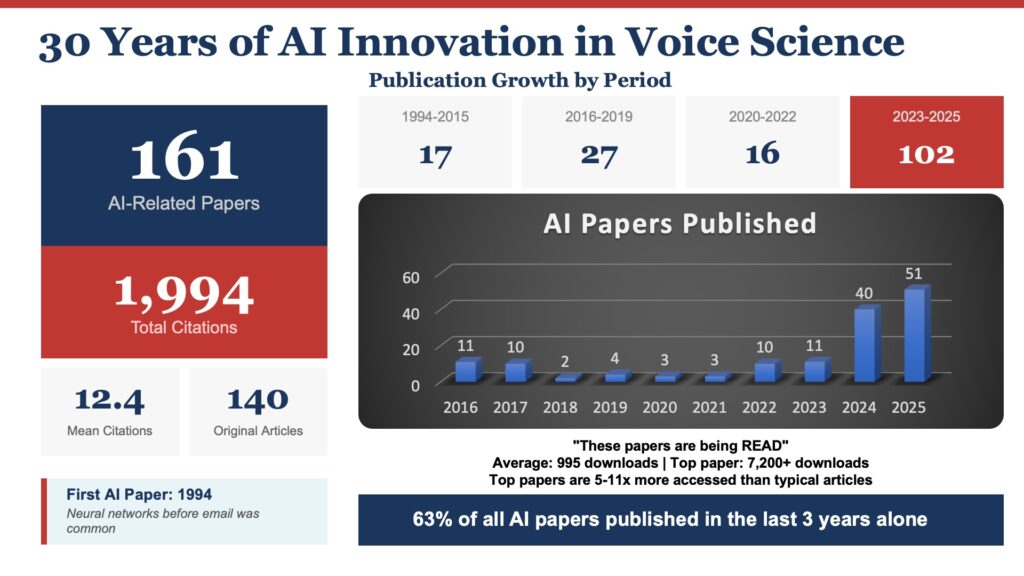
Yet, for the first two decades, growth was methodical and gradual. Between 1994 and 2015, the journal published just 17 papers touching upon machine learning or neural networks. The computational infrastructure of the era, combined with limited datasets, naturally restricted the velocity of research.
The Acceleration and Exponential Surge (2016–2025)
As computational power expanded and machine learning algorithms matured, the publication timeline began to shift dramatically.
- 2016–2019: 27 papers were published as deep learning techniques began proving their mettle against complex acoustic datasets.
- 2020–2022: 16 papers were published, navigating the disruptions of a global pandemic while laying groundwork for remote diagnostics.
- 2023–2025: An astonishing 102 papers were published in just this three-year window, accounting for 63 percent of all AI-related literature in the journal’s history.
In the year 2025 alone, the Journal of Voice published 51 AI-related papers—surpassing the total number of AI papers published during the entire first twenty years of our digital archiving combined. This is not mere incremental growth; it represents an exponential transformation of our entire scientific discipline.

Supporting Context & Metrics: Real-World Impact and Citation Reach
The value of academic literature is measured not only by its volume, but by its practical reach and application. Statistics surrounding the Journal of Voice’s AI portfolio reveal an extraordinary level of engagement from the global scientific community.
The average AI-related paper published in our journal has been downloaded nearly 1,000 times, a testament to the high demand for computational insights in clinical settings. Furthermore, specific landmark papers have achieved viral academic impact:
- COVID-19 Detection Study: Our single most-accessed AI paper—focusing on machine learning applications for COVID-19 detection via voice characteristics—has garnered over 7,200 downloads, eclipsing the median download rate for its issue by a factor of eleven.
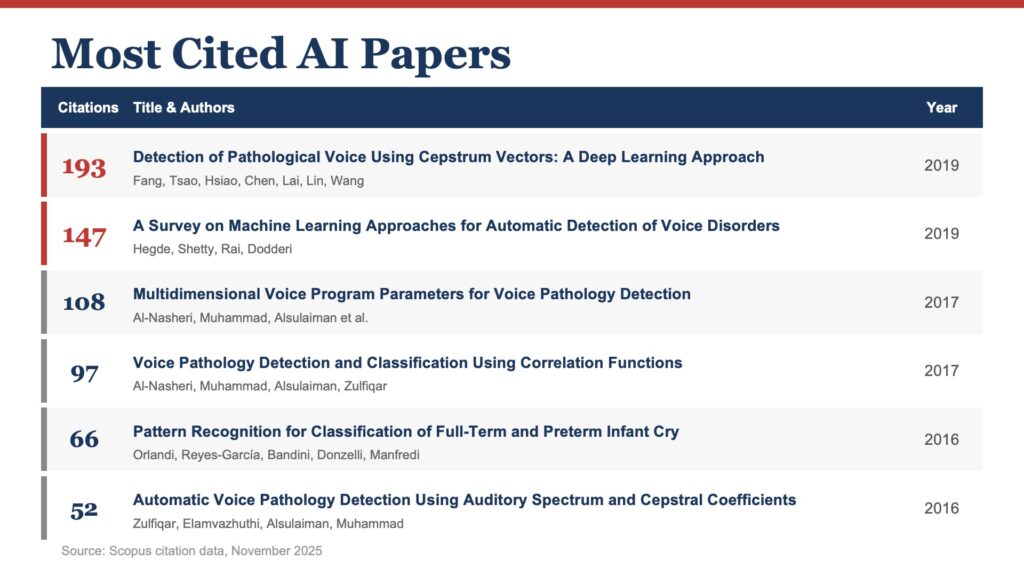
- Deep Learning Benchmarks: Fang and colleagues’ seminal 2019 study on deep learning for voice pathology detection has amassed 193 citations, while Hegde’s comprehensive machine learning survey has accumulated 147 citations. Each of these papers has been downloaded nearly 5,000 times.
These metrics signify much more than academic prestige. They represent clinicians in hospitals, researchers in university labs, and speech-language pathologists in private practices actively seeking actionable, practical tools to elevate the standard of patient voice care.
Landmark Research Reshaping Clinical Horizons
The body of literature published in the Journal of Voice spans several critical technological domains:
- Deep Learning for Voice Pathology Detection: Research spearheaded by Fang, Chen, Fujimura, and Cho has demonstrated that deep neural networks can identify vocal fold pathologies and classify laryngeal disorders with astonishing accuracy—often detecting acoustic aberrations imperceptible to the human ear.
- The Voice as a Digital Biomarker: Perhaps the most paradigm-shifting development is the conceptualization of the voice as a non-invasive digital biomarker for systemic health. Hemmerling and Wójcik-Pędziwiatr’s work on predicting the severity of Parkinson’s disease from voice signals has opened new avenues for remote neurological monitoring. Similarly, emerging systematic reviews explore vocal quality as an indicator for clinical depression and bipolar disorder, offering the tantalizing prospect of routine mental health screening through everyday speech analysis.
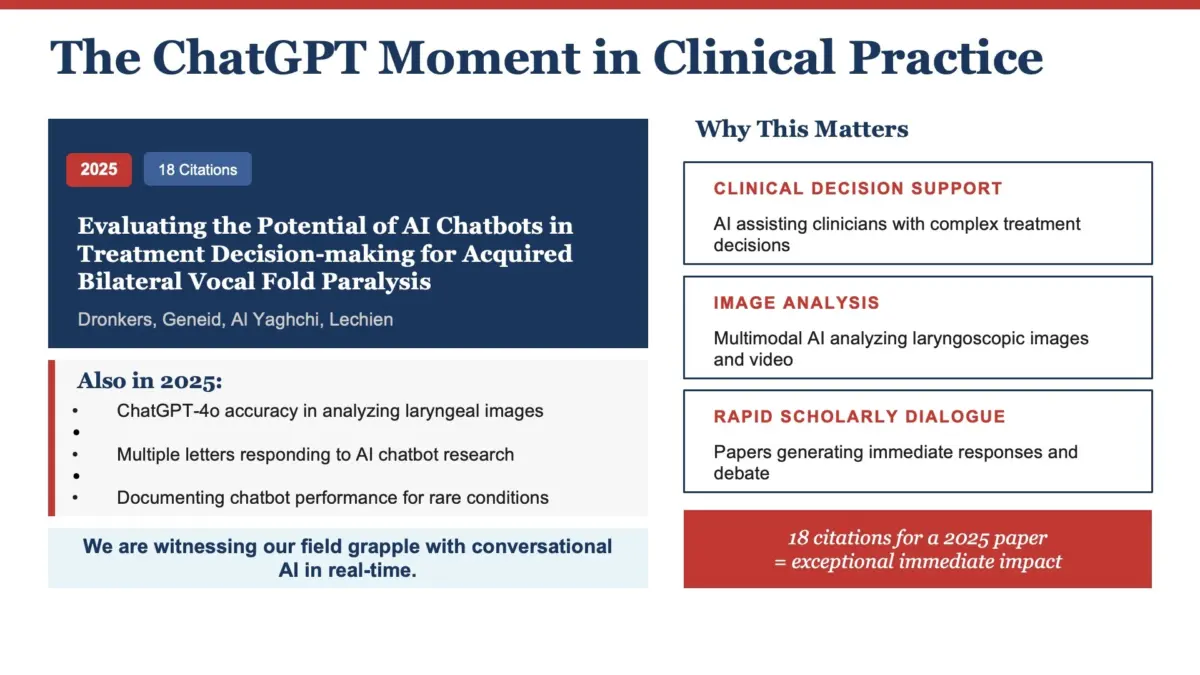
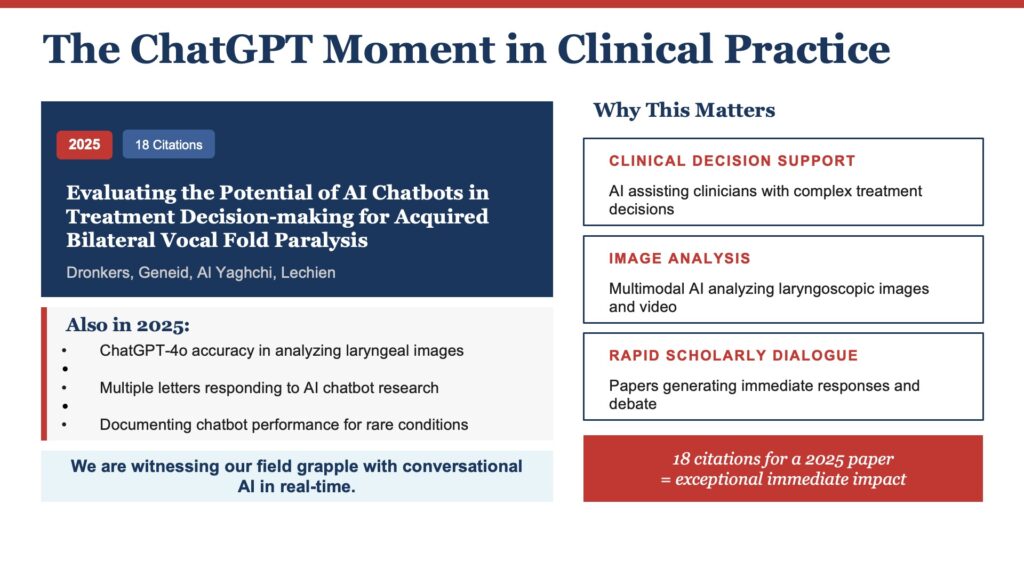
- AI Chatbots in Clinical Decision-Making: Recent 2025 publications, such as Dronkers and colleagues’ evaluation of AI chatbots in treatment decision-making for bilateral vocal fold paralysis, have ignited robust scholarly debate. Studies assessing the diagnostic accuracy of platforms like ChatGPT-4o when analyzing laryngeal images demonstrate that our field is actively and critically engaging with conversational AI in real-time clinical workflows.
Official Perspectives: Expert Insights on AI in Voice Science
To fully grasp the human and institutional dimensions of this technological shift, we must look to the thought leaders who are actively navigating these waters.
Dr. Mark Berardi: Managing Complexity and Synthetic Communication
Dr. Mark Berardi brings a unique, interdisciplinary perspective to voice science, rooted in physics and computation. He views artificial intelligence fundamentally as a tool for managing biological complexity.
"Machine learning and AI are tools to help with complexity, and communication is incredibly complex in its neurobiological and physiological processes. So I think the application is warranted," Dr. Berardi notes.
While noting that generative AI has not yet completely rewritten foundational research paradigms, he emphasizes its immediate value in eliminating bottlenecks in data processing and coding. Researchers can now rapidly generate and refine bespoke analytical code using natural language prompts.
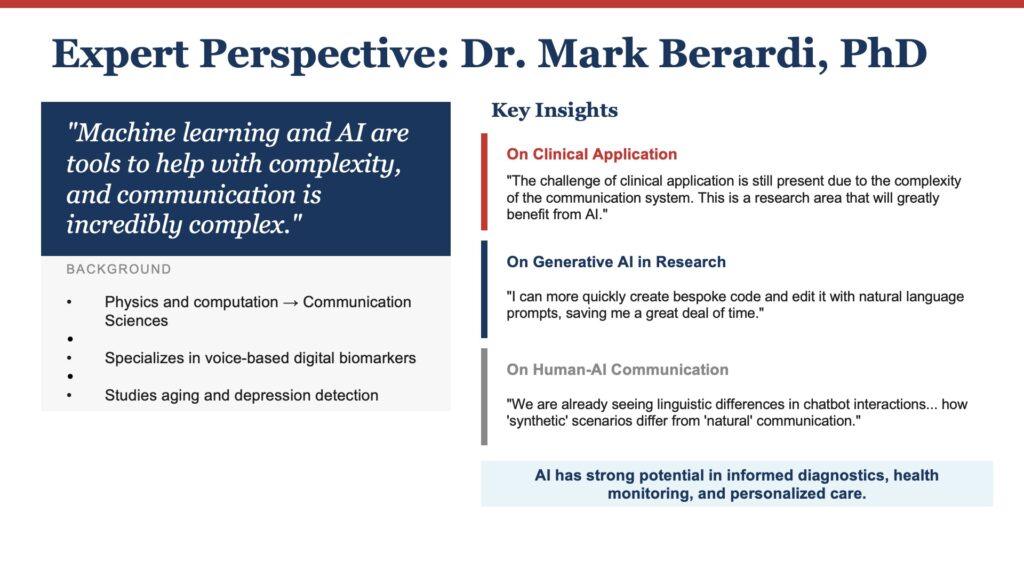
Intriguingly, Dr. Berardi’s research also examines human-AI interaction itself. He investigates how human speech patterns adapt when conversing with chatbots versus real humans, and how "synthetic" communication environments—such as Zoom calls—differ from traditional face-to-face interactions. As linguistic differences emerge in these digital spaces, voice science must expand its scope to study human vocalization not just in isolation, but in continuous conversation with machines.
Dr. Eric Hunter: Embracing Change with Ethical Clarity
Dr. Eric Hunter focuses heavily on the institutional and academic implications of AI integration within scholarly publishing and research workflows.
"These tools aren’t just novelties," Dr. Hunter observes. "They are rapidly becoming integrated into how we conduct literature reviews, organize data, extract themes from large bodies of text, and even summarize findings."
Large language models (LLMs) and AI-driven platforms are quietly embedding themselves into standard academic software infrastructure, from Microsoft Office to specialized literature-mining tools like NotebookLM and Claude. Rather than resisting this inevitable tide, Dr. Hunter issues a vital call to action for the scientific community: we must establish transparent guidelines regarding appropriate usage for both authors and reviewers.
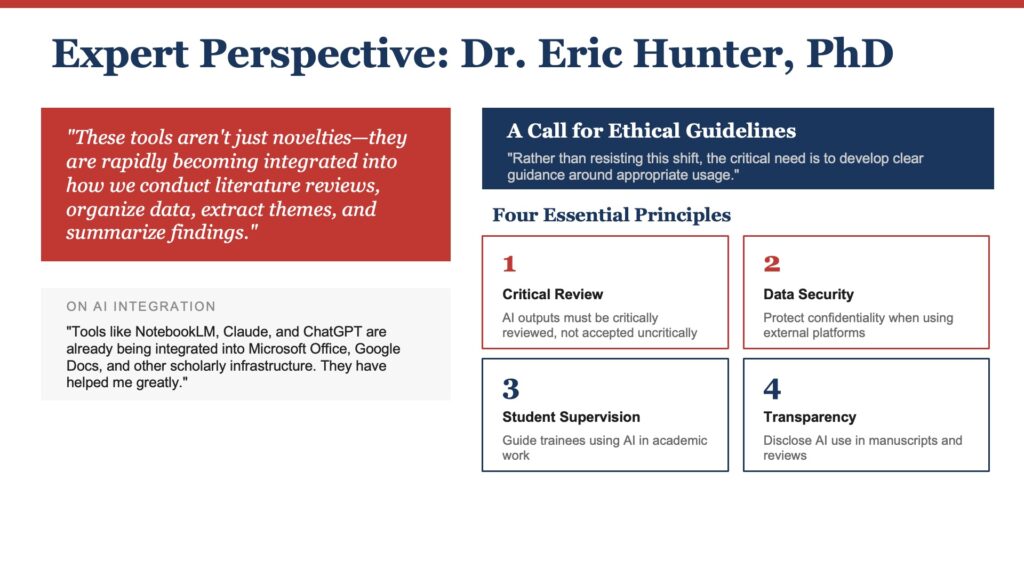
To ensure integrity, Dr. Hunter advocates for a balanced approach centered on productivity coupled with a shared ethical framework. The scientific community benefits most when researchers leverage AI to enhance efficiency while maintaining absolute accountability for the accuracy and originality of their published findings.
A Global Research Community
The momentum behind these advancements is sustained by a deeply collaborative, global network of scholars. Leading contributors to AI research within the Journal of Voice include Jérôme René Lechien, Dimitar Deliyski, Stephanie Zacharias, Ahmed Yousef, Paavo Alku, Leonardo Wanderley Lopes, and Maryam Naghibolhosseini, alongside dozens of other investigators spanning every inhabited continent. This is a unified global community dedicated to pushing the boundaries of what machine learning can reveal about the human voice.
Future Outlook: The Path Forward for Voice Science
As we look toward the next decade, the Journal of Voice remains firmly committed to serving as the premier platform for this evolving discipline. We will continue to champion rigorous research that pushes technological boundaries while upholding the highest standards of scientific integrity and peer review.
However, navigating this brave new world requires deliberate, collective action across three key fronts:

- Thoughtful Engagement: We must view AI tools for what they truly are—sophisticated instruments designed to manage complexity and amplify human expertise, never to replace clinical judgment. Researchers and clinicians must invest the time to understand both the powerful capabilities and the inherent limitations of these technologies.
- Collective Ethical Frameworks: The call for shared ethical guidelines cannot be answered by a single journal or isolated institution. It requires our entire international community—physicians, speech-language pathologists, engineers, and ethicists—to work in concert to establish transparent standards for AI-assisted research and clinical documentation.
- Open Collaboration and Publication: The 161 AI-related papers published in our journal to date represent merely the dawn of this movement. Every clinician observing a patient anomaly, every engineer refining an acoustic algorithm, and every educator bridging art and science holds insights vital to our collective progress.
An Extraordinary Moment in Human History
The human voice has accompanied our species for hundreds of thousands of years as our ultimate medium of survival, culture, and emotional resonance. Today, for the first time in human history, we possess computational tools sophisticated enough to truly decode its staggering complexity.
We stand at the threshold of an era where routine acoustic analysis can forewarn us of neurodegenerative decline, detect respiratory infections, monitor mental health, and extend the expert reach of clinicians to the most remote corners of the globe.
This is an extraordinary moment. The Journal of Voice and The Voice Foundation are honored to stand at its epicenter. The next decade promises discoveries far beyond our current imagination, and we look forward to charting that remarkable journey alongside our global community.