By Ian DeNolfo, Executive Director of The Voice Foundation
We stand today at a profound inflection point in the history of voice science—a historic juncture where artificial intelligence is fundamentally transforming how researchers conduct inquiries, analyze complex datasets, and care for patients. While the media often frames AI as a sudden, disruptive wave crashing over traditional industries, its deep integration into voice science is the result of decades of quiet, meticulous pioneering work.
As we examine the intersection of modern machine learning and the human voice, we witness not a sudden revolution, but the acceleration of a trajectory that began over thirty years ago. By bridging advanced computational models with the intricate physiology of human speech, the scientific community is unlocking diagnostic capabilities and therapeutic paradigms that were once confined to the realm of science fiction.
Executive Overview: A Paradigm Shift in Voice Science
The human voice has served as our primary instrument of connection, expression, and identity for hundreds of thousands of years. It carries the subtle nuances of our emotions, the state of our physical health, and the very essence of our personalities in a signal more information-dense than almost any other physiological output. Yet, for all its expressive power, decoding the physiological and neurobiological complexity of the voice has historically challenged clinicians and researchers alike.
Today, artificial intelligence provides the analytical horsepower required to decode this complexity. Through deep learning networks, machine learning algorithms, and natural language processing, the field of voice science is moving from subjective auditory perception to objective, quantifiable, and predictive analysis.
At the center of this transformation is The Journal of Voice, the premier peer-reviewed publication dedicated to voice science and medicine. Published under the auspices of The Voice Foundation, the journal has documented—and frequently driven—the evolution of AI in clinical otolaryngology, speech-language pathology, and computational linguistics. The data tells an unmistakable story: AI is no longer a peripheral research interest in voice science; it is the dominant engine of contemporary discovery.
The Voice Foundation: A Legacy of Interdisciplinary Innovation
To understand the magnitude of today’s technological leap, one must appreciate the rich legacy upon which it is built. In 1969, Dr. Wilbur James Gould founded The Voice Foundation in New York City. At a time when the interdisciplinary care of the human voice was virtually nonexistent, Dr. Gould possessed the groundbreaking foresight to bring together physicians, scientists, speech-language pathologists, performing artists, and vocal pedagogues. His mission was simple yet radical: foster a collaborative environment where diverse professionals could share their knowledge to optimize the care of the professional voice user.
The Foundation’s momentum quickly materialized into institutional milestones. In 1972, it hosted its first Annual Symposium—Care of the Professional Voice—followed by its inaugural Gala (later renamed Voices of Summer) in 1973. For over five decades, the Foundation has successfully built bridges between art and science, and between the clinical examining room and the performance stage.
Since 1989, The Voice Foundation has been guided by the visionary leadership of Dr. Robert Thayer Sataloff, an internationally renowned otolaryngologist who is simultaneously a professional singer and conductor. Dr. Sataloff’s prolific contributions include authoring more than 1,200 publications, including 79 textbooks. Under his stewardship, the Foundation relocated its headquarters to Philadelphia and expanded its global reach. Today, the annual Philadelphia Symposium draws hundreds of medical doctors, scientists, academics, speech-language pathologists, and performing artists from across the globe, united by a shared dedication to the vocal arts and sciences.
A Detailed Chronology: Thirty Years of AI Research in Voice Science
A common misconception in contemporary tech discourse is that artificial intelligence in medicine is a phenomenon born out of the 2020s. In reality, the Journal of Voice has been publishing peer-reviewed AI research for over three decades—longer than most contemporary observers realize.
The archival record reveals that as early as 1994—thirty-one years ago—the journal published a landmark paper by Rihkanen and colleagues entitled "Spectral Pattern Recognition of Improved Voice Quality." Utilizing nascent neural networks to analyze voice characteristics, this research was published during the exact same year that the World Wide Web was first emerging into public consciousness. Long before everyday professionals were sending emails or engaging with digital assistants, voice scientists were already training computational models to recognize patterns in acoustic data.
The Exponential Growth Timeline
While early applications were pioneering, the timeline of AI literature within the Journal of Voice demonstrates a period of prolonged incubation followed by explosive, exponential growth:
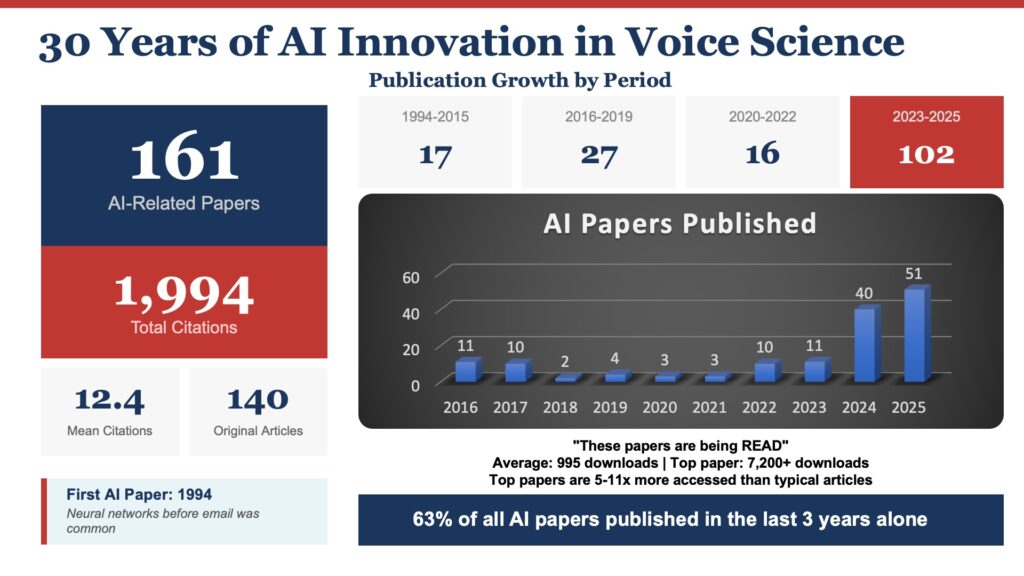
1994–2015: 17 papers published over two decades, laying the foundational methodology for automated acoustic analysis and early pattern recognition.
2016–2019: 27 papers published, reflecting the advent of deeper neural architectures and wider computational availability.
2020–2022: 16 papers published, bridging traditional clinical models with early machine learning diagnostic tools during a period of global healthcare disruption.
2023–2025: 102 papers published in just three years—representing 63 percent of the journal’s total historical output on the subject.
To fully grasp the velocity of this transformation, consider the year 2025 alone: the Journal of Voice published 51 AI-related papers. That single year surpassed the total output of the first twenty years of AI research in the journal combined. This is not merely gradual academic growth; it is an exponential transformation that is actively reshaping the boundaries of clinical otolaryngology.
Supporting Context & Metrics: Beyond Citations to Real-World Impact
Academic metrics are frequently criticized for measuring prestige rather than utility. However, a deep dive into the usage statistics of AI literature within the Journal of Voice demonstrates that these papers are not sitting dormant in digital archives—they are actively being downloaded, read, and applied by clinicians, researchers, and speech-language pathologists worldwide.
The average AI-related paper published in the journal has been downloaded nearly 1,000 times, a testament to the high demand for computational insights in clinical practice. Furthermore, landmark papers have achieved extraordinary reach:
COVID-19 Detection: The journal’s single most-accessed AI paper—a pioneering study examining machine learning models for COVID-19 detection via acoustic features—has been downloaded over 7,200 times, eclipsing the median download rate for its issue by a factor of eleven.
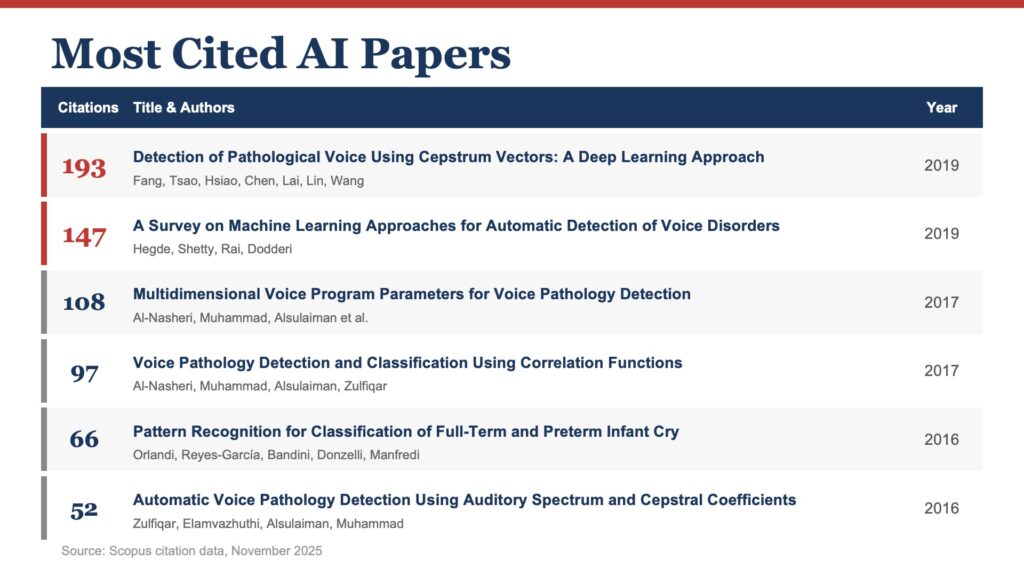
Deep Learning Benchmarks: Fang and colleagues’ 2019 deep learning study on voice pathology detection has amassed 193 citations and nearly 5,000 downloads, making it the most-cited AI paper in the journal’s history.
Foundational Surveys: Hegde’s comprehensive survey on machine learning approaches for the automatic detection of voice disorders has garnered 147 citations and nearly 5,000 downloads, serving as essential onboarding material for newcomers to the field.
These figures illustrate a vital reality: medical professionals are actively seeking out practical, data-driven tools to enhance diagnostic precision and patient outcomes.
Landmark Research Reshaping the Field
The body of literature accumulated by the Journal of Voice over the past three decades highlights several major thematic shifts in how computational tools intersect with human vocal physiology.
Deep Learning for Voice Pathology Detection
The cornerstone of modern computational voice analysis is the automated detection of vocal pathologies. Fang and colleagues’ benchmark study demonstrated that deep neural networks could detect pathological conditions using cepstrum vectors with remarkable accuracy—often identifying acoustic markers imperceptible to the human ear.
Building upon this foundation, researchers like Al-Nasheri (2017), Chen and Chen (2022), and Fujimura explored increasingly sophisticated neural network architectures, including one-dimensional convolutional neural networks (CNNs) and advanced multidimensional voice program parameters. These models allow clinicians to screen for structural and functional abnormalities with unprecedented sensitivity, reducing diagnostic subjectivity.
The Voice as a Digital Biomarker
Perhaps the most conceptually revolutionary shift in recent literature is the reframing of the human voice as a digital biomarker—a non-invasive, continuous window into systemic health.
Neurological disorders have been a primary focus of this research. Hemmerling and Wójcik-Pędziwiatr’s 2022 paper on predicting the severity of Parkinson’s disease from voice signals garnered immediate academic attention, demonstrating how micro-tremors and acoustic degradation can track neurodegeneration over time. Beyond neurology, systematic reviews published in the journal have explored voice quality as an indicator of psychiatric conditions, including major depressive disorder and bipolar disorder. The clinical implications are immense: routine vocal screening could theoretically flag early mental health shifts, enabling proactive intervention and alleviating pressure on overstretched healthcare infrastructure.
AI Chatbots in Clinical Decision-Making
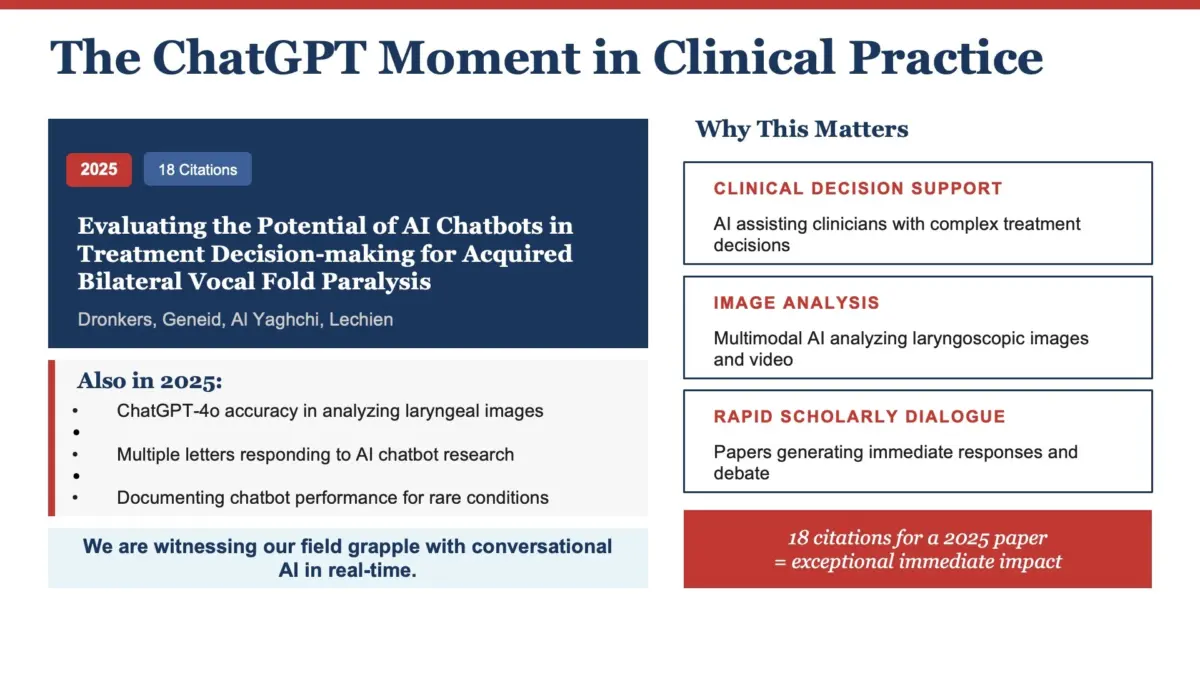
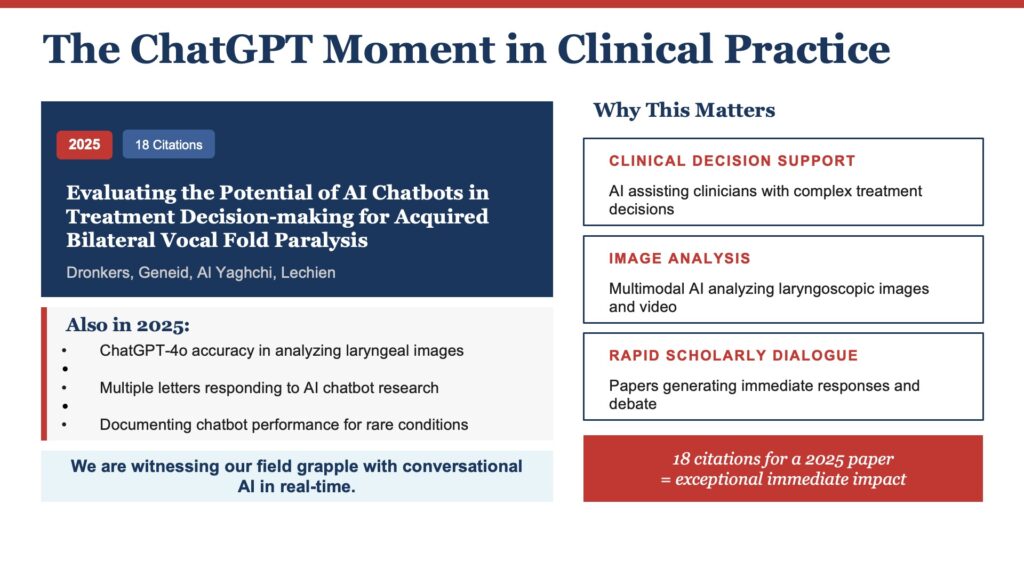
As conversational artificial intelligence matured into general public awareness, the Journal of Voice began exploring its utility in direct clinical decision-making. A prime example is Dronkers and colleagues’ 2025 study evaluating the potential of AI chatbots in treatment decision-making for acquired bilateral vocal fold paralysis. Accumulating 18 citations almost immediately upon publication, the paper sparked vibrant academic discourse, including multi-author responses and specialized investigations into the accuracy of advanced multimodal models (such as ChatGPT-4o) in analyzing laryngeal imagery.
Official Perspectives: Expert Insights on AI in Voice Science
To contextualize these technological leaps, two prominent voices within The Voice Foundation community share their perspectives on the promises, challenges, and responsibilities of integrating AI into scientific workflows.
Dr. Mark Berardi: Managing Complexity and Synthetic Communication
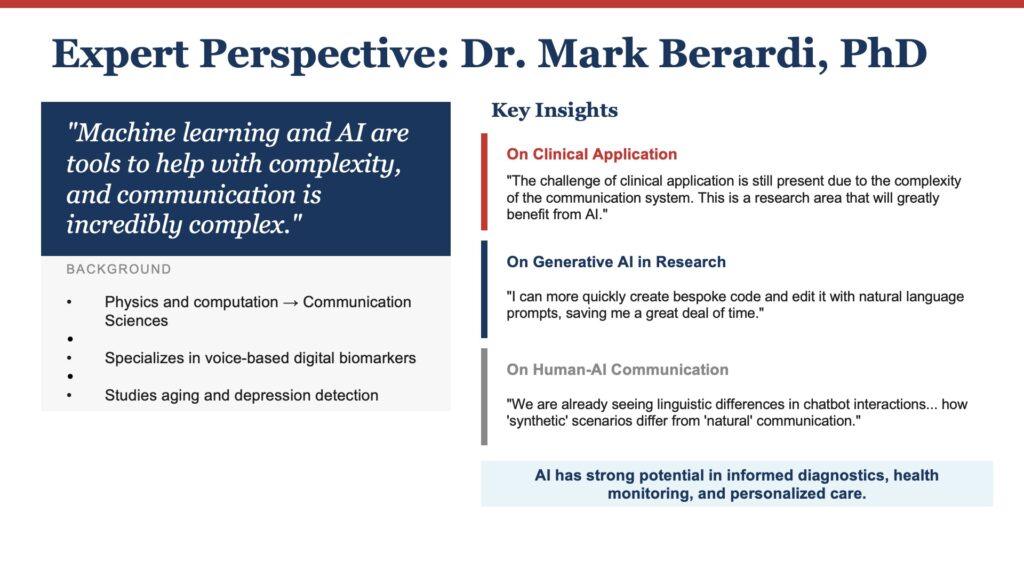
Dr. Mark Berardi brings a unique perspective to voice science, grounded in physics and computation. He views artificial intelligence fundamentally as a tool for managing biological complexity.
"Machine learning and AI are tools to help with complexity, and communication is incredibly complex in its neurobiological and physiological processes. So I think the application is warranted."
Dr. Berardi’s own research centers on developing voice-based digital biomarkers for aging and depression. "Acquiring speech and voice signals is relatively easy now, and we have shown potential for extracting meaningful health information," he notes. However, he cautions that the primary hurdle remains the sheer biological intricacy of human communication—an arena where machine learning naturally excels.
Regarding generative AI, Dr. Berardi offers a pragmatic assessment. While he has not yet observed it single-handedly rewriting fundamental research paradigms, he acknowledges its undeniable utility in eliminating operational bottlenecks. "I can now quickly create bespoke code and edit it with natural language prompts," he explains, streamlining data processing tasks that once required extensive manual programming.
Intriguingly, Dr. Berardi’s work also extends into human-AI communication itself. He studies how human vocal patterns adapt when speaking to synthetic agents versus other humans, noting measurable linguistic shifts in chatbot interactions and digital meeting platforms like Zoom. As our environment grows more synthetic, voice science must expand its scope to understand human expression in conversation with machines.
Dr. Eric Hunter: Embracing Change with Ethical Clarity
Dr. Eric Hunter emphasizes the institutional and administrative realities of AI integration within academic infrastructure.
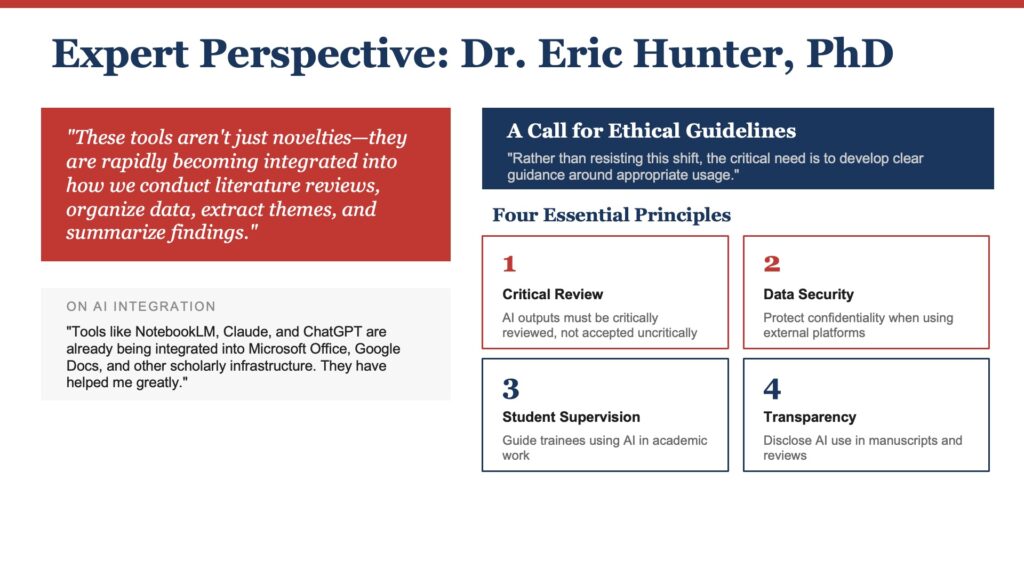
"These tools aren’t just novelties. They are rapidly becoming integrated into how we conduct literature reviews, organize data, extract themes from large bodies of text, and even summarize findings."
Dr. Hunter stresses that large language models and AI-driven platforms are permanently embedded into scholarly workflows, from manuscript preparation to peer review and collaborative writing. With tools like NotebookLM, Claude, and ChatGPT being woven natively into productivity software, academic institutions face an inescapable reality.
Rather than resisting this technological wave, Dr. Hunter issues a clear call to action: the development of rigorous ethical guidelines for both authors and reviewers. He outlines four essential principles for responsible academic AI integration:
Transparency: Clear disclosure of where and how AI tools are utilized in the research and writing process.
Accountability: Absolute human ownership of data interpretation, methodology, and final conclusions.
Data Integrity: Rigorous verification of AI-assisted literature synthesis to prevent hallucination or citation errors.
Equitable Access: Ensuring that computational tools do not create an exclusionary divide between resource-rich institutions and independent researchers.
"Our field will benefit most," Dr. Hunter concludes, "if we embrace the productivity these tools offer while also building a shared ethical framework for their responsible use."
A Global Research Community
The rapid ascent of AI in voice science is not the product of a few isolated laboratories. It is driven by a vibrant, interconnected global community of scholars. Among the most prolific contributors to the Journal of Voice are researchers whose work spans continents and disciplines:
Dr. Jérôme René Lechien (6 papers)
Dr. Dimitar Deliyski (5 papers)
Dr. Stephanie Zacharias (5 papers)
Dr. Ahmed Yousef (4 papers as first author)
Dr. Paavo Alku, Dr. Leonardo Wanderley Lopes, and Dr. Maryam Naghibolhosseini (4 papers each)
Supported by dozens of international research teams across every inhabited continent, these scientists are pioneering the marriage of artificial intelligence and otolaryngology. Their collective efforts prove that voice science is a truly global enterprise, united by a common commitment to decoding the human voice through computational excellence.
Future Outlook: The Path Forward for Voice Science
As The Journal of Voice looks toward the coming decades, it remains unswervingly committed to publishing rigorous, boundary-pushing research while maintaining the highest standards of scientific integrity. However, as the field navigates this exponential growth curve, it faces three critical imperatives:
Thoughtful Engagement: Researchers and clinicians must approach AI as an amplifier of human expertise rather than a replacement for clinical judgment. Understanding both the capabilities and the blind spots of algorithms is essential.
Collective Ethics: The scholarly community must actively build and refine a shared ethical framework, ensuring transparency, fairness, and accountability in AI-assisted research.
Collaborative Sharing: The 161 AI papers published to date represent merely the opening chapter of this scientific era. Every clinician, educator, and data scientist possesses insights capable of advancing our collective understanding.
Conclusion
The human voice remains our most intimate instrument of connection, carrying our emotions, our vulnerabilities, and our health in ways no other physiological signal can match. For the first time in human history, we possess computational instruments sophisticated enough to truly comprehend that complexity—tools capable of extending the reach of expert clinicians, detecting subtle pathological changes long before symptoms manifest, and democratizing access to high-quality voice care across the globe.
We stand at an extraordinary moment in time, and The Journal of Voice and The Foundation stand proudly at its center. The next decade promises even greater discoveries, deeper clinical insights, and a more profound understanding of what it means to give voice to the human condition.