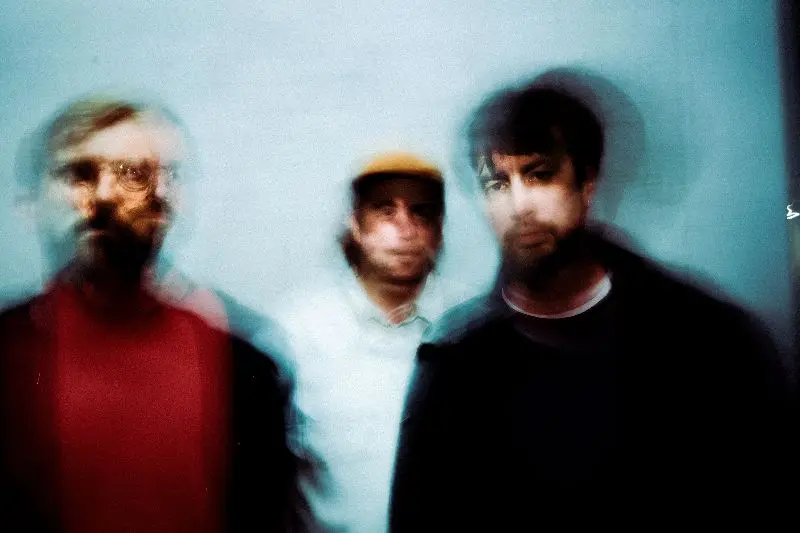
The contemporary underground music landscape is perpetually fueled by the cross-pollination of its most revered practitioners. When seasoned musicians step outside the confines of their primary outfits, the resulting creative friction often yields something entirely unexpected. Enter Post Common, a striking new transatlantic-minded British musical alliance forged by current and former stalwarts of JOHN, TRAAMS, and Sisterland.
Comprising Stuart Hopkins (guitar/vocals), Ian Humes (bass), and John Newton (drums/vocals), the newly minted trio is poised to carve out a distinct, abrasive niche within the modern post-punk ecosystem. The band has officially announced the upcoming release of their debut collection of songs, slated to arrive this November. Serving as the primary opening salvo for this new project is their blistering lead single, "Space/Time," a track that acts as a blueprint for the band’s idiosyncratic sonic architecture.
Post Common’s genesis is rooted in geography, shared history, and a mutual obsession with the foundational ethics of DIY punk combined with the stark, skeletal electronic dread of early New York no-wave and industrial pioneers. Across their upcoming debut EP, recorded at South London’s esteemed Bookhouse studio alongside engineer Tom Hill, the trio balances brutalist, machine-driven dissonance with deeply human, introspective lyricism.
This feature-length investigative profile explores the formation, collaborative mechanics, stylistic influences, and structural layout of Post Common’s debut. By examining the members’ rich pasts and the unique "exquisite corpse" writing dynamic that birthed these four tracks, we trace how a casual reconnection in Brighton evolved into one of the most compelling underground releases of the year.
Detailed Chronology: From Brighton Reunions to South London Studios
To understand the weight of Post Common, one must first trace the individual lineages of its members. Each musician brings to the table a wealth of road-tested experience from across the UK’s vibrant independent music circuit.
John Newton is widely recognized as the powerhouse drummer and vocalist for JOHN, the relentless alt-rock duo celebrated for their visceral live performances and uncompromising DIY ethos. Stuart Hopkins cut his teeth as a key creative force in TRAAMS, a band celebrated for their motorik rhythms, jagged guitar work, and expansive post-punk structures. Ian Humes, meanwhile, honed his low-end sensibilities through his work with Sisterland. Despite these established trajectories, fate—and a relocation—had other plans.
The Brighton Catalyst
The catalyst for Post Common occurred when Stuart Hopkins moved back to Brighton. In the vibrant coastal creative hub, Hopkins and John Newton reconnected. What began as casual conversations quickly escalated into late-night deep dives over a shared, unyielding love for the DIY punk rock lineage—specifically the foundational, politically charged, and fiercely independent catalog of Washington, D.C.’s legendary Dischord Records.
However, the two musicians were not interested in simply replicating the guitar-bass-drums blueprints of their past bands or their influences. Instead, they found themselves drawn to the cold, mechanical pulse of early electronic experimentation, most notably the pioneering minimalist industrial dread of the New York City duo Suicide.
The puzzle pieces finalized when Ian Humes entered the fold. Humes and Newton struck up a friendship while browsing the bins at a local independent record shop. Recognizing a shared creative hunger and complementary instrumental instincts, Humes was drafted on bass, solidifying the three-piece lineup that would become Post Common.
The Recording Sessions at The Bookhouse
With a burgeoning collection of songs and a distinct aesthetic vision, the trio booked time at The Bookhouse, a revered studio nestled in South London. To capture their volatile blend of organic instrumentation and electronic textures, they enlisted the expertise of engineer Tom Hill.
The studio environment served as a laboratory where traditional rock instrumentation could be systematically dismantled and reassembled. Out went the standard reliance on purely acoustic dynamics; in came an arsenal of drum pads, electronic rhythm generators, and textured signal processing. The sessions at The Bookhouse were characterized by a spirit of radical experimentation—a deliberate attempt by three seasoned veterans to unlearn their muscle memory and challenge the conventions of how a rock band should operate in the studio.
Supporting Context & Metrics: The Aesthetics of Brutalism vs. Introspection
The sonic and lyrical framework of Post Common relies heavily on the contrasting yet complementary artistic personalities of its primary songwriters, Stuart Hopkins and John Newton. Rather than operating under a singular, unified narrative voice, the band utilizes a dual-perspective framework that mirrors architectural styles.
The "Exquisite Corpse" Writing Methodology
Speaking on the collaborative process, John Newton illuminates the unorthodox methods that brought these tracks to life.
"This was the first experiment of me writing lyrics and Stu mangling them in his own way," Newton explains, highlighting the unpredictable nature of their partnership. "It’s a really good illustration of that exquisite corpse process. A lot of drum pads and electronic stuff; a deliberate attempt to play around and challenge more traditional instrumentation."
The "exquisite corpse" technique—a method popularized by Surrealists where a collective assembles a piece of work where no single creator knows the full trajectory of what the others are contributing—allowed Post Common to bypass overthinking. Lyrics passed between Newton and Hopkins were subjected to structural fracturing, vocal distortion, and rhythmic repositioning, resulting in a fractured, high-tension narrative flow.
Architectural Metaphors: The Outside and the Inside
The dichotomy between Hopkins and Newton’s lyrical and atmospheric contributions is perhaps best summarized by Hopkins himself, who divides the band’s creative output along architectural lines.
"Sometimes we collaborate, and sometimes we write separately," Hoxton [Hopkins] shares. "John’s more dystopian and industrial, like he’s Bauhaus, while I’m personal. If he’s brutalist, I’m more introspective—if he’s the outside of the house, I’m the inside."
This division creates a fascinating tension throughout the upcoming release. On one hand, the listener is confronted with exterior pressures—industrial decay, systemic alienation, and mechanized dystopian anxiety (the brutalist exterior). On the other hand, those bleak macro-environments give way to hyper-focused, deeply vulnerable psychological explorations (the domestic, introspective interior).
Dischord, Suicide, and the Modern Post-Punk Landscape
To contextualize Post Common’s sonic footprint, one must look at the broader landscape of 21st-century independent music. While contemporary post-punk has seen a massive commercial and critical resurgence over the past decade, many acts fall into the trap of retro-fetichism, rehashing the tropes of late-70s UK and post-millennial revival bands.
Post Common sidesteps this trap by pulling inspiration from a weirder, more challenging lineage. By wedding the ethical rigor of Dischord Records—where art and community take precedence over industry machinery—with the confrontational, synth-driven minimalism of Suicide, the band creates a bridge between punk’s raw socio-political urgency and electronic music’s ability to evoke claustrophobia and modern alienation. The integration of modern drum pads and digital sequencing alongside Humes’ anchoring basslines ensures that the project sounds firmly rooted in the anxieties of the present moment.
Official Statements & Track Breakdown
The rollout for Post Common’s debut project officially commences with the release of lead single "Space/Time." Serving as the vanguard for the November collection, the track encapsulates the band’s mission statement: a collision of organic muscle and synthetic menace.
The full tracklist for the upcoming debut release features four carefully curated pieces designed to be absorbed as a singular, cohesive statement:
Post Common Official Tracklist
"Space/Time"
"Check Atomiser"
"Invisible Tools"
"Paywall"
Each song title hints at themes deeply relevant to contemporary life: temporal anxiety ("Space/Time"), mechanized surveillance or labor ("Check Atomiser"), alienation through technology ("Invisible Tools"), and digital gatekeeping or capitalist friction ("Paywall").
The artwork for the project, revealed alongside the tracklist and single announcement, reinforces this stark, uncompromising aesthetic. Designed to mirror the industrial and brutalist themes embedded in the music, the visual presentation strips away extraneous ornamentation in favor of bold, monolithic imagery.
Future Outlook
As the music industry braces for the official November arrival of Post Common’s debut collection, anticipation among followers of the underground circuit is palpable. It is rare for a supergroup-adjacent project to so thoroughly divest itself of the commercial expectations tied to its members’ primary bands. Instead of resting on the laurels of JOHN or TRAAMS, Hopkins, Humes, and Newton have chosen to step into unfamiliar territory, armed with drum pads, tape delays, and a shared desire for self-sabotage and reinvention.
The implications of "Space/Time" and the forthcoming EP extend beyond a mere side-project novelty. Post Common represents a vital exercise in deconstruction. By merging industrial coldness with deeply human introspection, the trio has mapped out a compelling new direction for contemporary alternative music.
As the release date approaches, music critics and fans alike will be watching closely to see how this studio experiment translates to the live stage and how far the band intends to push their sonic boundary-shredding. One thing is certain: the foundations have been poured, the brutalist exterior is up, and Post Common has firmly established itself as one of the most essential new voices in the underground.