
Executive Overview
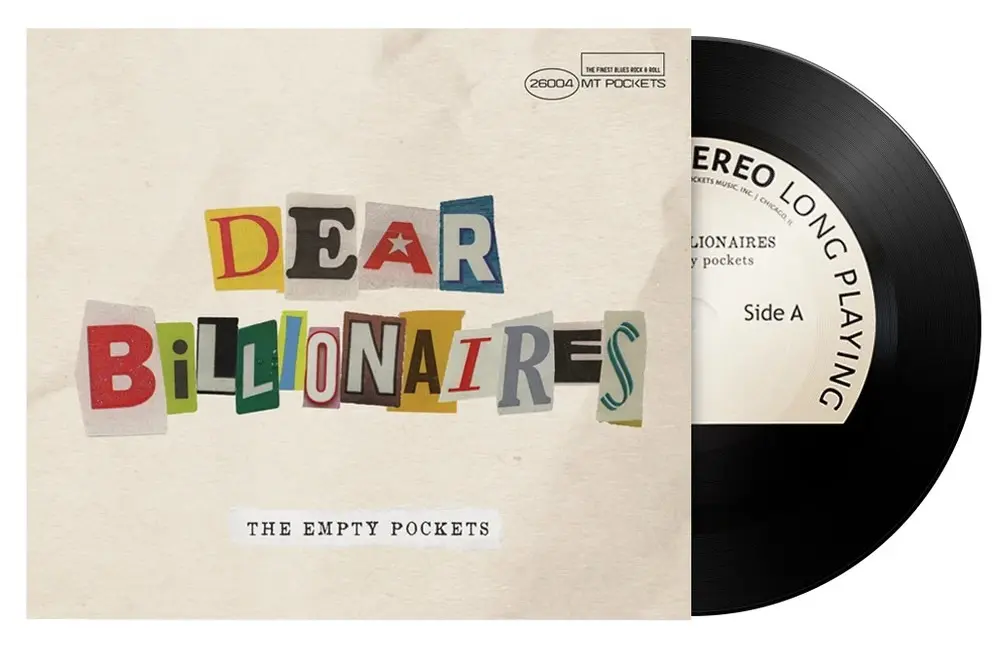
In an era dominated by algorithmic music promotion, influencer partnerships, and increasingly convoluted premium tiers for fans, independent rock music rarely manages to stop the cultural scroll. Yet, Chicago-based roots-rock outfit The Empty Pockets has achieved the seemingly impossible. With the rollout of their latest studio album, Dear Billionaires, the band has introduced a pricing strategy that has sent shockwaves through both the music industry and economic commentary circles alike: a standard compact disc that costs everyday fans $20, but carries a staggering, hyper-inflated price tag of $285,000 exclusively for the world’s ultra-wealthy.
Far from being a simple publicity stunt, this audacious gambit serves as a multi-layered artistic statement. It combines razor-sharp socioeconomic commentary with a high-stakes, tongue-in-cheek marketing campaign. The premise is disarmingly simple, yet brilliantly provocative. If a verified or self-proclaimed billionaire wishes to purchase Dear Billionaires, they are invited to pay a sum roughly equivalent to the median price of a comfortable suburban home—all for a standard, mass-produced silver CD. There is no deluxe packaging, no handwritten lyric sheet, no golden ticket, and not even a digital download code upgrade.
As the music industry continues to grapple with streaming payouts that favor tech conglomerates over working artists, and as global wealth disparity widens to unprecedented historical proportions, The Empty Pockets have held up a mirror to late-stage capitalism. By exploiting the mechanics of luxury pricing and flipping them on their head, the band has transformed the humble CD format into an ideological battleground. This comprehensive report examines the genesis of the campaign, the mechanics of the honor-system transaction, the broader thematic weight of the album, and the profound implications this marketing marvel holds for the future of independent music promotion.
Detailed Chronology: The Making of a Modern Satirical Masterpiece
To understand how a mid-tier roots-rock band from the American Midwest captured the attention of global financial observers, one must trace the deliberate, step-by-step evolution of the Dear Billionaires campaign.
Phase 1: Conceptualization in the Studio
The seeds of the campaign were sown during the recording sessions for the band’s latest album. Comprising core members Josh Solomon, Erika Brett, Nate Ditch, and Adam Skull, The Empty Pockets have long built a reputation for crafting timeless Americana, blues-infused rock, and lyrically dense storytelling. However, as the songs for this specific project took shape, the lyrical content inevitably gravitated toward contemporary anxieties: the suffocating weight of modern labor, the erosion of the middle class, the commodification of everyday existence, and the staggering consolidation of global wealth in the hands of a microscopic elite.
The band recognized a fundamental irony in releasing music about economic inequality through traditional industry channels. In the modern music economy, artists are routinely told to create expensive VIP packages, exclusive vinyl variants, and tiered membership models to squeeze every last dollar out of working-class fans who are already stretched thin by inflation and soaring costs of living.
"We found ourselves writing songs about power structures, wealth accumulation, and the strange realities of the modern economy," explains guitarist and vocalist Josh Solomon. "It felt hollow to just put out a standard record and pretend like the world outside our studio windows isn’t burning. We needed the release mechanism itself to reflect the themes of the music."
Phase 2: Designing the Pricing Architecture
Months before the album’s official release date, the band’s creative team sat down to design the storefront architecture. They wanted to create a clear, unambiguous dichotomy between the experience of the everyday consumer and the theoretical experience of a global titan of industry.
For the average listener, the physical CD would be priced at a standard, accessible $20—a fair market price that covers manufacturing, shipping, and a modest margin for an independent band navigating a post-physical retail landscape. But for the world’s billionaires, the band decided to introduce a bespoke SKU: the Billionaire Tier.
The website development team was tasked with building a frictionless yet profoundly cheeky user journey. Instead of integrating complex, corporate-style verification software that would require tedious paperwork or corporate legal teams, the band opted for radical simplicity paired with high comedic value. They instituted a checkout button bearing the deadpan declaration: "I swear I am a billionaire."
Phase 3: Launch and Public Discovery
When the pricing tier went live on the band’s official web store, it initially operated as an inside joke for early newsletter subscribers and social media followers. However, within 48 hours, digital culture sleuths and music industry analysts discovered the listing.
Screenshots of the $285,000 price tag began circulating across X (formerly Twitter), Reddit, and LinkedIn. Financial commentators appreciated the dry humor, while music critics marveled at the sheer audacity of charging luxury-car prices for a technology format widely considered obsolete by mainstream consumers. Within a week, the campaign transitioned from a clever indie band marketing trick into a viral cultural phenomenon, driving unprecedented traffic to The Empty Pockets’ digital ecosystem and sparking conversations far outside traditional music circles.
Supporting Context & Metrics: The Economics of Music and Modern Wealth
To truly appreciate the genius of The Empty Pockets’ campaign, one must contextualize it within the grim financial realities of the modern music industry and the surreal stratosphere of contemporary wealth accumulation.
The Streaming Economy vs. Physical Ownership
For independent artists in the 2020s, the economic landscape is notoriously hostile. Streaming platforms like Spotify and Apple Music pay out fractions of a cent per stream—typically ranging from $0.003 to $0.005 per play. An independent band must accumulate millions of streams just to cover the basic costs of recording, mixing, mastering, and promoting a professional-grade album.
+-------------------------------------------------------------------------+
|                  THE MODERN ARTIST REVENUE GAP                          |
+-------------------------------------------------------------------------+
|                                                                         |
|  1 Standard CD Sale ($20)      =  ~4,000 to 6,600 Streaming Plays       |
|                                                                         |
|  1 Billionaire CD Sale ($285k) =  ~57,000,000 to 95,000,000 Streams      |
|                                                                         |
+-------------------------------------------------------------------------+
As illustrated above, selling a single physical CD at $20 provides an artist with immediate, tangible revenue equivalent to thousands of individual streams. But when scaled up to the $285,000 Billionaire Tier, the financial disparity becomes laughable. A single purchase at that price point by an ultra-high-net-worth individual would yield the equivalent streaming revenue of tens of millions of listener plays—a milestone that many successful indie acts spend years trying to achieve.
The Billionaire Class and the Illusion of Special Treatment
The brilliance of the campaign lies in its inversion of luxury marketing psychology. For decades, luxury brands—from watchmakers to private aviation brokers—have operated on the premise that higher prices must unlock superior quality, exclusive craftsmanship, or tangible social status. Wealthy consumers are conditioned to expect velvet ropes, custom monogramming, and concierge-level pampering when they spend exorbitant sums.
The Empty Pockets completely shatter this paradigm. By purchasing the $285,000 CD, a billionaire receives absolutely nothing more than a working-class fan who pays a literal fraction of a percent of that cost. There is no autographed booklet, no titanium casing, no private listening party with the band, and no expedited shipping via a Gulfstream jet.
As the band’s website explicitly notes: "No autograph. No deluxe packaging. No exclusive material. No additional benefits."
This aspect of the campaign touches on a profound sociological truth highlighted by Josh Solomon: "Money buys special treatment almost everywhere. Here, it buys one CD." In a world where the ultra-wealthy can buy political influence, legal immunity, expedited healthcare, and bespoke luxury experiences, The Empty Pockets have created a singular commercial space where capital loses its purchasing power. A billionaire’s dollar buys the exact same standard plastic-jewel-case compact disc as a college student working a part-time job at a coffee shop.
Official Statements and Creative Philosophy
The members of The Empty Pockets have been remarkably candid about the motivations driving Dear Billionaires. Rather than viewing the campaign as a cynical cash grab, they frame it as an artistic extension of the music itself—a physical manifestation of the album’s thematic core.
Deconstructing the Honor System
One of the most frequently asked questions from curious fans and journalists alike concerns how the band plans to prevent pranksters from clicking the "I swear I am a billionaire" button just for the digital thrill of seeing a six-figure invoice.
The band’s answer is rooted in a refreshing mixture of pragmatism and philosophical humor. The band has publicly confirmed that they will not request bank statements, tax returns, portfolios of publicly traded equities, or proof of private aviation ownership from anyone who attempts to purchase the album at the inflated price point.
"We are operating entirely on an honor system," the band notes on their official checkout page. If a tech titan, venture capitalist, or oil heir wants to log onto the internet, click a button affirming their nine-figure net worth, and wire $285,000 to an independent roots-rock band from Chicago, the band is more than willing to test the boundaries of corporate benevolence.
The Intersection of Art and Activism
In interviews following the viral spread of the campaign, Josh Solomon elaborated on the band’s underlying philosophy regarding the accessibility of art in contemporary society.
"When you name a record Dear Billionaires, you are essentially writing an open letter to the people who hold the economic levers of our society," Solomon explains. "We wanted to make sure that letter wasn’t trapped behind a paywall of exclusivity. The music is for everyone. It’s accessible for twenty bucks. But if the people who control the wealth of nations want to participate in the commerce of our art, we wanted to give them an open door—even if that door comes with a heavy dose of irony."
The band’s commitment to keeping the standard edition affordable ensures that their core audience—working-class music lovers, blues enthusiasts, and everyday consumers—is never priced out of enjoying the physical artifact of the album. The contrast between the $20 price tag and the $285,000 price tag serves as a stark visual and economic reminder of the chasm dividing the ultra-wealthy from the rest of the global population.
Future Outlook: The Legacy of a Satirical Campaign
As Dear Billionaires continues to circulate through cultural, musical, and economic channels, the long-term impact of The Empty Pockets’ campaign offers fascinating lessons for the future of independent art and marketing.
1. A New Blueprint for Indie Band Promotion
In an overcrowded digital marketplace where traditional advertising budgets are often prohibitive for independent musicians, organic virality is the holy grail. By crafting a campaign that blends biting social commentary with interactive, high-concept humor, The Empty Pockets secured millions of dollars in equivalent earned media value without spending a dime on traditional ad spend. Future independent artists will undoubtedly study this campaign as a masterclass in how to leverage cultural friction to generate global attention.
2. The Resurgence of Physical Media as Conceptual Art
For over a decade, physical media—particularly the CD—has been dismissed by tech evangelists as a dying format destined for museum displays. However, campaigns like this demonstrate that physical formats possess unique tactile and conceptual properties that digital streaming can never replicate. You cannot proudly display a Spotify stream on your coffee table, nor can you attach a satirical six-figure price tag to an MP3 file with the same comedic and artistic impact. The humble compact disc, long derided as an outdated medium, has been successfully weaponized as an instrument of conceptual performance art.
3. Will a Billionaire Actually Buy It?
As of press time, no verified member of the Forbes 400 has publicly stepped forward to complete the transaction and purchase the $285,000 standard-edition CD. However, the lack of a completed high-net-worth sale does not diminish the campaign’s success. In fact, the absence of a billionaire buyer arguably serves the band’s narrative even better, underscoring the detachment of the ultra-wealthy from the everyday cultural experiences of the working class.
Should a billionaire eventually take the bait, click the honor-system button, and wire the funds, The Empty Pockets have promised to document the transaction with appropriate gravity. Until then, the band remains happily ensconced in the studio, touring relentlessly, and proving to the music industry at large that wit, intelligence, and creative fearlessness remain the most potent promotional tools at an artist’s disposal.
In a world where wealth so often dictates access, privilege, and preferential treatment, The Empty Pockets have reminded us through a simple plastic jewel case that great music belongs to everyone—and that sometimes, a billionaire’s fortune is worth precisely the cost of a standard CD, plus an unforgettable punchline.