
Executive Overview
For decades, the digital music streaming revolution has been a double-edged sword for niche music genres. While platforms like Spotify, Apple Music, and Amazon Music boast catalogs numbering in the tens of millions of tracks, their algorithms and user interfaces are fundamentally optimized for mainstream, pop, and hip-hop consumption—genres where the primary unit of currency is the standalone track or the artist’s primary album. For complex, historically layered, and heavily collaborative genres like classical and jazz, the standard streaming architecture often falls woefully short.
While Apple famously addressed this deficiency for the classical community by launching Apple Music Classical—a dedicated, standalone application built to handle the convoluted metadata, composer listings, and multi-movement works inherent to classical music—jazz fans have largely been left to fend for themselves. Mainstream platforms frequently fracture jazz catalogs, misattribute sidemen, obscure recording dates, and fail to capture the intricate web of collaborations that defined entire eras of the genre.
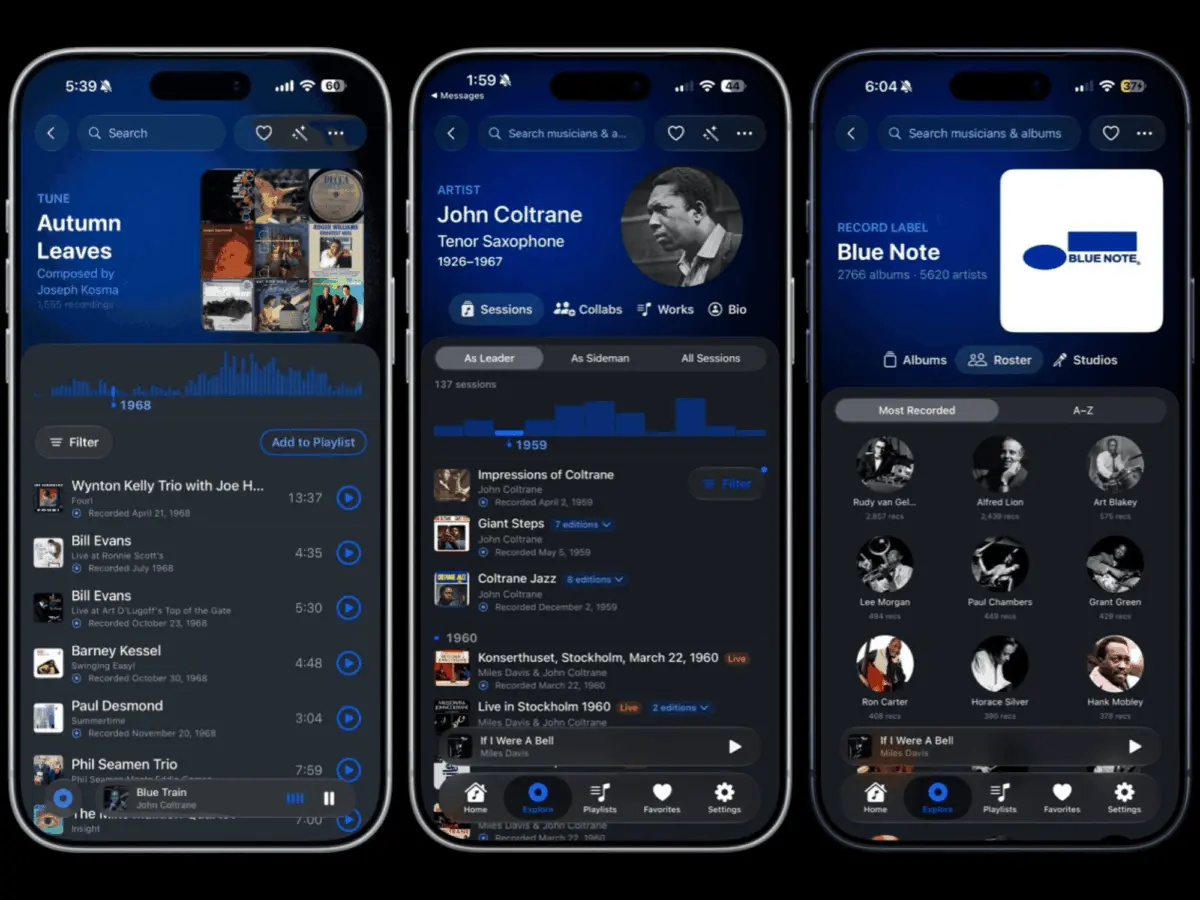
Enter Sessionography, a new independent iOS app created by developer and jazz enthusiast Joe LeBlanc. Designed to bridge the gap between massive streaming catalogs and the rigorous demands of jazz aficionados, Sessionography acts as a specialized companion app that layers deeply researched historical metadata on top of an Apple Music subscription. By mapping out sessions, sidemen, record labels, and recording studios, Sessionography transforms the passive streaming experience into an active, educational exploration of jazz history.
This article investigates the genesis of Sessionography, the technical ingenuity required to build a feature-complete app as a solo developer, the broader implications for genre-specific niche applications, and how this tool signals a maturing ecosystem for data-driven music discovery.
Detailed Chronology: From Personal Scratchpad to App Store Reality
The journey of Sessionography did not begin in a corporate boardroom or a venture-backed startup incubator. Like many software projects born out of genuine necessity, it started as a personal quest to solve a frustrating user experience.
The Genesis: A Developer’s Quest
Joe LeBlanc, an independent software developer with a lifelong passion for jazz, found himself continually frustrated by how standard streaming apps handled the genre. Jazz is unique in its collaborative fluidity. A legendary trumpeter might record as a leader on one Tuesday, appear as an uncredited or secondary sideman on a hard-bop session the following Thursday, and join a sprawling big band ensemble the weekend after. In a standard streaming search bar, this rich interconnected web is flattened into isolated album listings and disjointed track suggestions.
LeBlanc initially began cataloging his own listening habits and personal music library connections. As a developer, he recognized that the underlying APIs provided by Apple Music offered a robust foundation for playback, but lacked the human-curated context, historical interconnectivity, and relational database architecture that jazz demanded. What started as a local script and a personal database gradually evolved into a comprehensive conceptual framework for an application.
Development and Ecosystem Integration
Unlike many indie projects that launch with a bare-bones interface and slowly add features, LeBlanc took a holistic approach to the iOS ecosystem from day one. Recognizing that modern music consumption happens across multiple devices and contexts, Sessionography was engineered from the ground up to integrate deeply with Apple’s hardware and software ecosystem.
During the development phase, LeBlanc focused on several key technical milestones:
- API Mapping: Tying the app’s relational database directly to Apple Music’s vast catalog to ensure seamless track playback without requiring a separate audio engine.
- Cross-Device Continuity: Implementing native support for Apple Watch, allowing users to control and explore context while away from their phones.
- Voice and Accessibility: Integrating Siri voice shortcuts and comprehensive accessibility features to ensure the app could be navigated smoothly by all users.
- In-Car Optimization: Developing a dedicated CarPlay mode, recognizing that long car journeys are a primary listening environment for dedicated jazz enthusiasts.
The Public Launch
Sessionography officially launched on the iOS App Store, positioning itself as a premium utility for listeners willing to look beneath the surface of their favorite recordings. Utilizing a freemium model—free to download with in-app purchases required to unlock advanced features, alongside the prerequisite active Apple Music subscription—the app quickly caught the attention of music tech journalists and dedicated audiophiles alike.
Supporting Context & Metrics: The Anatomy of Jazz Metadata
To understand why Sessionography is a breakthrough for jazz fans, one must understand the unique metadata challenges plaguing jazz on modern streaming platforms.
The Sideman Problem
In mainstream music, credits are relatively straightforward: Primary Artist, Featured Artist, Producer, Songwriter. In jazz, the lines blur entirely. Consider the monumental 1959 recording sessions for Miles Davis’s Kind of Blue. While Miles Davis is universally credited as the primary artist, the album features towering figures like John Coltrane, Cannonball Adderley, Wynton Kelly, Bill Evans, Paul Chambers, and Jimmy Cobb.
On generic streaming interfaces:

- Searching for "Bill Evans" might lead a user primarily to his trio recordings, completely missing his indispensable contributions as a sideman on Kind of Blue or his work with other bandleaders unless deep-dive scrolling or manual searches are performed.
- Sessionography fundamentally upends this by treating every musician as a node in a vast, interconnected network. Users can click on a sideman from a 1957 Blue Note session and instantly see every other recording that specific drummer or bassist participated in across the entire Apple Music library.
Dissecting "Smart Playlists" and Historical Filtering
One of Sessionography’s most powerful features is its ability to generate context-aware "smart playlists." Traditional streaming playlists are static or algorithmically generated based on collaborative filtering (i.e., "If you liked X, you might like Y"). Sessionography’s smart playlists, however, allow listeners to dynamically filter music based on musicological and historical parameters:
- Originals vs. Standards: Jazz is built on the interpretation of the Great American Songbook. Sessionography allows users to isolate definitive original compositions from endless covers of jazz standards, or conversely, pull together dozens of unique interpretations of a single standard like "All of Me" or "Round Midnight."
- Studio vs. Live Recordings: The energy of a smoky, late-night jazz club performance differs vastly from a clinical studio session. The app enables precise filtering to curate sets based on recording environments.
- Chronological and Demographic Brackets: Listeners can filter by decades (e.g., the bebop explosion of the 1940s vs. the modal and avant-garde movements of the 1960s), group sizes (from intimate piano trios to massive 20-piece big bands), and curation depth (balancing widely recognized "essential" recordings against rare "deep cuts" for seasoned collectors).
Platform Ecosystem and Monetization Metrics
The technical execution of Sessionography highlights a growing trend in software development: solo developers leveraging massive platform ecosystems to build hyper-specialized vertical tools.
| Feature Category | Implementation Details | User Benefit |
|---|---|---|
| Audio Source | Apple Music API integration | Access to over 100 million tracks without hosting audio files. |
| Historical Data | Custom relational database | Maps sessions, sidemen, labels, and recording studios. |
| Hardware Sync | Apple Watch & CarPlay native apps | Seamless listening and discovery across mobile, watch, and auto. |
| Accessibility | Full VoiceOver and dynamic type support | Inclusive design for all users. |
| Monetization | Freemium with one-time or subscription unlocks | Sustainable indie development model. |
Official Statements and Industry Perspective
While Apple has remained relatively quiet regarding third-party apps building niche layers on top of its music infrastructure, industry analysts and musicologists have been quick to praise the development of tools like Sessionography.
Joe LeBlanc, reflecting on the philosophy behind the application during its rollout, emphasized that the app was never intended to replace streaming services, but rather to give them a soul:
"Streaming platforms solved the problem of access, but they accidentally sacrificed context in the process. Music—especially jazz—is a conversation between artists across decades. If you don’t show the listener who is speaking, where they were sitting, and who else was in the room, you are only giving them half the story."
Independent app development experts have also pointed to Sessionography as a masterclass in modern API utilization. By outsourcing the expensive, legally complex, and infrastructure-heavy task of audio licensing and streaming to Apple Music, a single developer was able to focus entirely on UI/UX, database architecture, and user value.
Musicologist and jazz historian Dr. Arthur Vance noted the cultural significance of such tools in an interview regarding digital preservation:
"For generations, liner notes on physical vinyl gatefolds and CD booklets were the primary textbooks for jazz education. When we moved to digital files and streaming, those liner notes vanished into thin air. Apps that reconstruct that historical metadata are not just convenient music players; they are vital cultural preservation tools that keep the history of the art form alive for younger generations."
Future Outlook: The Rise of Vertical Music Apps
Sessionography arrives at a fascinating crossroads in the digital audio industry. As mainstream streaming services increasingly homogenize their interfaces to cater to passive, algorithm-fed listeners, a distinct counter-movement is emerging among passionate music enthusiasts, audiophiles, and independent developers.
Will Other Genres Follow Suit?
The success of Apple Music Classical proved that specialized metadata interfaces are commercially and culturally viable at a corporate level. Now, indie projects like Sessionography are proving that the same model can be successfully decentralized and built by single developers for other complex genres.
Potential avenues for future vertical music apps could include:
- Electronic & Dance Music: Apps that map underground record labels, DJ residency histories, remix lineages, and underground club provenance.
- Progressive Rock & Metal: Platforms that track sprawling concept albums, shifting band line-ups, producer credits, and intricate guest appearances.
- Folk & Roots Music: Tools that trace traditional song genealogies, regional migration of folk motifs, and archival field recordings.
The Path Forward for Sessionography
As LeBlanc continues to iterate on Sessionography, future updates are expected to expand the depth of the historical database, refine smart playlist generation algorithms, and incorporate community-driven annotation features.
For the everyday jazz fan, the message is clear: the golden age of algorithmic black boxes is being challenged by tools designed to illuminate, educate, and deeply connect listeners to the music they love. Sessionography is more than just an app; it is a digital liner note for the twenty-first century, proving that when technology respects the complexity of art, the listening experience is immeasurably enriched.