Voice science stands at a profound inflection point. For over half a century, the medical, scientific, and artistic communities have strived to decode the intricacies of the human voice—an acoustic fingerprint that mirrors both human emotion and physical health. Today, that mission is undergoing a seismic shift. Artificial intelligence (AI) and advanced machine learning are no longer peripheral novelties in this specialized field; they are central catalysts fundamentally reshaping how researchers conduct investigations, how clinicians analyze complex acoustic data, and how patients receive care.
This intersection of artificial intelligence and voice science is not a sudden, overnight phenomenon. Rather, it is the culmination of decades of quiet, pioneering cross-disciplinary work. Led by institutions like The Voice Foundation and its premier peer-reviewed publication, the Journal of Voice, the scientific community has spent over thirty years integrating computational intelligence with laryngology, otolaryngology, and speech-language pathology.
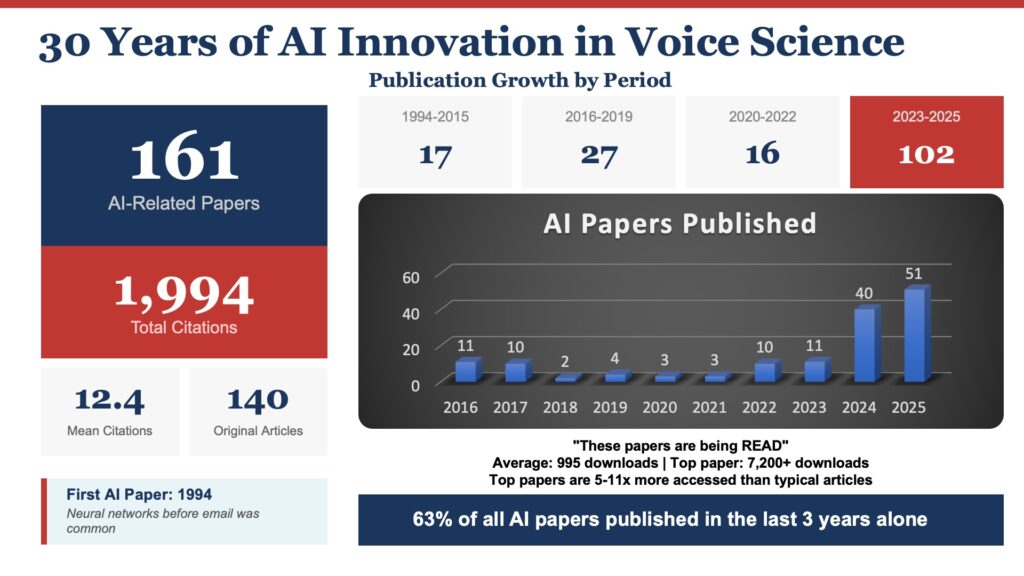
An examination of recent publishing data reveals an astonishing acceleration. Out of more than 160 foundational AI-related papers published in the Journal of Voice over the last three decades, an overwhelming 63 percent—102 studies—have appeared in just the past three years. With 51 papers published in 2025 alone, the discipline has transitioned from gradual academic exploration to exponential, real-world transformation. From non-invasive digital biomarkers capable of tracking neurological decline and mental health disorders to conversational AI guiding clinical decision-making, voice science has entered an unprecedented era of discovery.
A Legacy of Innovation: Bridging Art and Science
To understand the current technological revolution in voice science, one must look back to its institutional roots. In 1969, Dr. Wilbur James Gould founded The Voice Foundation in New York City during an era when comprehensive, interdisciplinary care for the human voice was virtually nonexistent. Dr. Gould possessed the extraordinary foresight to unite physicians, scientists, speech-language pathologists, performing artists, and educators. His vision broke down traditional academic silos, creating a collaborative space where the medical needs of professional voice users could be properly addressed.
This collaborative spirit manifested in the Foundation’s first Annual Symposium—Care of the Professional Voice—launched in 1972, followed by its inaugural Gala (later named Voices of Summer) in 1973. For more than five decades, the organization has successfully built bridges between art and science, clinical medicine and the theatrical stage.
Since 1989, The Voice Foundation has been under the stewardship of Dr. Robert Thayer Sataloff, an internationally renowned otolaryngologist, professional singer, and conductor. Dr. Sataloff’s prolific contributions include authoring more than 1,200 publications and 79 textbooks. Under his guidance, the Foundation relocated to Philadelphia and expanded its global reach, cementing its status as the world’s leading hub for voice research and education. Today, the annual Philadelphia symposium draws hundreds of medical, scientific, academic, and artistic professionals from across the globe, while the Foundation’s flagship publication, the Journal of Voice, remains the definitive peer-reviewed journal dedicated to voice science and medicine.
Detailed Chronology: Thirty Years of AI Research in Voice Science
While the broader public consciousness has only recently awakened to the capabilities of generative artificial intelligence and deep learning, the readership and contributors of the Journal of Voice have been exploring computational models for over three decades.
The timeline of artificial intelligence in voice science shatters the misconception that machine learning in medicine began in the 2020s:
The Genesis (1994): Thirty-one years ago, the Journal of Voice published a paper by Rihkanen and colleagues titled "Spectral Pattern Recognition of Improved Voice Quality." Utilizing rudimentary neural networks to analyze acoustic patterns, this research was published the exact same year the World Wide Web was emerging into public consciousness—meaning the voice science community was leveraging AI before most professionals had ever sent a corporate email.
The Formative Era (1995–2015): For the next two decades, computational voice analysis grew at a steady, incremental pace. During this 20-year span, 17 foundational papers laid the groundwork for feature extraction, signal processing, and basic pattern recognition.
The Acceleration Phase (2016–2019): As computing power surged and deep learning architectures matured, interest quickened. Between 2016 and 2019, the journal published 27 papers focusing on machine learning applications for vocal pathology detection.
The Plateau and Pivot (2020–2022): Amidst a global pandemic that forced healthcare and research systems to adapt rapidly, 16 papers explored remote acoustic monitoring, paving the way for digital health solutions.
The Exponential Explosion (2023–2025): The recent trajectory represents a radical upward spike. Between 2023 and 2025, researchers published 102 AI-related papers. In 2025 alone, the journal released 51 AI-centric studies—surpassing the total output of the first twenty years combined. This is not incremental academic growth; it is an exponential transformation of an entire medical specialty.
Supporting Context and Metrics: Real-World Impact and Landmark Research
The true measure of a scientific publication extends far beyond its raw paper count or theoretical citations; it lies in its real-world utility for clinicians, researchers, and speech-language pathologists. Usage statistics for the Journal of Voice demonstrate that these computational studies are actively shaping clinical workflows globally.
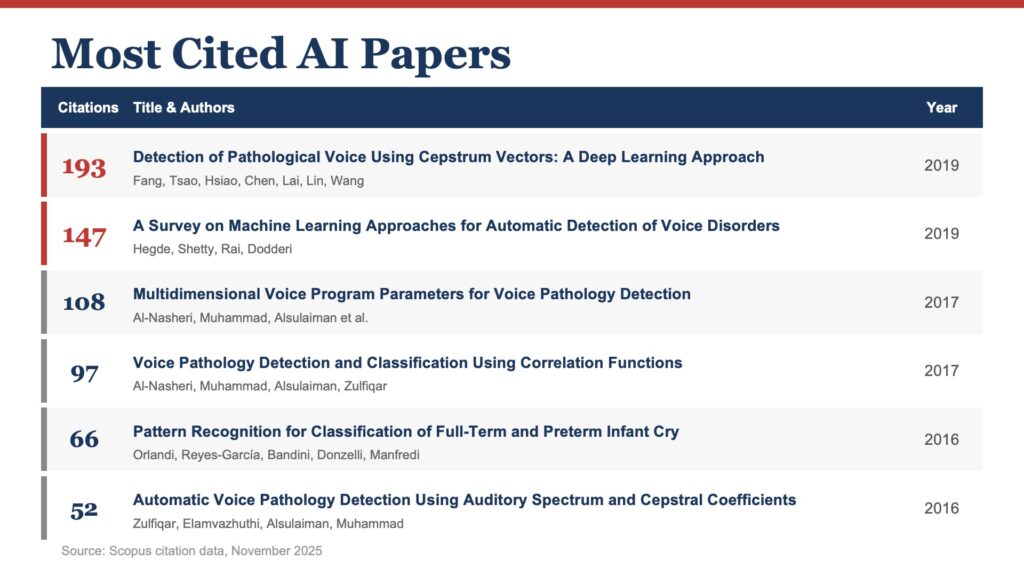
The average AI-focused paper in the journal has been downloaded nearly 1,000 times. Leading this charge is a landmark study on machine learning for COVID-19 detection via acoustic features, which has garnered over 7,200 downloads—eleven times the median for articles in its issue. Similarly, the journal’s top-cited works—such as Fang and colleagues’ deep learning study (193 citations) and Hegde’s machine learning survey (147 citations)—have each been accessed nearly 5,000 times. These figures represent active clinicians and researchers seeking practical, data-driven solutions to elevate patient care.
Decoding Pathology and Disease via Deep Learning
Landmark studies have fundamentally altered how vocal disorders are identified. Fang and colleagues’ 2019 paper, "Detection of Pathological Voice Using Cepstrum Vectors: A Deep Learning Approach," demonstrated that deep neural networks could identify pathological conditions with remarkable accuracy using subtle acoustic features imperceptible to the human ear.
Complementing this, Hegde’s comprehensive survey mapped the landscape of machine learning in automatic voice disorder detection, serving as essential reading for new researchers. Subsequent innovations—such as Chen and Chen’s work on deep neural networks for voice classification, Fujimura’s exploration of one-dimensional convolutional neural networks, and Cho and Choi’s comparative analysis of CNN models for laryngoscopic imagery—have continuously pushed the boundaries of diagnostic precision.
Voice as a Digital Biomarker
Perhaps the most clinically profound evolution is the conceptualization of the human voice as a digital biomarker—a non-invasive window into systemic health.
Neurological Monitoring: Groundbreaking research has established voice analysis as a reliable tool for tracking neurodegenerative conditions like Parkinson’s disease. Studies predicting Parkinson’s severity from routine voice signals have rapidly accumulated dozens of citations, moving computational laryngology closer to point-of-care clinical application.
Mental Health Analytics: Systematic reviews are increasingly exploring vocal quality as a digital biomarker for depression and bipolar disorder. The clinical implications are immense: routine vocal screening could allow for earlier psychological intervention, mitigating the burden on overburdened mental health infrastructure.
Respiratory Surveillance: Machine learning algorithms designed to assess COVID-19 and other respiratory infections from voice characteristics highlight how simple audio recordings can act as sentinels for systemic respiratory health.
AI Chatbots in Clinical Practice
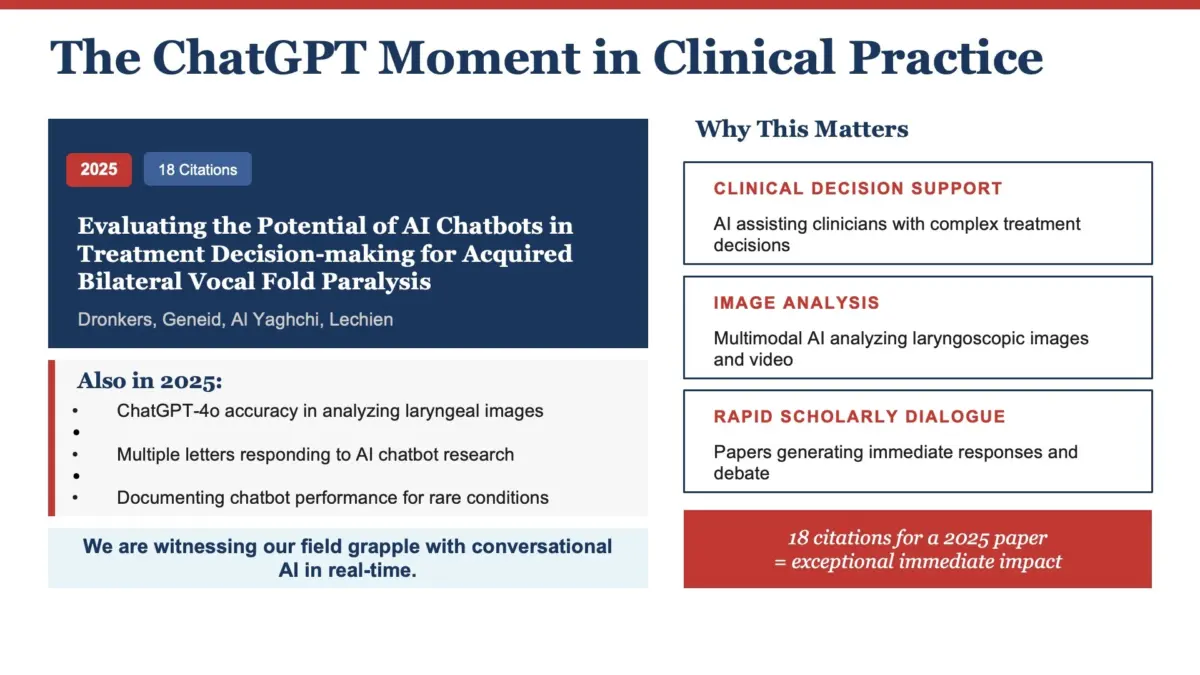
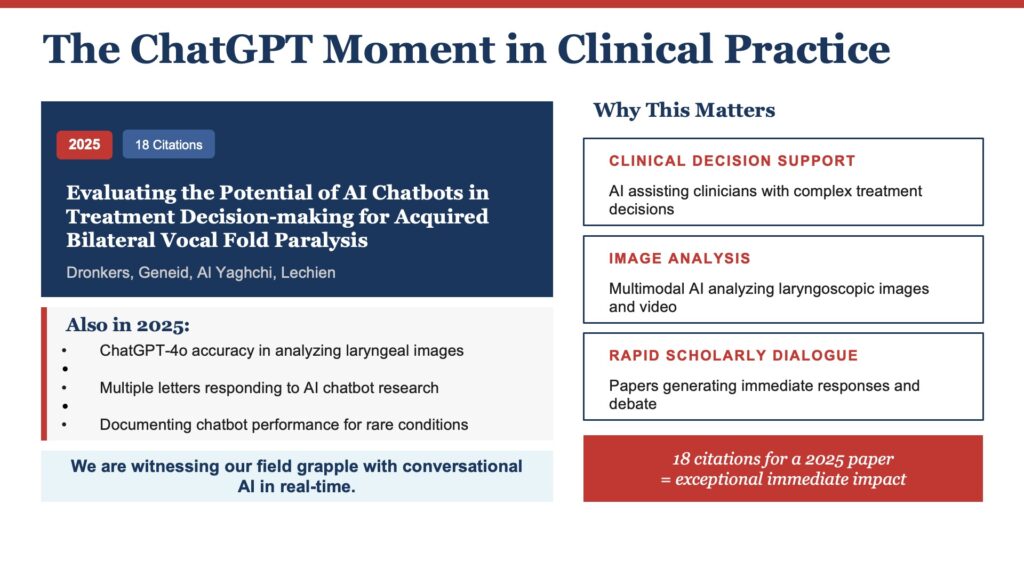
In 2025, the journal expanded its scope to examine conversational AI and large language models (LLMs) in clinical decision-making. Research evaluating the utility of AI chatbots in treatment planning for complex conditions—such as acquired bilateral vocal fold paralysis—has triggered widespread academic discourse, including letters to the editor and investigative responses regarding the diagnostic accuracy of models like ChatGPT-4o in analyzing laryngeal images. The medical community is actively navigating the promises and pitfalls of conversational AI within clinical environments.
Official Statements and Expert Perspectives
To successfully navigate this technological frontier, leading minds within The Voice Foundation emphasize the need for balanced perspectives, combining computational enthusiasm with rigorous ethical oversight.
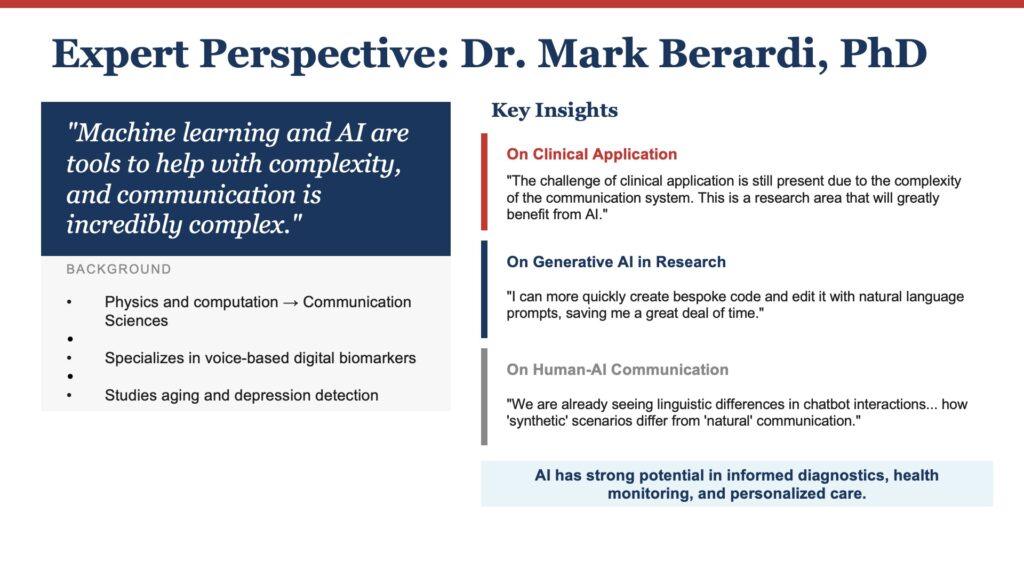
Dr. Mark Berardi: AI as a Tool for Complexity
Drawing from a background in physics and computation, Dr. Mark Berardi views artificial intelligence through the lens of complexity management.
"Machine learning and AI are tools to help with complexity, and communication is incredibly complex in its neurobiological and physiological processes. So I think the application is warranted," Dr. Berardi explains.
His research focuses on extracting health insights—such as aging and depression markers—from accessible speech signals. While he notes that generative AI has not yet completely rewritten foundational research paradigms, he acknowledges its undeniable utility in solving administrative and computational bottlenecks. Researchers can now rapidly prototype and refine bespoke code using natural language prompts.
Intriguingly, Dr. Berardi is also investigating human-AI communication itself. By analyzing how humans alter their linguistic patterns when speaking to chatbots versus real people—or how "synthetic" environments like Zoom calls distort interpersonal dynamics—he believes the field must broaden its aperture. Researchers must study not just the human voice in isolation, but the human voice in active conversation with machines.
Dr. Eric Hunter: Embracing Change with Ethical Clarity
Dr. Eric Hunter focuses heavily on the institutional and academic implications of AI integration within scholarly publishing.
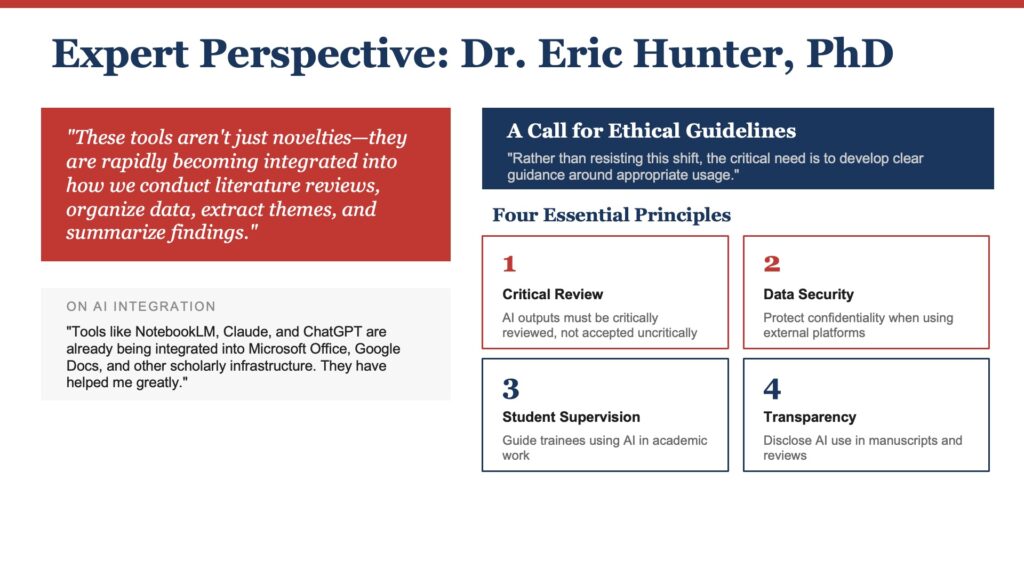
"These tools aren’t just novelties," Dr. Hunter observes. "They are rapidly becoming integrated into how we conduct literature reviews, organize data, extract themes from large bodies of text, and even summarize findings."
Dr. Hunter points out that large language models are permanently embedded in modern academic workflows, spanning manuscript preparation, peer review, and collaborative writing via platforms integrated into everyday productivity software. Rather than resisting this technological wave, he issues a clear call to action: the scientific community must establish transparent usage guidelines for authors and reviewers alike.
Dr. Hunter champions four essential pillars for ethical AI adoption in research:
Transparency: Clear disclosure of where and how AI tools were utilized during the research and drafting processes.
Human Accountability: Uncompromising adherence to the principle that human authors remain entirely responsible for the integrity, accuracy, and originality of published work.
Editorial Integrity: Rigorous screening by journals to prevent algorithmic over-reliance and the introduction of fabricated data or hallucinations.
Equitable Access: Ensuring that computational advancements benefit international research communities uniformly, bridging institutional resource gaps.
"Our field will benefit most," Dr. Hunter concludes, "if we embrace the productivity these tools offer while also building a shared ethical framework for their responsible use."
A Global Research Community
This computational revolution is propelled by a vast, interconnected international network. Leading contributors to AI research within the Journal of Voice span continents, featuring prominent investigators such as Jérôme René Lechien, Dimitar Deliyski, Stephanie Zacharias, Ahmed Yousef, Paavo Alku, Leonardo Wanderley Lopes, and Maryam Naghibolhosseini. Supported by dozens of laboratories across the globe, these researchers share a unified commitment to decoding the human voice through advanced machine learning.
Future Outlook: The Path Forward for Voice Science
As the Journal of Voice charts its course through the remainder of the decade, it remains committed to publishing pioneering research that maintains the highest standards of scientific rigor. However, realizing the full clinical potential of artificial intelligence requires coordinated, collective action across three distinct fronts:
Thoughtful Engagement with Technology: Researchers and clinicians must view AI not as a replacement for human clinical judgment, but as an advanced cognitive amplifier designed to manage overwhelming datasets and complex physiological variables.
Harmonized Ethical Frameworks: As Dr. Hunter emphasizes, developing clear, enforceable ethical guidelines regarding AI authorship and data analysis cannot be achieved by isolated institutions; it demands a unified global consensus.
Continuous Knowledge Sharing: The 161 AI-focused papers published to date represent merely the foundation. Clinicians, speech-language pathologists, and computer scientists must continue sharing empirical insights to refine algorithms and translate computational models into everyday bedside care.
The human voice has served as our primary instrument of connection, expression, and identity for hundreds of millennia. It carries our emotional states, our deepest vulnerabilities, and our systemic health markers in ways no other physiological signal can replicate.
Now, for the first time in human history, science possesses the technological sophistication necessary to truly decode that complexity—to uncover what the voice whispers about our brains, our bodies, and our overall well-being. By expanding the reach of expert clinicians, catching subtle pathologies before they escalate, and democratizing access to voice care worldwide, artificial intelligence has opened a golden door for the discipline.
The Journal of Voice and The Voice Foundation stand proudly at the center of this transformation. The coming decade promises discoveries far beyond current horizons, and the scientific community stands ready to listen.
About the Author
Ian DeNolfo is Executive Director of The Voice Foundation, which publishes the Journal of Voice. A graduate of The Juilliard School and The Curtis Institute of Music, he formerly performed as a leading tenor at opera houses worldwide before transitioning to arts administration and leadership at The Voice Foundation.