
Executive Overview
Voice science stands at a monumental crossroads. For over half a century, the rigorous study of the human voice has navigated the delicate intersection between art and medicine, vocal pedagogy and otolaryngology. Today, however, that intersection is being fundamentally remapped by an undeniable technological force: artificial intelligence (AI).
Far from being a sudden, disruptive trend confined to Silicon Valley boardrooms, the convergence of AI and voice science is rooted in decades of quiet, persistent academic inquiry. At the center of this transformation is The Voice Foundation and its premier peer-reviewed publication, the Journal of Voice. Long before generative pre-trained transformers or neural networks became household phrases, visionary researchers were already leveraging computational algorithms to decode the hidden mechanics of vocal acoustics.
Recent publishing metrics reveal a staggering acceleration. Out of more than 160 artificial intelligence-related papers published in the Journal of Voice since its first computational study in 1994, an astonishing 63 percent—102 papers—have appeared in just the last three years. With 51 AI-focused papers published in 2025 alone, the discipline has transitioned from gradual academic curiosity to an exponential transformation.
This article explores the historical foundations, landmark breakthroughs, real-world clinical applications, and future ethical imperatives defining this new era. Guided by institutional longevity and propelled by cutting-edge computational power, voice science is no longer just listening to the human voice; it is translating it as a foundational digital biomarker of systemic health.

Detailed Chronology: A Legacy of Interdisciplinary Innovation and Early AI Adoption
The Foundations of Interdisciplinary Care
To understand the magnitude of today’s technological leap, one must appreciate the rich lineage upon which it rests. In 1969, Dr. Wilbur James Gould founded The Voice Foundation in New York City. At a time when specialized, interdisciplinary care for the human voice was virtually nonexistent, Dr. Gould possessed the profound foresight to break down traditional academic silos. He brought together an eclectic coalition of physicians, vocal scientists, speech-language pathologists, performing artists, and master teachers to share expertise in the preservation and care of the professional voice user.
In 1972, the Foundation hosted its inaugural Annual Symposium: Care of the Professional Voice, quickly followed by its first Gala (later christened Voices of Summer) in 1973. For more than five decades, these platforms have successfully bridged the gap between the clinical examination room and the performance stage.
Since 1989, the Foundation has been under the visionary leadership of Dr. Robert Thayer Sataloff, an internationally renowned otolaryngologist, professional singer, and conductor. Dr. Sataloff has authored more than 1,200 publications, including 79 textbooks. Under his stewardship, the Foundation relocated its headquarters to Philadelphia, cementing its status as the global epicentre of voice research through continuous scientific rigor and educational outreach. Today, its annual Philadelphia symposium draws hundreds of medical practitioners, researchers, academics, and performers from across the globe, while the Journal of Voice remains the undisputed gold standard for peer-reviewed voice science and medicine.
Thirty-One Years of Computational Voice Science
While contemporary discourse often treats AI as a novel phenomenon born in the 2020s, the Journal of Voice was publishing artificial intelligence research before the public consciousness had even fully grasped the utility of the World Wide Web.
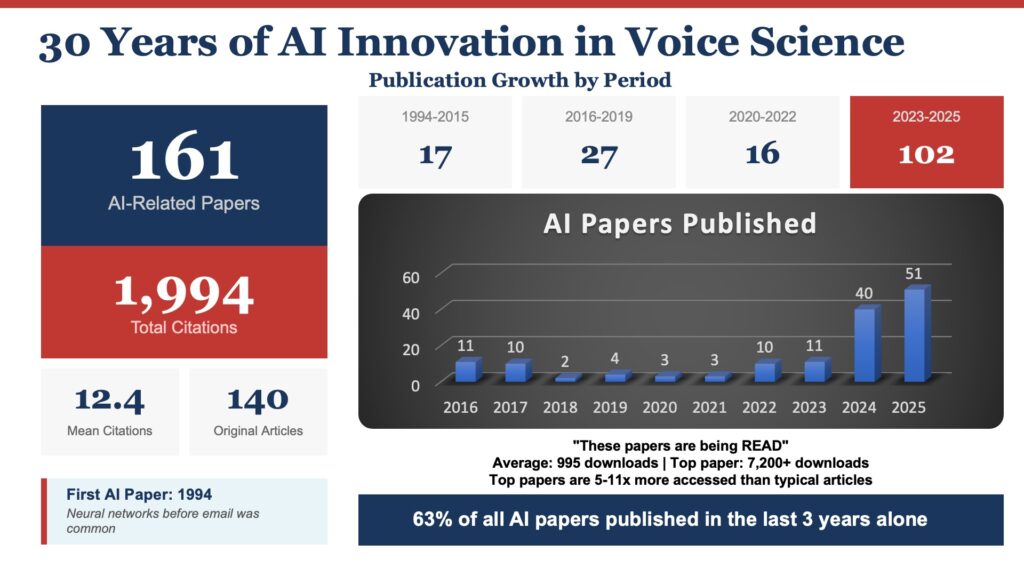
In 1994, the journal published a landmark paper by Rihkanen and colleagues titled "Spectral Pattern Recognition of Improved Voice Quality." Utilizing primitive neural networks to analyze voice parameters, this study proved that computational architecture could parse acoustic nuances long before standard email communication became ubiquitous.
Publication Timeline of AI Research in the Journal of Voice:
┌─────────────────┬──────────────────────────────────────────────┐
│ Years           │ Number of Published AI-Related Papers        │
├─────────────────┼──────────────────────────────────────────────┤
│ 1994 – 2015     │ 17 papers                                    │
│ 2016 – 2019     │ 27 papers                                    │
│ 2020 – 2022     │ 16 papers                                    │
│ 2023 – 2025     │ 102 papers                                   │
└─────────────────┴──────────────────────────────────────────────┘
The trajectory evolved steadily through the late 1990s and 2000s, gaining moderate momentum between 2016 and 2019 with 27 papers. However, the post-2020 era exhibits a hyper-exponential curve. The publication of 102 papers between 2023 and 2025—culminating in 51 papers in the year 2025 alone—surpasses the output of the journal’s entire first two decades combined. This explosion of scholarship signals that artificial intelligence has transitioned from a supplementary analytical tool into the primary engine driving modern voice research.
Supporting Context & Metrics: Beyond Citations to Real-World Clinical Impact
Academic metrics are frequently criticized for measuring prestige rather than utility. However, an analysis of the usage data surrounding AI research in the Journal of Voice paints a radically different picture: these articles are actively being downloaded, studied, and applied by frontline practitioners worldwide.
The average AI-focused paper published in the journal has garnered nearly 1,000 downloads. More impressively, breakout studies have achieved massive global reach. For instance, a seminal study investigating machine learning methodologies for COVID-19 detection via voice characteristics has been downloaded over 7,200 times—eleven times the median download rate for articles in its respective issue.
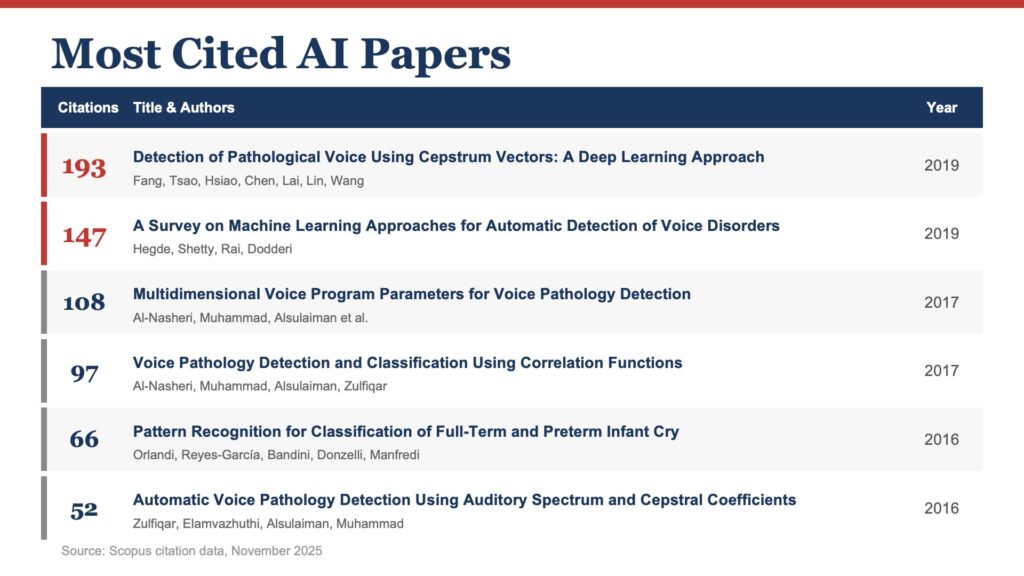
Similarly, the journal’s top-cited works demonstrate immense scholarly and practical resonance:
- Fang and colleagues’ 2019 deep learning study on pathological voice detection has amassed 193 citations and nearly 5,000 downloads.
- Hegde’s comprehensive survey on machine learning approaches for automatic voice disorder detection has secured 147 citations alongside matching download numbers.
Both papers consistently rank among the top three most-accessed articles in their respective publication issues. These staggering figures reflect a clear reality: clinicians, researchers, and speech-language pathologists are not merely nodding to academic theory; they are actively hunting for practical, data-driven tools to elevate patient care.
Landmark Research Shaping the Field
Deep Learning and Pathology Detection
The foundational work of Fang et al. (2019), titled "Detection of Pathological Voice Using Cepstrum Vectors: A Deep Learning Approach," shattered traditional diagnostic limitations. By demonstrating that deep neural networks could identify vocal pathologies with exceptional precision using acoustic features imperceptible to the human ear, the study opened new frontiers in early disease detection.
Subsequent breakthroughs built upon this framework. Researchers such as Al-Nasheri et al. (2017) explored multidimensional voice program parameters and correlation functions, while Chen and Chen (2022), Fujimura, and Cho and Choi advanced the architecture further by deploying one-dimensional convolutional neural networks and testing CNN models on complex laryngoscopic imagery.

Voice as a Digital Biomarker
Perhaps the most paradigm-shifting concept to emerge from recent literature is the conceptualization of the human voice as a digital biomarker—a non-invasive, continuous window into an individual’s systemic health.
Neurological health has proven particularly fertile ground for this methodology. Hemmerling and Wójcik-Pędziwiatr (2022) published transformative work predicting the severity of Parkinson’s disease directly from voice signals, capturing 29 citations in a brief three-year window. Furthermore, recent systematic reviews have explored voice quality variations as predictive digital biomarkers for major depressive disorder and bipolar disorder. The clinical implications are staggering: routine, passive voice analysis could soon screen for psychiatric shifts, facilitating early interventions and alleviating immense burdens on overstretched mental health infrastructures.
Conversational AI in Clinical Workflows
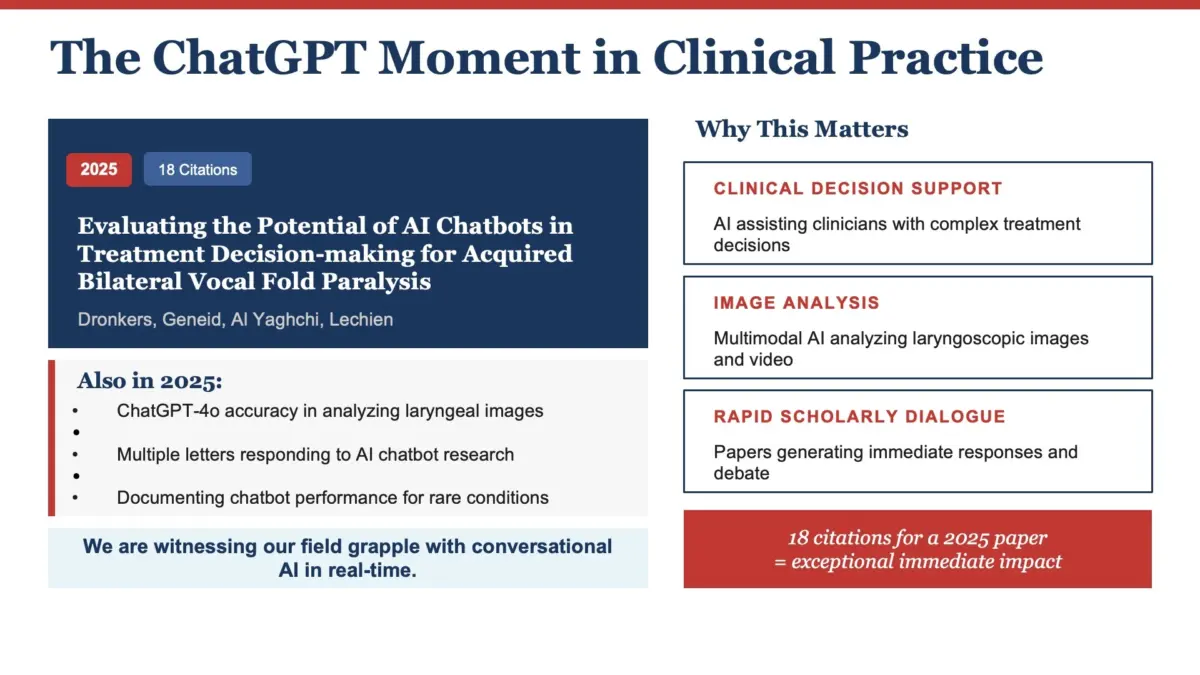
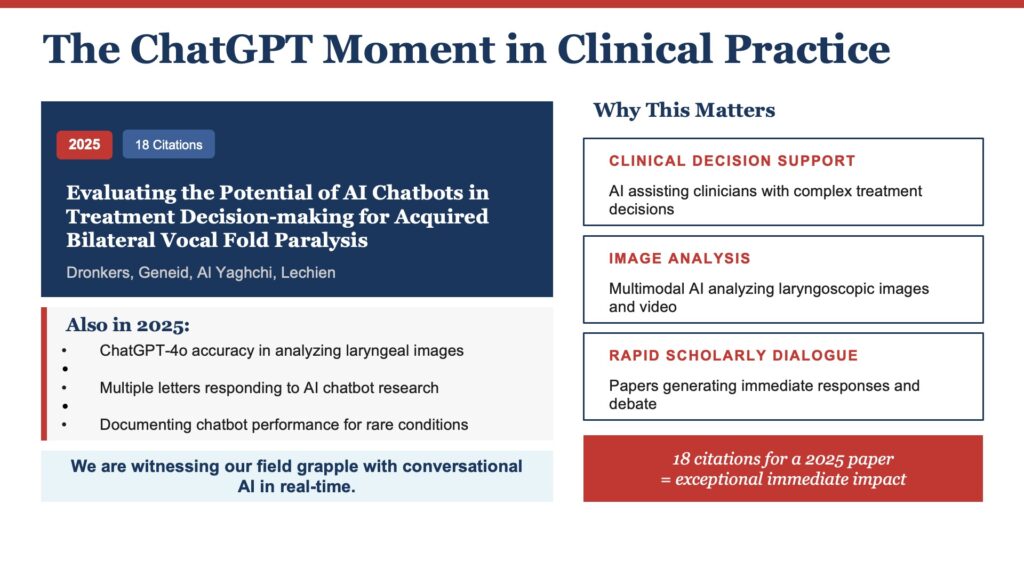
Entering the contemporary landscape, the Journal of Voice has begun evaluating the role of generative AI and chatbots in high-stakes clinical decision-making. A notable 2025 study by Dronkers and colleagues, "Evaluating the Potential of AI Chatbots in Treatment Decision-making for Acquired Bilateral Vocal Fold Paralysis," accumulated 18 rapid citations within months of publication—an extraordinary velocity for scholarly impact. This paper sparked robust academic discourse, including responsive letters and independent investigations into platforms like ChatGPT-4o’s accuracy in evaluating laryngeal images, signaling that the medical community is actively stress-testing conversational AI within real-world clinical environments.
Official Statements and Expert Perspectives
To fully grasp the socio-technical dimensions of this shift, one must examine the viewpoints of computational and institutional leaders currently steering the discipline.
Dr. Mark Berardi: Managing Complexity and Synthetic Communication
Dr. Mark Berardi, whose academic roots bridge physics, computation, and voice science, views artificial intelligence fundamentally as an instrument for managing complexity.
"Machine learning and AI are tools to help with complexity, and communication is incredibly complex in its neurobiological and physiological processes. So I think the application is warranted."
Dr. Berardi’s current research targets voice-based digital biomarkers for aging and depression. While acquiring speech signals has become frictionless, he notes that the true obstacle remains the inherent complexity of human communication itself—an obstacle where machine learning thrives. Regarding generative AI, Dr. Berardi offers a pragmatic assessment. While it has not yet overhauled foundational research paradigms, it successfully obliterates operational bottlenecks, allowing researchers to rapidly write and refine bespoke code using natural language prompts.
Most intriguingly, Dr. Berardi’s lab is investigating human-AI communication dynamics: how humans alter their vocal patterns when speaking to chatbots versus people, and how "synthetic" communication mediums (such as Zoom calls) alter interpersonal exchange.
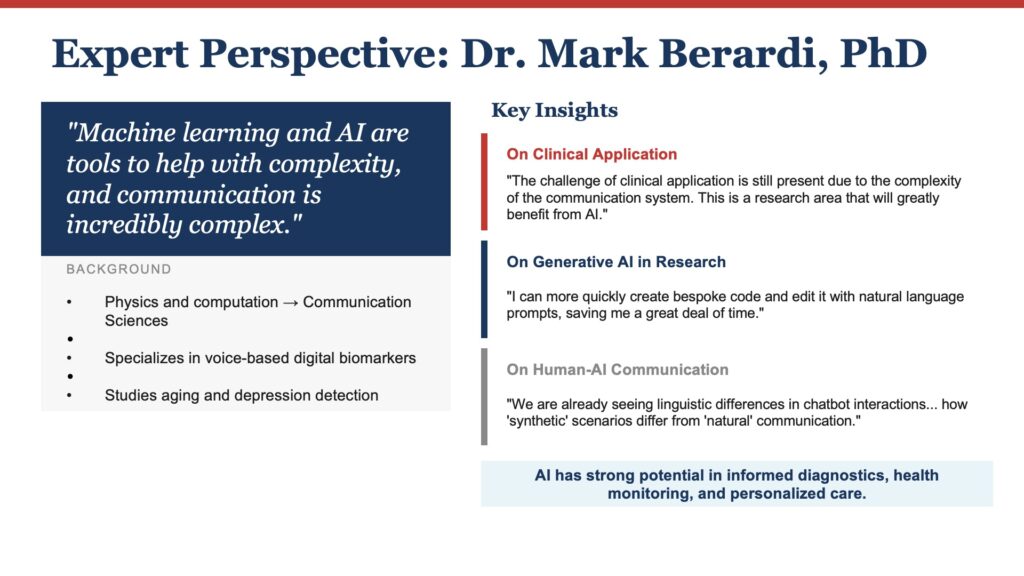
"We are already seeing linguistic differences in chatbot interactions," Dr. Berardi notes, suggesting that voice science must soon expand its purview to analyze human speech directed at machines.
Dr. Eric Hunter: Embracing Change with Ethical Clarity
Dr. Eric Hunter focuses heavily on the institutional and structural ramifications of widespread AI adoption in academia.
"These tools aren’t just novelties," Dr. Hunter observes. "They are rapidly becoming integrated into how we conduct literature reviews, organize data, extract themes from large bodies of text, and even summarize findings."
Dr. Hunter argues that large language models are permanently embedded within modern academic workflows, from manuscript drafting and peer review to collaborative data analysis. Rather than engaging in futile resistance, he issues an urgent call to action: the academic community must establish clear guidelines governing appropriate, transparent usage for both authors and reviewers.
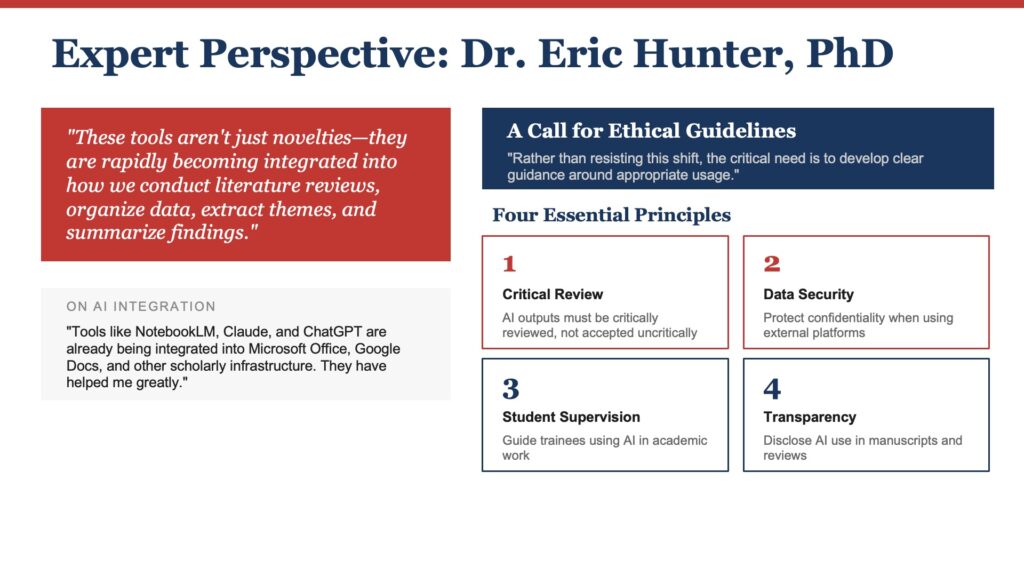
To achieve sustainable integration, Dr. Hunter outlines four foundational pillars for ethical AI utilization in academic publishing:
- Transparency: Full disclosure of any AI tools utilized during literature synthesis, data organization, or structural drafting.
- Human Accountability: Authors must retain absolute responsibility for the factual accuracy, intellectual integrity, and originality of their published findings.
- Intellectual Rigor: AI must serve to amplify—not substitute for—critical human analysis and expert clinical judgment.
- Equitable Access: Ensuring that computational tools and datasets remain accessible across international research communities, preventing digital divides.
"Our field will benefit most," Dr. Hunter concludes, "if we embrace the productivity these tools offer while also building a shared ethical framework for their responsible use."
A Global Research Community
This computational renaissance is propelled by a deeply collaborative, international network of scholars. Key contributors shaping the pages of the Journal of Voice include Jérôme René Lechien, Dimitar Deliyski, Stephanie Zacharias, Ahmed Yousef, Paavo Alku, Leonardo Wanderley Lopes, and Maryam Naghibolhosseini. Hailing from institutions spanning every inhabited continent, these researchers prove that the digital transformation of voice science is a unified, global endeavor.
Future Outlook: Navigating the Next Decade
As the Journal of Voice looks toward the future, the path forward requires deliberate, collective action across three distinct fronts:

- Thoughtful Engagement: Voice professionals must master AI tools to understand their analytical boundaries. These platforms are designed to amplify human expertise, not replace clinical judgment.
- Ethical Harmonization: The voice science community must actively collaborate to formulate standardized ethical guidelines, answering Dr. Hunter’s call for institutional frameworks that safeguard scientific integrity.
- Continued Scholarly Output: With over 160 papers serving as a baseline, researchers, clinicians, and educators must continue contributing innovative insights to ensure the collective knowledge base expands dynamically.
An Extraordinary Moment in Human History
The human voice has served as our primary instrument of connection, emotional resonance, and identity for hundreds of thousands of years. It carries the nuances of our physical health, our psychological states, and our deepest identities in ways no other physiological signal can replicate.
Now, for the first time in human history, we possess computational tools sophisticated enough to genuinely decode that complexity—translating what the voice reveals about our brains and bodies. These technologies promise to extend the reach of expert clinicians, catch pathological changes before they manifest as severe medical crises, and democratize access to advanced voice care across the globe.
We stand at an extraordinary inflection point. With institutions like The Voice Foundation and the Journal of Voice serving as anchors of excellence, the next decade of voice science promises discoveries that will forever change how we listen to, understand, and heal the human voice.
About the Author
Ian DeNolfo is Executive Director of The Voice Foundation, which publishes the Journal of Voice. A graduate of The Juilliard School and The Curtis Institute of Music, he formerly performed as a leading tenor at major opera houses worldwide before transitioning his career toward arts administration, institutional leadership, and voice science.