Voice science stands at a profound evolutionary juncture. For centuries, the human voice has served as our most intimate instrument of connection, emotional expression, and personal identity. Yet, decoding the physiological, neurological, and acoustic complexities of vocal production has long pushed human analytical capabilities to their limits. Today, artificial intelligence (AI) and machine learning (ML) are fundamentally reshaping how researchers conduct investigations, analyze complex datasets, and care for patients.
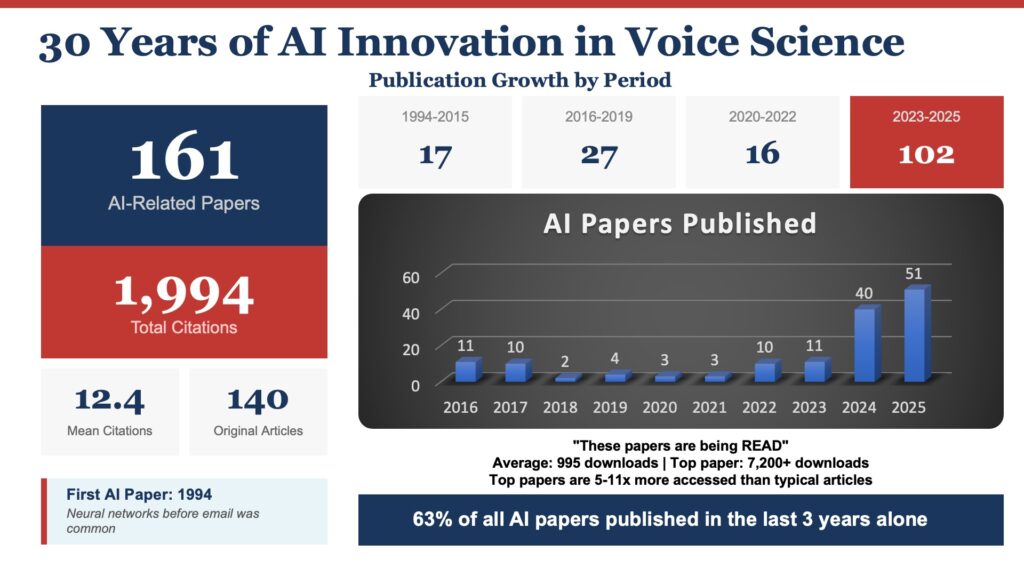
At the center of this transformation is The Voice Foundation and its premier peer-reviewed publication, the Journal of Voice. While mainstream academic publishing is only recently grappling with the explosive rise of generative AI and machine learning, voice science has quietly pioneered computational approaches for over three decades. An analysis of publishing data reveals an extraordinary acceleration: of the 161 AI-related papers published in the Journal of Voice since its first machine learning study in 1994, a staggering 63% (102 papers) have been published in just the last three years (2023–2025).
This article explores the historical trajectory of AI in voice science, examines the breakthrough research turning the voice into a digital biomarker for systemic health, highlights the integration of conversational AI into clinical practice, and outlines the urgent need for a shared ethical framework as the field races toward a digitally augmented future.
Detailed Chronology: Three Decades of AI Innovation in Voice Science
The integration of artificial intelligence into voice research did not begin with the current generative AI boom. Long before the popularization of large language models or the widespread adoption of everyday internet tools, forward-thinking voice scientists recognized that computational neural networks held the key to unlocking vocal complexities imperceptible to the human ear.
The Pioneering Era (1994–2015)
The foundational chapter of AI in voice science opened in 1994, the exact same year the World Wide Web entered public consciousness. The Journal of Voice published a landmark paper by Rihkanen and colleagues titled "Spectral Pattern Recognition of Improved Voice Quality." Utilizing rudimentary neural networks to analyze voice characteristics, this study proved that computational systems could evaluate acoustic properties with a level of granularity previously thought impossible.
Despite this early breakthrough, growth during the first two decades was measured. Between 1994 and 2015, just 17 AI-related papers appeared in the journal. Researchers were laying the groundwork, testing the viability of neural networks, and validating early models against clinical observations.
The Acceleration and Exponential Leap (2016–2025)
As computational power expanded and machine learning architectures matured, the pace of publication quickened:
2016–2019: 27 papers exploring more advanced algorithms and preliminary deep learning frameworks.
2020–2022: 16 papers navigating the challenges and opportunities presented during the global pandemic, including pioneering work on automated respiratory health detection.
2023–2025: An unprecedented explosion of 102 papers, culminating in 51 AI-related papers published in 2025 alone—surpassing the output of the journal’s entire first twenty years combined.
This meteoric rise reflects a paradigm shift. AI is no longer a peripheral novelty or a speculative sub-discipline; it has become central to the methodology of modern otolaryngology, speech-language pathology, and computational voice science.
Supporting Context & Metrics: Real-World Impact and Landmark Research
The explosion of literature in the Journal of Voice is matched by its real-world utility. These studies are not merely sitting quietly in digital archives; they are being actively downloaded, cited, and applied by clinicians, researchers, and therapists across the globe.
Unprecedented Engagement Metrics
High Download Rates: The average AI-related paper in the Journal of Voice commands nearly 1,000 downloads.
The COVID-19 Benchmark: The single most-accessed AI paper—a study investigating machine learning models for COVID-19 detection—has amassed over 7,200 downloads, representing roughly eleven times the median readership for articles in its issue.
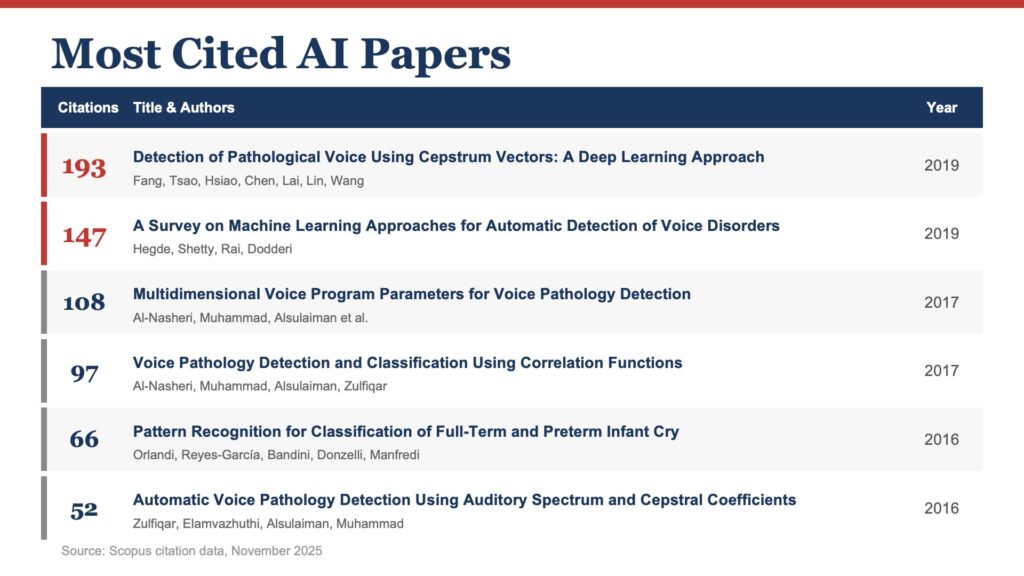
Top Citations: The journal’s most-cited works underscore a deep hunger for diagnostic tools. Fang and colleagues’ 2019 deep learning study has accumulated 193 citations, while Hegde’s comprehensive machine learning survey stands at 147 citations. Both papers approached nearly 5,000 downloads each, cementing their status as essential reading for anyone entering the field.
Landmark Research Reshaping Clinical Frontiers
1. Deep Learning for Voice Pathology Detection
Fang and colleagues’ 2019 study, "Detection of Pathological Voice Using Cepstrum Vectors: A Deep Learning Approach," demonstrated that deep neural networks could identify vocal pathologies with remarkable accuracy by analyzing acoustic features invisible to the human ear. This paved the way for subsequent innovations, such as Chen and Chen’s work on voice classification via deep neural networks, Fujimura’s utilization of one-dimensional convolutional neural networks, and Cho and Choi’s comparative analyses of CNN models applied to laryngoscopic images.
2. The Voice as a Digital Biomarker
Perhaps the most profound philosophical and clinical shift in recent years is the conceptualization of the human voice as a digital biomarker—a non-invasive, highly accessible window into systemic health.
Neurological Disorders: Groundbreaking research spearheaded by scholars like Hemmerling and Wójcik-Pędziwiatr (2022) has demonstrated how voice signal analysis can predict the severity of Parkinson’s disease, garnering significant academic attention and moving steadily toward point-of-care clinical applications.
Mental Health: Recent systematic reviews highlight how vocal quality fluctuations can serve as digital biomarkers for depression and bipolar disorder. The clinical implications are immense: routine voice analysis could soon allow for the early detection of mental health shifts, reducing the crushing burdens currently placed on healthcare systems.
3. AI Chatbots in Clinical Decision-Making
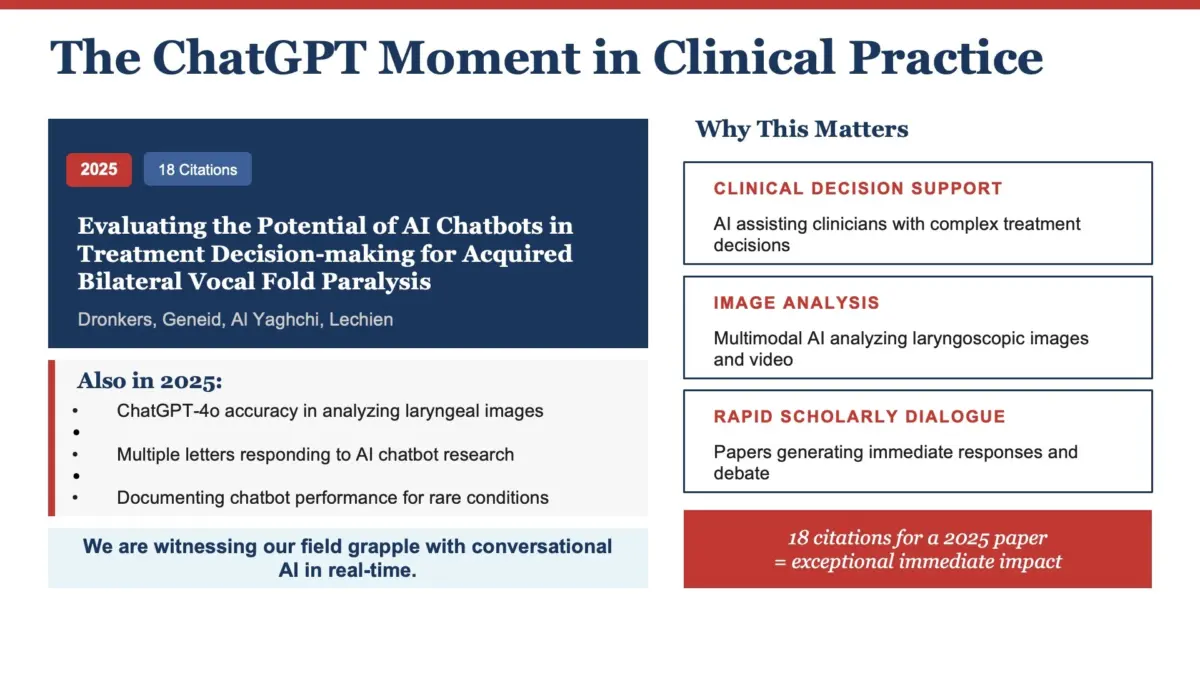
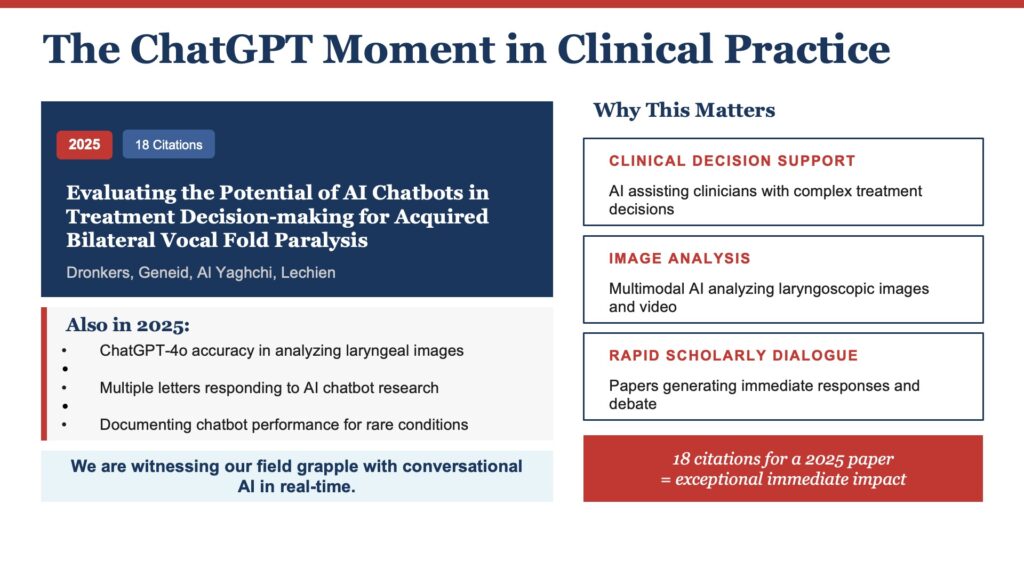
The year 2025 marked a new frontier with the publication of research examining conversational AI in medical environments. Dronkers and colleagues’ paper, "Evaluating the Potential of AI Chatbots in Treatment Decision-making for Acquired Bilateral Vocal Fold Paralysis," captured immediate scholarly impact with 18 citations in its debut year. Follow-up studies, letters to the editor, and evaluations of platforms like ChatGPT-4o in analyzing laryngeal imagery signal that the medical community is actively—and critically—interrogating the role of conversational agents in patient care.
Official Statements and Expert Perspectives
To understand the human and institutional dimensions of this technological wave, one must look to the leaders guiding The Voice Foundation and its research ecosystem.
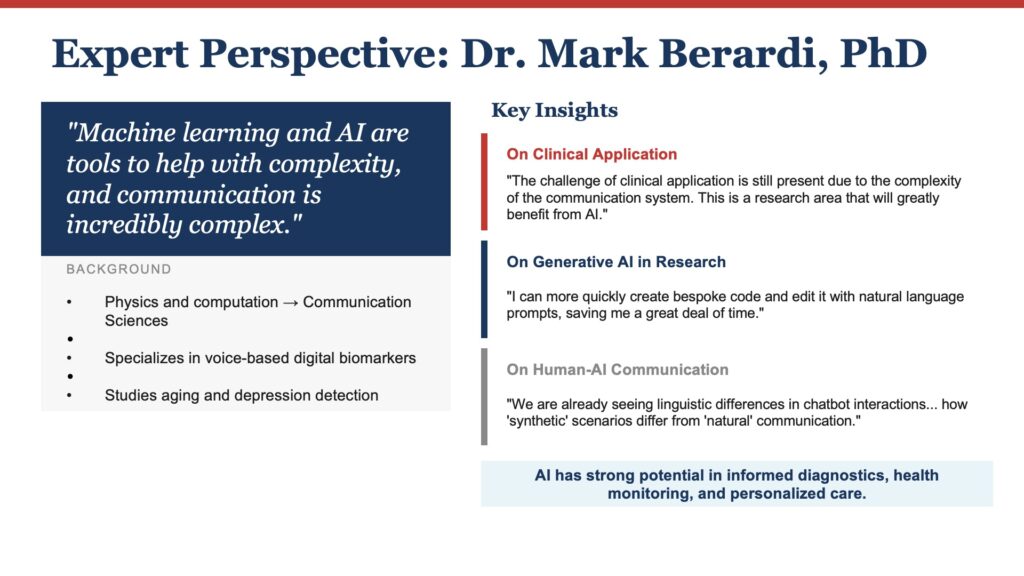
Dr. Mark Berardi: Managing Complexity and Synthetic Communication
Dr. Mark Berardi, bridging a background in physics and computation with voice science, views artificial intelligence fundamentally as a mechanism for managing complexity.
"Machine learning and AI are tools to help with complexity, and communication is incredibly complex in its neurobiological and physiological processes. So I think the application is warranted," Dr. Berardi notes.
While he acknowledges that generative AI has not yet completely revolutionized raw research discovery, he emphasizes its immediate value in eliminating operational bottlenecks—particularly in custom code generation and natural-language-driven data processing. Moreover, Dr. Berardi’s current work investigates an intriguing downstream effect of our technological age: human-AI communication. As humans adapt their speech patterns when interacting with digital assistants, synthetic environments, and video conferencing software, the field faces the unique challenge of studying human conversational behavior not just with other humans, but directly with machines.
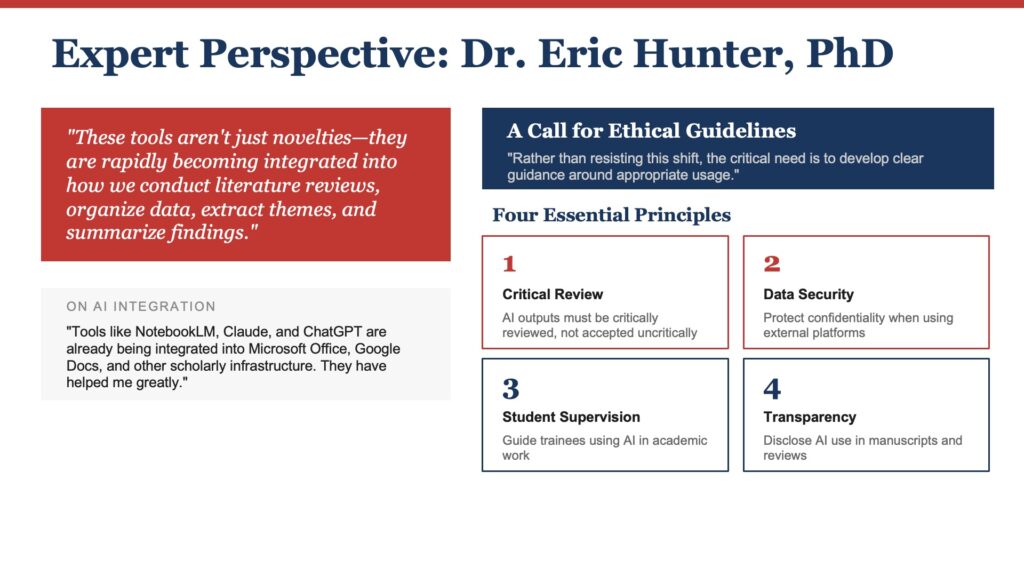
Dr. Eric Hunter: Embracing Technological Change with Ethical Clarity
Dr. Eric Hunter focuses heavily on the institutional integration of AI within scholarly and academic workflows.
"These tools aren’t just novelties," Dr. Hunter observes. "They are rapidly becoming integrated into how we conduct literature reviews, organize data, extract themes from large bodies of text, and even summarize findings."
With tools like large language models embedded seamlessly into Microsoft Office, Google Docs, and academic publishing ecosystems, Dr. Hunter issues a vital call to action. Rather than engaging in futile resistance, the academic community must proactively establish clear usage guidelines for authors and reviewers alike. He advocates for a balanced approach that maximizes the productivity enhancements of AI while preserving rigorous academic integrity and human intellectual ownership.
A Global Collaborative Network
This digital revolution is propelled by a vast, interconnected international community. Leading contributors to the Journal of Voice—such as Jérôme René Lechien, Dimitar Deliyski, Stephanie Zacharias, Ahmed Yousef, Paavo Alku, Leonardo Wanderley Lopes, and Maryam Naghibolhosseini—alongside dozens of research laboratories across every inhabited continent, demonstrate that the advancement of AI in voice science is a truly global enterprise united by a shared mission.
Future Outlook: Navigating the Path Forward
As the Journal of Voice looks toward the next decade under the legacy established by Dr. Wilbur James Gould in 1969 and sustained by Dr. Robert Thayer Sataloff since 1989, the path forward is marked by both immense promise and distinct operational challenges. Ian DeNolfo, Executive Director of The Voice Foundation, emphasizes that the scientific community must navigate this inflection point with intention and unity.
Three core imperatives define the road ahead:
Thoughtful Engagement: Researchers and clinicians must treat AI systems as amplifiers of human expertise rather than replacements for clinical judgment. Understanding both the powerful capabilities and the inherent limitations of algorithms is paramount.
Collective Ethical Frameworks: Developing robust ethical guidelines for AI-assisted research, manuscript generation, and data analysis cannot be achieved by isolated institutions. It requires a collaborative, community-wide consensus.
Continuous Knowledge Sharing: The 161 published AI papers represent only the opening chapter. Continued publishing, cross-disciplinary dialogue, and open scientific exchange will ensure that discoveries in computational voice science directly benefit patients in clinics and performers on stages worldwide.
Conclusion: An Extraordinary Moment
For hundreds of millennia, the human voice has carried our joys, our sorrows, our health, and our deepest identities in ways no other biological signal can replicate. Today, for the first time in human history, we possess analytical instruments sophisticated enough to truly decode that complexity.
By bridging the gap between art and science, clinic and stage, The Voice Foundation and the Journal of Voice stand firmly at the epicenter of this renaissance. The coming decade promises discoveries that will extend the reach of expert clinicians, catch subtle pathologies before they manifest as critical illnesses, and democratize access to advanced voice care across the globe. The sonic horizon is expanding, and the future of voice science has only just begun.
About the Author: Ian DeNolfo is Executive Director of The Voice Foundation, publisher of the Journal of Voice. A graduate of The Juilliard School and The Curtis Institute of Music, he formerly performed as a leading tenor at opera houses worldwide before transitioning to arts administration and scientific leadership at The Voice Foundation.