
Executive Overview
Voice science stands at a monumental, irreversible inflection point. For over half a century, the medical, scientific, and artistic communities have strived to decode the infinitely complex mechanisms of the human voice—an acoustic fingerprint that mirrors our emotional states, physiological health, and innermost identities. Today, that centuries-old quest is undergoing a paradigm shift driven by artificial intelligence (AI) and machine learning (ML). Far from a passing technological trend, the integration of computational algorithms into voice science is fundamentally transforming how researchers conduct investigations, how clinicians analyze pathological data, and how patients receive holistic care.
At the epicenter of this transformation is The Voice Foundation and its premier peer-reviewed publication, the Journal of Voice. Long before generative AI dominated public discourse, the Foundation’s flagship journal was quietly laying the groundwork for computational voice analysis. In 1994, the journal published pioneering research exploring neural networks for voice quality recognition—an era when the World Wide Web was in its infancy and email was still a novelty to the general public.
Fast forward to the present day, and this academic trajectory has evolved from a trickle of experimental papers into an exponential wave. In the past three years alone, the Journal of Voice has published over 100 AI-related studies, culminating in a record-breaking output in 2025. This deep dive explores the historical evolution, clinical breakthroughs, digital biomarker applications, ethical frameworks, and future roadmap of artificial intelligence in voice science.
Detailed Chronology: Three Decades of AI in Voice Science
The integration of artificial intelligence into voice research did not happen overnight; it is the culmination of more than thirty years of methodical, interdisciplinary inquiry.

The Genesis: 1994–2015
In 1994, Rihkanen and colleagues published a landmark paper titled "Spectral Pattern Recognition of Improved Voice Quality" in the Journal of Voice. Utilizing rudimentary neural networks to analyze acoustic patterns, this study demonstrated that computational models could identify subtle voice improvements that human ears might miss. However, for the next two decades, computational voice analysis remained confined to specialized engineering labs and theoretical physics departments. Between 1994 and 2015, only 17 papers touching upon machine learning or neural networks were published in the journal. The computing power, data storage, and algorithmic sophistication required to process the immense complexity of human speech simply were not yet universally accessible.
The Acceleration Phase: 2016–2022
As computational power surged and deep learning architectures matured, the pace of publication began to quicken. Between 2016 and 2019, 27 AI-focused papers found their way into the Journal of Voice, establishing foundational methodologies for automated voice pathology detection. Even during the global disruptions of 2020–2022, the field maintained steady momentum with 16 publications, pivoting in many instances toward remote diagnostics and telemedicine applications necessitated by the COVID-19 pandemic.
The Exponential Explosion: 2023–2025
The true inflection point arrived post-2023. Propelled by the explosion of generative AI, large language models (LLMs), and advanced convolutional neural networks (CNNs), researchers flooded the Journal of Voice with unprecedented volumes of high-caliber data.
Of the 161 AI-related papers published in the journal’s history up to the close of 2025, an astonishing 102 papers—63 percent—were published in the final three years. The publication timeline paints a dramatic picture of exponential growth:
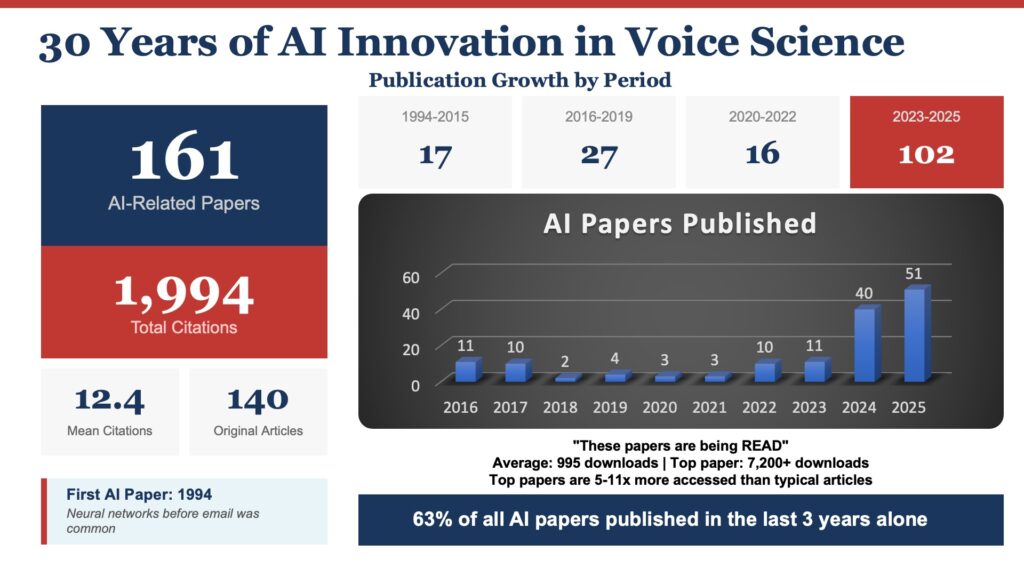
- 1994–2015: 17 papers
- 2016–2019: 27 papers
- 2020–2022: 16 papers
- 2023–2025: 102 papers
In the single year of 2025, the journal published 51 AI-related papers—surpassing the total output of the first twenty years combined. This is not gradual academic growth; it is an exponential transformation that is permanently redefining the boundaries of otolaryngology, speech-language pathology, and computational science.
Supporting Context & Metrics: Global Impact and Readership
The numerical explosion of academic literature is only half the story. The true measure of this technological pivot lies in its real-world consumption, citation velocity, and clinical utility.
Global Readership and High-Impact Citations
Research published in the Journal of Voice is not idling in academic silos; it is actively shaping clinical practice worldwide. The average AI-related paper published in the journal boasts nearly 1,000 downloads, reflecting immense global interest from clinicians, biomedical engineers, and speech-language pathologists.
Several landmark studies have achieved extraordinary reach:
- Machine Learning for COVID-19 Detection: The most-accessed AI paper in the journal’s history—focusing on machine learning applications for identifying COVID-19 through acoustic characteristics—has surpassed 7,200 downloads, scoring eleven times the median for articles in its respective issue.
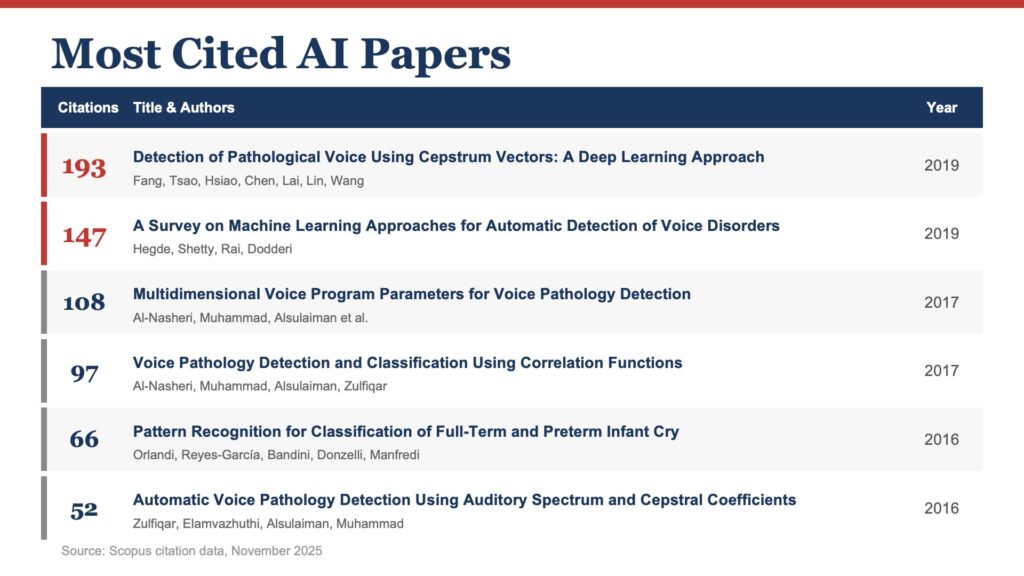
- Deep Learning for Pathology (Fang et al., 2019): Titled "Detection of Pathological Voice Using Cepstrum Vectors: A Deep Learning Approach," this work stands as the most-cited AI paper in the journal’s history with 193 citations and nearly 5,000 downloads. It proved conclusively that deep neural networks could isolate vocal pathologies using acoustic features imperceptible to the human ear.
- Comprehensive Machine Learning Surveys (Hegde et al.): Mapping the theoretical and practical landscape of automated voice disorder detection, this paper has garnered 147 citations and nearly 5,000 downloads, serving as mandatory reading for new entrants to the field.
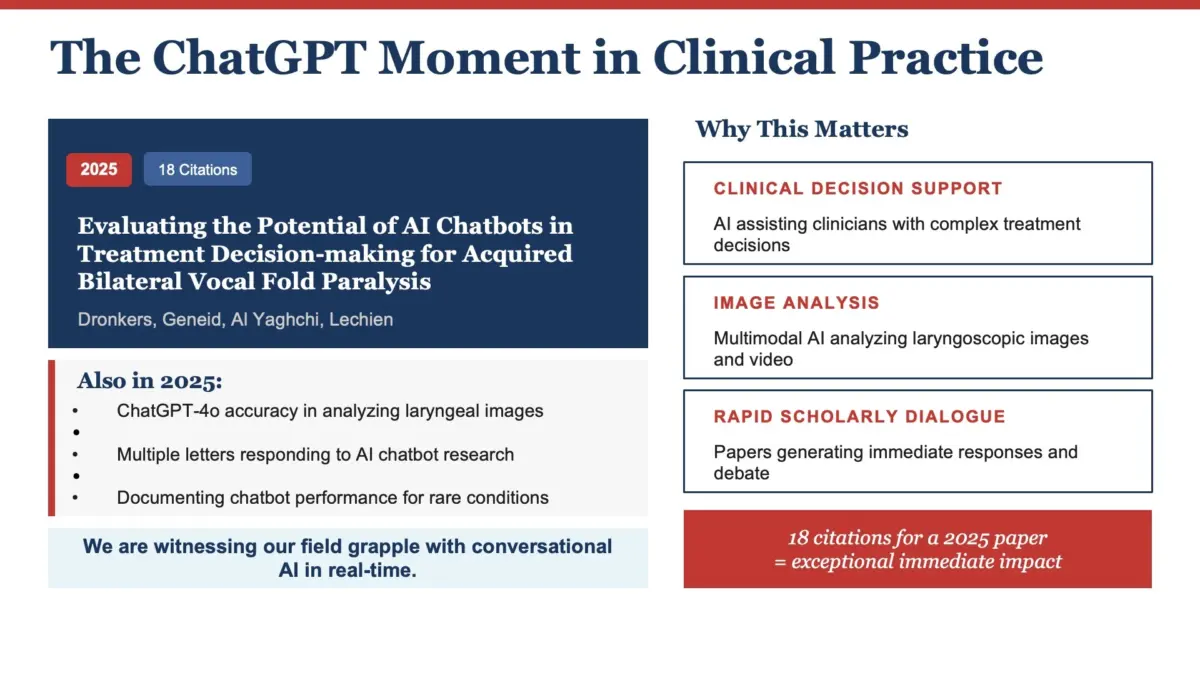
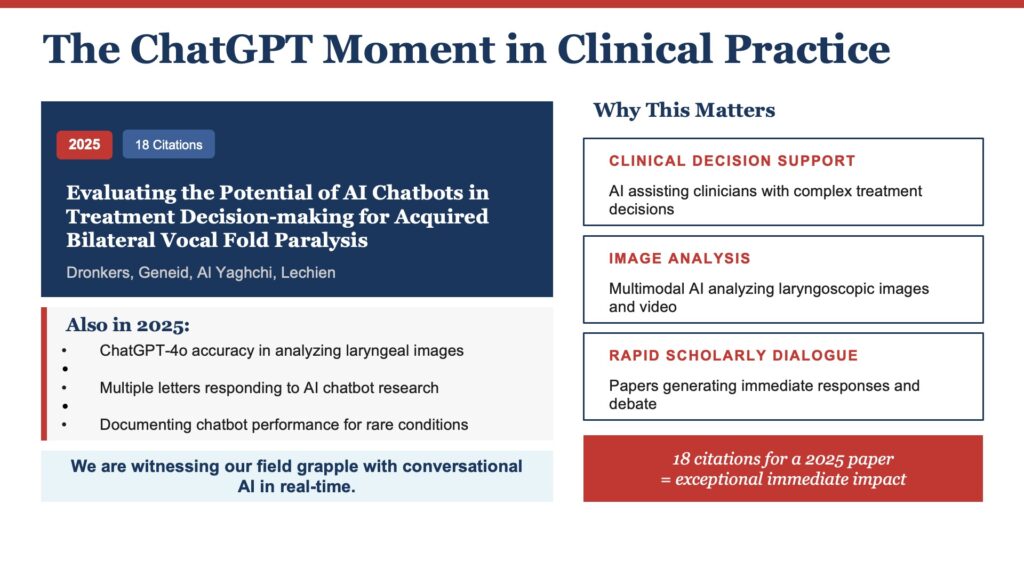
- Clinical Chatbots (Dronkers et al., 2025): Examining the viability of AI chatbots in treatment decision-making for acquired bilateral vocal fold paralysis, this 2025 paper quickly accumulated 18 citations alongside multiple letters to the editor, demonstrating immediate real-world scholarly and clinical impact.
A Global Research Community
This computational renaissance is driven by a truly international network of researchers. Leading contributors such as Jérôme René Lechien, Dimitar Deliyski, Stephanie Zacharias, Ahmed Yousef, Paavo Alku, Leonardo Wanderley Lopes, and Maryam Naghibolhosseini—alongside dozens of multidisciplinary teams spanning every populated continent—are bridging the gap between computer science and vocal medicine.
Official Statements & Expert Perspectives
To understand the human and institutional dimensions of this technological shift, one must look to the leaders who have guided both the historical development of voice science and its current computational evolution.
Dr. Robert Thayer Sataloff: Five Decades of Interdisciplinary Bridge-Building
Founded in New York City in 1969 by Dr. Wilbur James Gould—who brought together physicians, scientists, speech-language pathologists, performers, and teachers—The Voice Foundation has long championed interdisciplinary care. Since 1989, the Foundation has been guided by Dr. Robert Thayer Sataloff, an internationally renowned otolaryngologist, professional singer, conductor, and author of over 1,200 publications (including 79 textbooks). Under Dr. Sataloff’s visionary leadership from Philadelphia, the Foundation has cemented the Journal of Voice as the undisputed premier peer-reviewed journal dedicated to voice science, steadily preparing the groundwork for the exact technological revolution we are witnessing today.
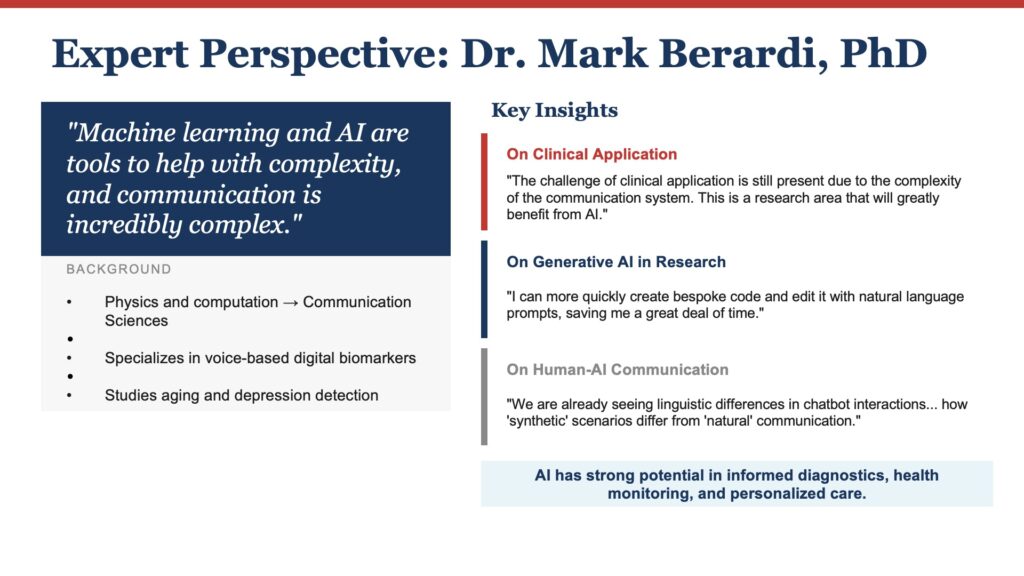
Dr. Mark Berardi: Managing Complexity and Synthetic Conversation
Dr. Mark Berardi, whose academic roots bridge physics and computation, views artificial intelligence fundamentally as a master tool for managing complexity.

"Machine learning and AI are tools to help with complexity, and communication is incredibly complex in its neurobiological and physiological processes. So I think the application is warranted," Dr. Berardi notes.
Dr. Berardi’s current research targets voice-based digital biomarkers for aging and depression. While acquiring speech signals has become remarkably frictionless, he emphasizes that the underlying challenge remains the sheer intricacy of the human communication system—a domain where machine learning algorithms excel.
Regarding generative AI, Dr. Berardi offers a pragmatic, nuanced perspective. While generative models have not yet single-handedly rewritten fundamental research paradigms, they have successfully dismantled persistent operational bottlenecks, particularly in data processing and bespoke code creation using natural language prompts.
Intriguingly, Dr. Berardi’s lab is also investigating human-AI communication itself. By studying how humans adjust their linguistic patterns when conversing with chatbots versus real people—and how "synthetic" communication environments like video calls warp natural discourse—his research suggests that voice science must soon expand to decode human speech not only in isolation, but in continuous interaction with machines.
Dr. Eric Hunter: Institutional Integration and Ethical Clarity
Dr. Eric Hunter highlights the inescapable reality of institutional AI adoption. These tools, he argues, are no longer novelties; they are rapidly becoming woven into the fabric of scholarly infrastructure—managing literature reviews, organizing data sets, extracting qualitative themes, and streamlining manuscript workflows through platforms like NotebookLM, Claude, and ChatGPT.
Rather than resisting this tidal wave, Dr. Hunter issues an urgent call to action for the scientific community: establish clear, proactive ethical guidance for authors, reviewers, and researchers. He champions four foundational principles to govern academic AI use:
- Transparency: Openly disclosing where and how AI tools were utilized in data curation, analysis, or drafting.
- Accountability: Maintaining human responsibility for the scientific accuracy, validity, and integrity of published findings.
- Data Privacy: Safeguarding sensitive patient health information and voice biometric data against unauthorized model training.
- Editorial Integrity: Ensuring peer-review processes remain grounded in rigorous human expertise rather than automated rubber-stamping.
"Our field will benefit most," Dr. Hunter concludes, "if we embrace the productivity these tools offer while also building a shared ethical framework for their responsible use."
Future Outlook: The Next Frontier in Voice Science
As we look toward the horizon, the applications of artificial intelligence in voice science extend far beyond diagnostic assistance. The field is rapidly maturing across three primary frontiers:
1. Voice as a Digital Biomarker for Systemic Health
Perhaps the most profound paradigm shift is the recognition of the human voice as a non-invasive, continuous digital biomarker for systemic health.
- Neurological Disorders: Recent breakthroughs, including Hemmerling and Wójcik-Pędziwiatr’s 2022 research on predicting Parkinson’s disease severity from acoustic signals, demonstrate that algorithms can detect microscopic motor tremors and vocal degradation long before clinical presentation.
- Mental Health: Systematic reviews exploring voice quality as a digital biomarker for depression and bipolar disorder open up staggering possibilities. Routine voice screening could soon enable early mental health interventions, easing the burden on overstretched healthcare infrastructure.
- Respiratory Sentinel Systems: Machine learning models analyzing respiratory sounds and voice features offer early warning systems for pulmonary conditions, cementing the voice as an all-encompassing indicator of bodily well-being.
2. Clinical Decision-Support and Conversational AI
The integration of generative models and clinical chatbots into diagnostic workflows is redefining medical decision-making. As papers evaluating AI chatbots in complex treatments (such as vocal fold paralysis) accumulate citations and spark rigorous debate, the medical community is actively establishing boundaries between assistive AI and autonomous clinical judgement.
3. Preserving Scientific Integrity and Expanding Access
Moving forward, the Journal of Voice and The Voice Foundation remain dedicated to balancing technological innovation with uncompromising scientific rigor. As Executive Director Ian DeNolfo notes, the human voice remains our most intimate instrument of connection, emotion, and identity. Armed with computational tools capable of decoding its hidden complexities, clinicians can extend their reach, detect pathologies at their earliest and most treatable stages, and democratize access to advanced voice care across the globe.
The sonoric singularity is here. By embracing computational power while fiercely guarding our ethical frameworks, the global voice science community stands ready to unlock the next decade of unprecedented medical and artistic discovery.