By Ian DeNolfo, Executive Director, The Voice Foundation With reporting and analysis on the evolution of artificial intelligence in voice medicine, pathology detection, and digital biomarkers.
Executive Overview
Today, we stand at a definitive and historic inflection point in voice science. We are navigating a transformative moment where artificial intelligence (AI) and machine learning (ML) are not merely supplementing research—they are fundamentally reshaping how we conduct complex investigations, analyze multi-dimensional biomedical data, and provide proactive, precise care to patients worldwide.
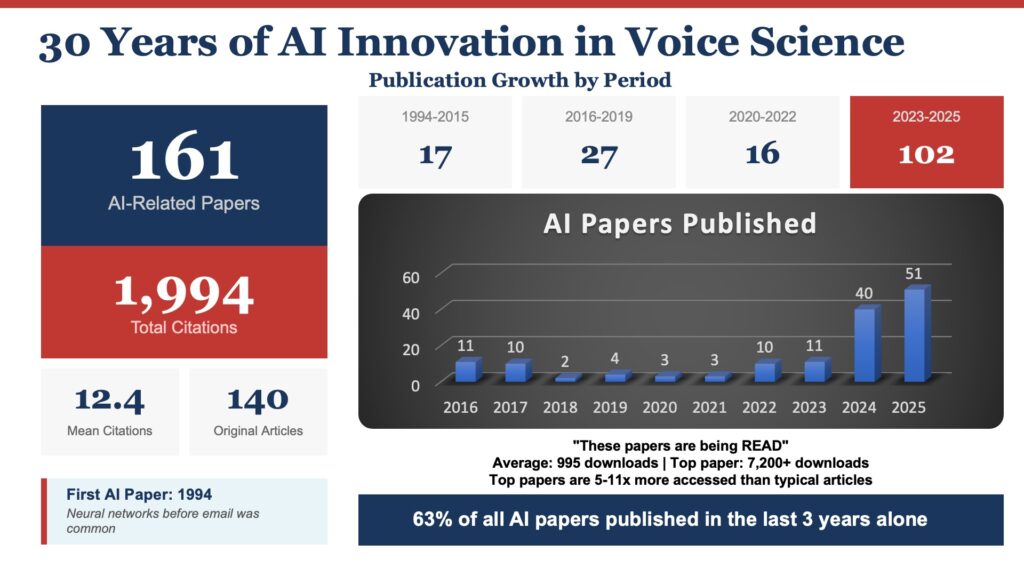
This digital renaissance in voice science builds upon a rich, five-decade legacy of interdisciplinary collaboration. Yet, the current acceleration of artificial intelligence has moved beyond gradual evolution into exponential transformation. A staggering 63% of all AI-related papers published in the Journal of Voice over the past three decades have appeared in just the last three years (2023–2025). In 2025 alone, the journal published 51 artificial intelligence papers—surpassing the total output of the field’s first twenty years combined.
From detecting hidden laryngeal pathologies using deep neural networks to pioneering the use of the human voice as a non-invasive digital biomarker for systemic diseases like Parkinson’s, depression, and respiratory conditions, the landscape of otolaryngology and speech-language pathology has fundamentally changed. As we look ahead, the imperative for our global community is clear: we must embrace the profound computational power of these tools while establishing rigorous, ethical frameworks that safeguard clinical judgment and scientific integrity.
A Legacy of Innovation: Bridging Art, Science, and Medicine
To understand the magnitude of today’s technological leap, one must first look back at the institutional foundations that made this interdisciplinary progress possible.
In 1969, Dr. Wilbur James Gould founded The Voice Foundation in New York City. At a time when comprehensive, interdisciplinary care for the human voice was virtually non-existent, Dr. Gould possessed the visionary foresight to bring together groups of professionals who historically operated in professional silos: physicians, vocal scientists, speech-language pathologists, performing artists, and master voice teachers. His goal was simple yet revolutionary—to create a unified platform to share knowledge and optimize the care of the professional voice user.
Just a few years later, in 1972, the Foundation hosted its inaugural Annual Symposium: Care of the Professional Voice, swiftly followed by its first Gala (later named Voices of Summer) in 1973. For over fifty years, these gatherings have served as vital bridges connecting the rigorous demands of medical science with the emotive art of the stage.
Since 1989, The Voice Foundation has been under the visionary leadership of Dr. Robert Thayer Sataloff, an internationally renowned otolaryngologist, master clinician, professional singer, and conductor. Dr. Sataloff’s prolific contributions to medicine include authoring more than 1,200 publications and 79 textbooks. Under his guidance, the Foundation relocated its headquarters to Philadelphia, expanding its global footprint, elevating interdisciplinary scientific inquiry, and cementing its status as the premier hub for voice education.
Today, the Foundation’s annual Philadelphia Symposium draws hundreds of elite medical doctors, scientists, academics, speech-language pathologists, and performing artists from across the globe. Alongside this thriving academic ecosystem, the Foundation publishes the Journal of Voice—the undisputed premier peer-reviewed journal dedicated exclusively to voice science, medicine, and clinical care.
Thirty Years of AI Research: A Silent Revolution
While mainstream media treats artificial intelligence as a recent phenomenon born of the mid-2010s deep learning boom, the Journal of Voice has been publishing pioneering AI and neural network research for over three decades.
In 1994—thirty-one years ago—the journal published a landmark paper by Rihkanen and colleagues entitled "Spectral Pattern Recognition of Improved Voice Quality." Utilizing nascent artificial neural networks to analyze acoustic voice patterns, this study was published during the exact same year the World Wide Web was emerging into public consciousness. Long before most academics had ever sent a professional email, voice scientists were already employing machine learning algorithms to decode acoustic data.
The Exponential Timeline of AI Publication
For many years, computational voice research progressed steadily, albeit in specialized pockets. However, the publication timeline over the last decade tells a dramatic story of exponential acceleration:
1994–2015: 17 papers
2016–2019: 27 papers
2020–2022: 16 papers
2023–2025: 102 papers (accounting for 63% of the 31-year total)
In the single year of 2025, the Journal of Voice published 51 AI-related articles. This represents an unprecedented paradigm shift, moving the field from theoretical computational modeling into high-frequency, clinical application.
Beyond Citations: Real-World Clinical Impact
Academic metrics are often confined to citation counts, but the true value of the AI research published in the Journal of Voice is measured by its active, real-world utility among clinicians, speech-language pathologists, and researchers on the front lines of patient care.
Usage statistics for these digital publications reveal extraordinary global reach:
The average AI paper in the journal has been downloaded nearly 1,000 times.
The most-accessed AI paper—a pioneering study examining machine learning applications for COVID-19 detection—has surpassed 7,200 downloads, representing eleven times the median readership for standard articles in that issue.
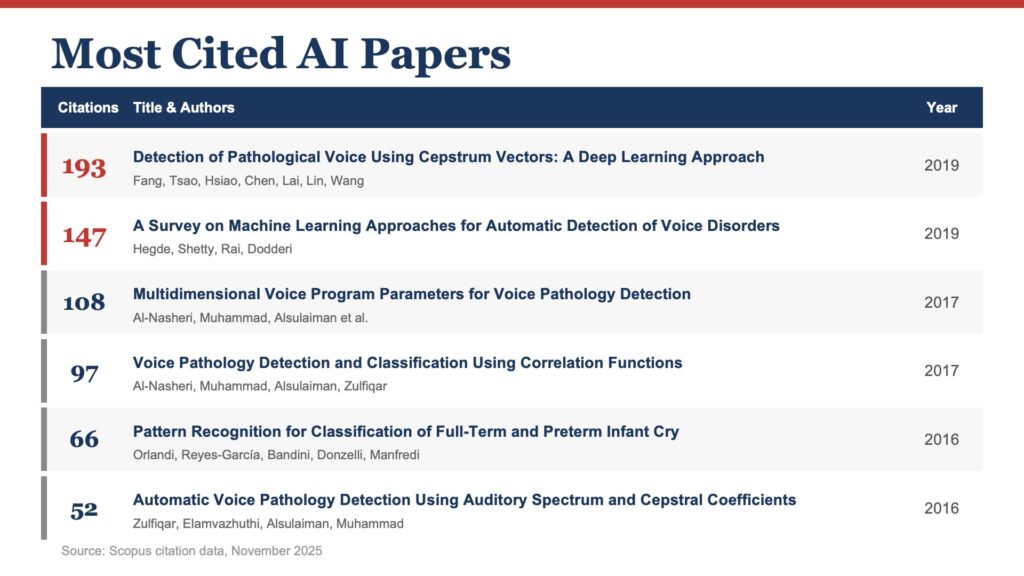
The two most-cited works—Fang and colleagues’ deep learning study (193 citations) and Hegde’s comprehensive machine learning survey (147 citations)—have each been downloaded nearly 5,000 times.
These figures demonstrate that clinicians are actively seeking practical, technology-driven tools to enhance diagnostic accuracy, streamline workflows, and improve therapeutic outcomes for patients experiencing vocal pathology.
Landmark Research Reshaping the Field
Deep Learning for Voice Pathology Detection
In 2019, Fang and colleagues published "Detection of Pathological Voice Using Cepstrum Vectors: A Deep Learning Approach," which has since become the most-cited AI paper in the journal’s history, accumulating 193 citations. This foundational research demonstrated conclusively that deep neural networks could detect underlying laryngeal and vocal pathologies with remarkable precision—using acoustic features operating far beyond the perceptual threshold of the human ear.
This work was significantly bolstered by Hegde and colleagues’ comprehensive "Survey on Machine Learning Approaches for Automatic Detection of Voice Disorders" (147 citations), which systematically mapped the algorithmic landscape and established a vital onboarding manual for researchers entering the field. Further contributions from Al-Nasheri (2017), Chen and Chen (2022), Fujimura, and Cho and Choi have continuously pushed the boundaries of what is computationally possible in automated laryngeal and vocal classification.
The Voice as a Digital Biomarker
Perhaps the most conceptually transformative development in modern medicine is the recognition of the human voice as a digital biomarker—a non-invasive, accessible window into systemic neurological, psychological, and physical health.
Recent groundbreaking studies have validated the use of routine voice analysis to detect and monitor neurodegenerative conditions like Parkinson’s disease. For example, Hemmerling and Wójcik-Pędziwiatr’s 2022 paper on predicting Parkinson’s severity directly from acoustic signals quickly garnered 29 citations within its first three years, paving the way for continuous, remote patient monitoring.
Beyond neurology, systematic reviews published in the journal have begun exploring voice quality as a digital biomarker for clinical depression and bipolar disorder. The clinical implications are profound: routine acoustic screenings could enable earlier psychological interventions, easing the immense operational burden on overstretched mental health care infrastructures globally. Furthermore, machine learning models assessing respiratory health via vocal biomarkers have redefined how clinicians conceptualize sentinel screening tools during respiratory illness outbreaks.
AI Chatbots in Clinical Practice
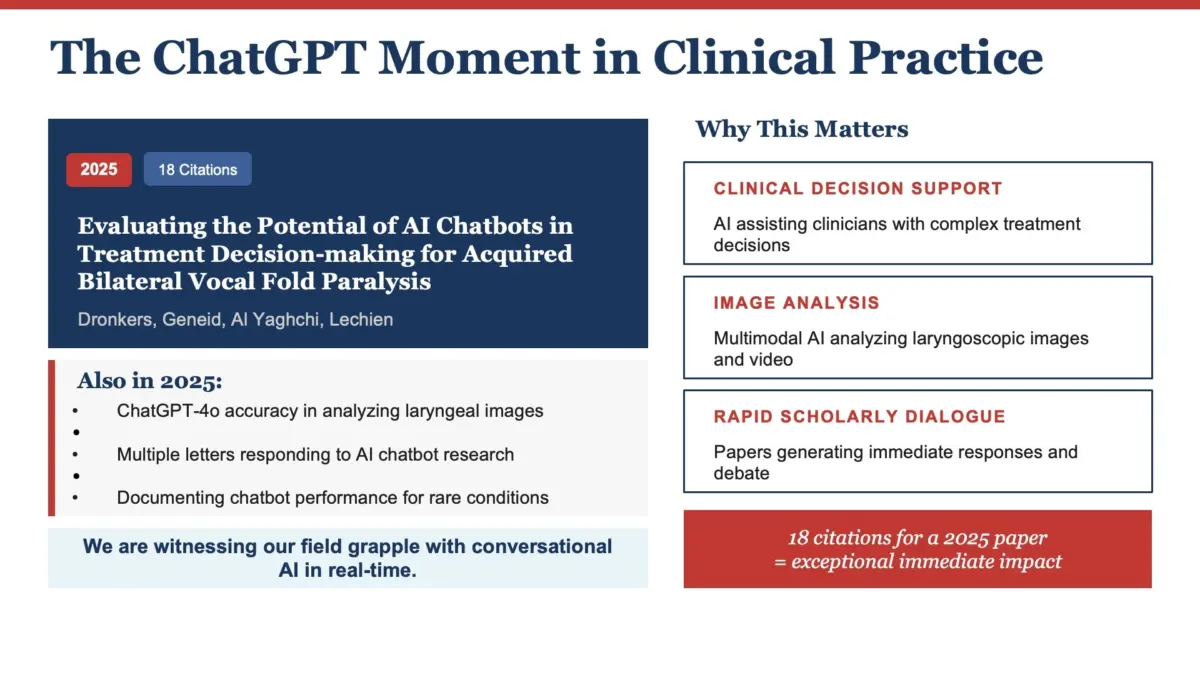
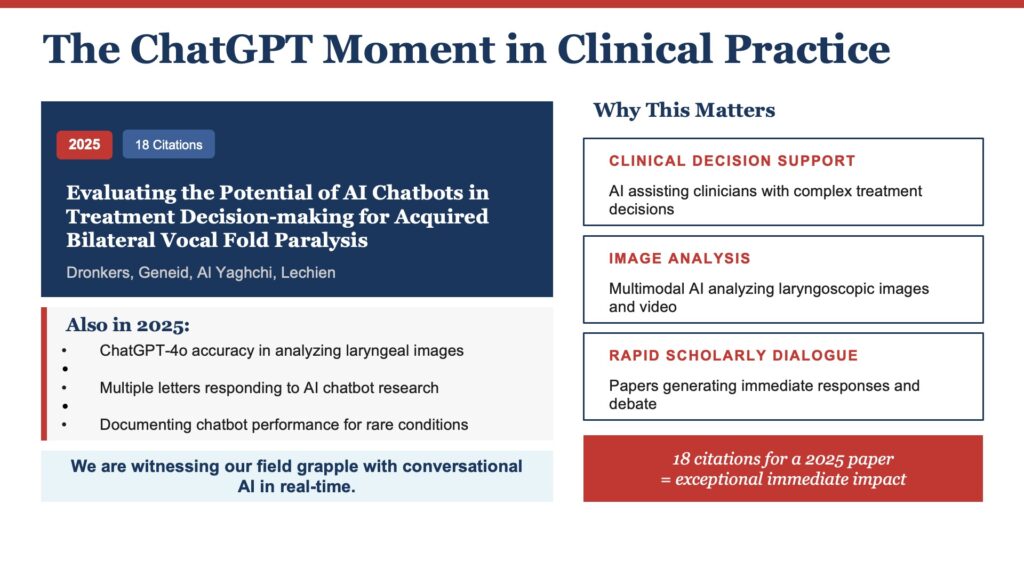
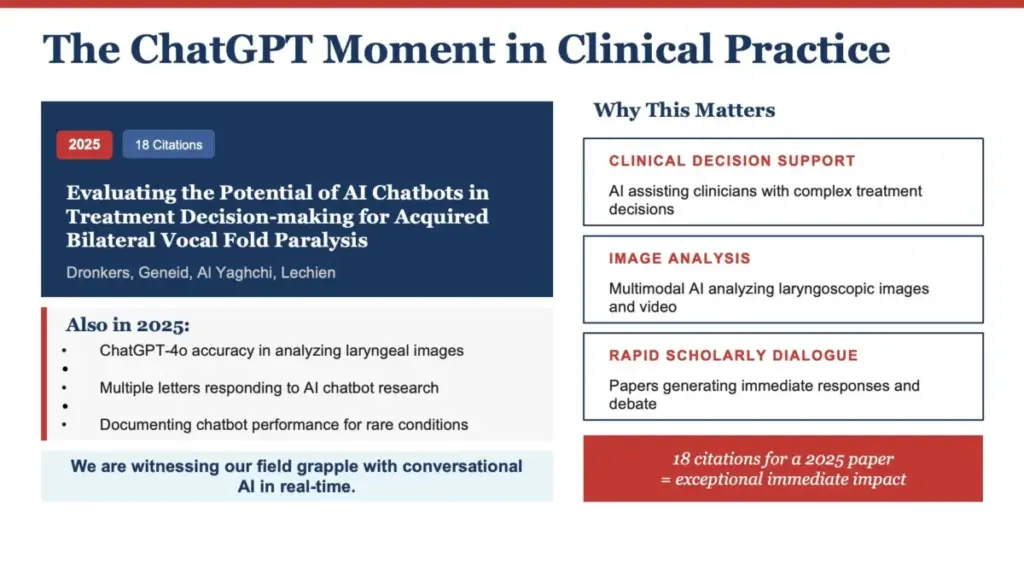
Entering 2025, the Journal of Voice expanded its scope to evaluate conversational artificial intelligence and large language models (LLMs) in clinical decision-making. Dronkers and colleagues’ influential study, "Evaluating the Potential of AI Chatbots in Treatment Decision-making for Acquired Bilateral Vocal Fold Paralysis," rapidly accumulated 18 citations within months of publication—an extraordinary velocity demonstrating immediate scholarly engagement.
This work sparked robust academic discourse, including multiple letters to the editor and peer responses assessing the diagnostic accuracy of advanced models like ChatGPT-4o in analyzing complex laryngeal images. The field is actively and transparently grappling with the integration of conversational AI into daily medical workflows.
Expert Perspectives on AI in Voice Science
To unpack these technological shifts, we turn to leading voices within our scientific community who are actively shaping the intersection of computation, ethics, and clinical practice.
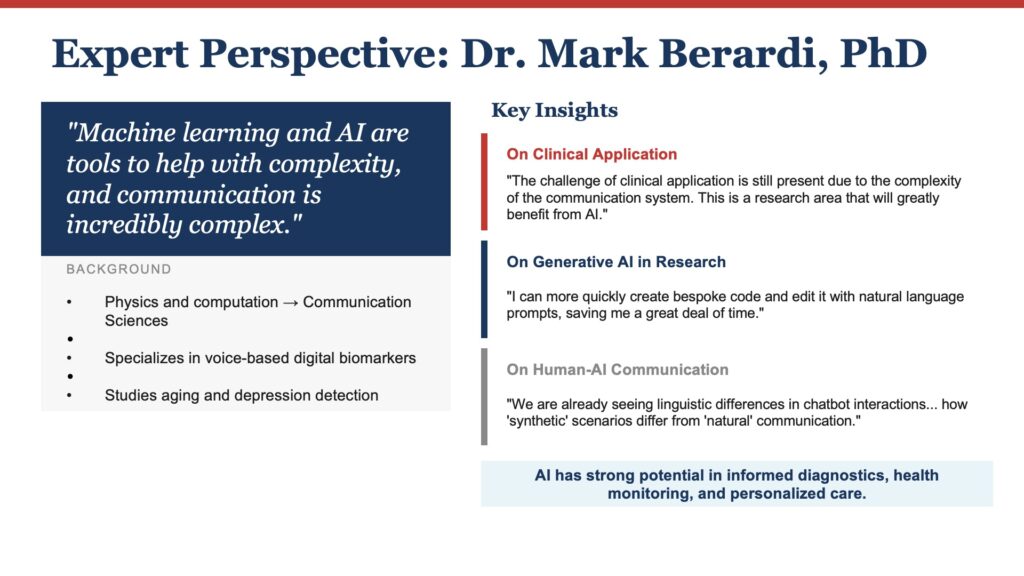
Dr. Mark Berardi: Managing Biological Complexity
Dr. Mark Berardi brings a rare and valuable perspective to voice science, grounded in advanced physics and computation. He views artificial intelligence fundamentally as an indispensable tool for managing overwhelming complexity.
"Machine learning and AI are tools to help with complexity, and communication is incredibly complex in its neurobiological and physiological processes. So I think the application is warranted," explains Dr. Berardi.
His current research centers on extracting voice-based digital biomarkers for human aging and clinical depression. While acquiring clean speech signals has become technically straightforward, the true scientific hurdle remains the inherent complexity of the human communication apparatus itself—an obstacle uniquely suited to modern machine learning architectures.
On the topic of generative AI, Dr. Berardi offers a pragmatic and nuanced assessment:
"While it hasn’t yet rewritten the fundamental physics of our research, it has radically streamlined our workflows by addressing major research bottlenecks—particularly in coding and data processing. I can now rapidly construct bespoke analytical code and refine it using natural language prompts."
Intriguingly, Dr. Berardi is also pioneering research into human-AI communication dynamics—investigating how human linguistic patterns adapt when speaking to conversational agents compared to other humans, and how "synthetic" communication formats (such as video conference calls) alter vocal output compared to face-to-face interaction. As synthetic agents become ubiquitous, voice science must expand its purview to analyze human vocal behavior in direct conversation with machines.
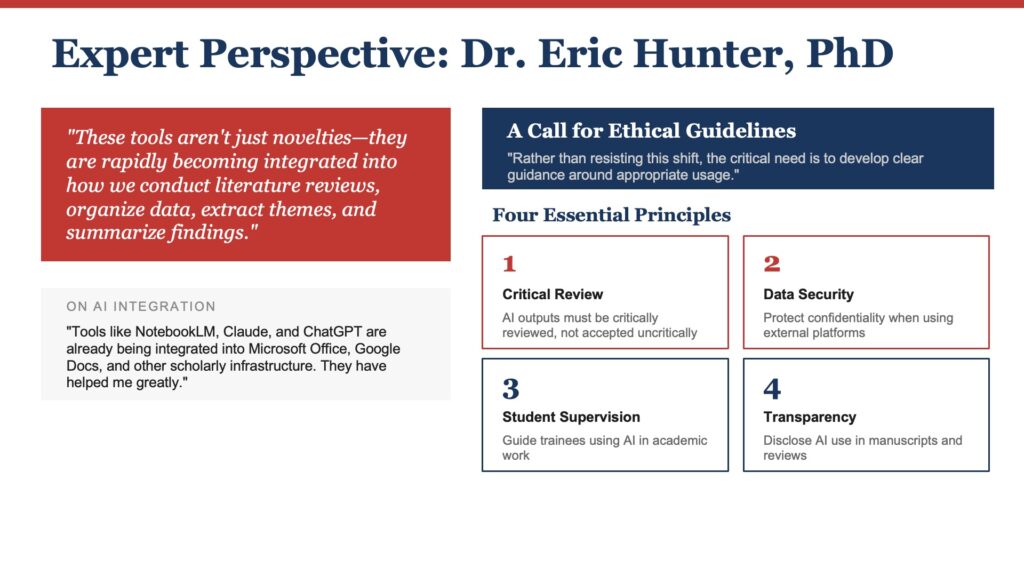
Dr. Eric Hunter: Embracing Technological Change with Ethical Clarity
Dr. Eric Hunter focuses heavily on the institutional, structural, and educational implications of artificial intelligence integration within academic scholarship.
"These tools aren’t just novelties," Dr. Hunter observes. "They are rapidly becoming integrated into how we conduct literature reviews, organize data, extract thematic insights from massive corpuses of text, and synthesize clinical findings."
Dr. Hunter stresses an inescapable reality for the academic community: large language models and AI-driven platforms are permanently embedded in modern scholarly infrastructure—from manuscript preparation and peer review to collaborative writing across global institutions. Rather than attempting to resist this technological tide, he issues a clear call to action: our immediate priority must be the establishment of transparent, robust ethical guidelines.
To navigate this transition successfully, Dr. Hunter outlines four foundational pillars for ethical AI utilization in academic publishing:
Absolute Transparency: Authors must clearly disclose if and how generative tools were utilized during data collection, analysis, or drafting phases.
Human Accountability: Researchers retain complete intellectual and ethical responsibility for the veracity, accuracy, and integrity of published findings.
Algorithmic Literacy: Editors, reviewers, and authors must educate themselves on the operational limitations, biases, and hallucinations inherent in LLM architectures.
Equitable Access: The benefits of AI-enhanced research tools must be democratized to support international researchers across varying institutional resource levels.
"Our field will benefit most," Dr. Hunter concludes, "if we actively embrace the productivity gains these tools offer while simultaneously building a shared, rigorous ethical framework for their responsible application."
A Global Research Community
The rapid ascent of AI in voice science is not the product of isolated laboratories working in silos. It is driven by a vibrant, highly collaborative global research community spanning every continent.
Key contributors leading this charge in the Journal of Voice include prominent scholars such as:
Jérôme René Lechien (6 papers)
Dimitar Deliyski (5 papers)
Stephanie Zacharias (5 papers)
Ahmed Yousef (4 papers as first author)
Paavo Alku, Leonardo Wanderley Lopes, and Maryam Naghibolhosseini (4 papers each)
Supported by dozens of international research teams, these investigators are proving that artificial intelligence, when paired with rigorous scientific methodology, can unlock unprecedented diagnostic and therapeutic insights into the human voice.
The Path Forward: Challenges and Collective Action
As the Journal of Voice continues to serve as the premier academic platform for this rapidly evolving discipline, we remain steadfast in our commitment to publishing peer-reviewed research that pushes scientific boundaries while upholding the highest standards of integrity. However, this transition demands proactive, collective action across three primary fronts:
Thoughtful Technological Engagement: We must utilize AI tools deliberately. These platforms are designed to manage biological complexity and amplify human expertise—not to replace expert clinical judgment or critical scientific reasoning.
Harmonized Ethical Frameworks: Dr. Hunter’s call for a shared ethical structure cannot be addressed by a single journal or institution. It requires a unified, community-wide commitment to transparency, fairness, and accountability.
Continued Open Scientific Exchange: The 161 AI-related papers published to date represent merely the foundation. Every clinician, speech-language pathologist, engineer, and educator possesses unique insights that can enrich our collective understanding.
An Extraordinary Moment in Voice Science
For hundreds of thousands of years, the human voice has served as humanity’s most primal and versatile instrument of connection, emotional expression, and individual identity. It carries our health, our psychological state, and our very essence in ways no other biomedical signal can replicate.
Now, for the first time in human history, we possess computational tools sophisticated enough to truly decode that complexity—to uncover what the voice reveals about our brains, our bodies, and our long-term wellbeing. We have developed technologies that can extend the reach of expert clinicians, detect subtle pathological shifts long before overt symptoms manifest, and democratize access to world-class voice care for underserved populations around the globe.
We are living through an extraordinary moment in time, and the Journal of Voice and The Voice Foundation proudly stand at its epicenter. The coming decade promises diagnostic and therapeutic discoveries previously confined to science fiction. We look forward to documenting, vetting, and sharing those breakthroughs with our global community as we chart the future of voice science together.