
Executive Overview
As the United States approaches its landmark 250th semiquincentennial anniversary, the nation’s cultural institutions are evaluating which artistic works best encapsulate the American experiment—its triumphs, its contradictions, and its enduring myths. This week, the Washington National Opera answers that question by staging one of the crowning achievements of late 20th-century American music: John Adams’s minimalist masterpiece, Nixon in China.
Hosted at the historic Constitution Hall, this high-profile revival features an alliance of legendary proportions. At the center of the production is iconic American baritone Thomas Hampson, who steps into the title role of Richard Nixon. Hampson, a titan of the classical vocal world, brings a globally celebrated interpretation back to his home soil for the first time in its complete form. Having previously triumphed in the role at the prestigious Paris Opera and workshopped excerpts with the Boston Symphony Orchestra, Hampson’s portrayal has already earned international acclaim for its psychological depth and vocal mastery.
Composed by John Adams with a libretto by Alice Goodman, Nixon in China premiered in 1987 and instantly revolutionized contemporary opera. By taking real-time historical events—President Richard Nixon’s groundbreaking 1972 visit to the People’s Republic of China—and elevating them to the realm of operatic myth, the work bridged the gap between contemporary journalism and timeless archetype.
Now, as Hampson brings his nuanced, multi-faceted depiction of the 37th U.S. President to Washington, D.C., the production serves as both a reflection on modern political history and a masterclass in vocal performance. Beyond the capital, Hampson’s itinerary confirms that this interpretation will travel to some of the world’s most prestigious stages, including Valencia’s Palau de les Arts and Milan’s legendary Teatro alla Scala. For opera aficionados and history buffs alike, this cultural event marks a defining moment in the contemporary performance calendar.
Detailed Chronology: From 1972 Diplomacy to Operatic Immersion
To understand the cultural weight of the Washington National Opera’s current production, one must retrace the dual timelines of the historical events that inspired the opera and the subsequent evolution of Hampson’s journey with the role.
The Historical Catalyst: February 1972
In February 1972, President Richard Nixon undertook a week-long, highly risky diplomatic trip to the People’s Republic of China. Ending 25 years of diplomatic isolation between the United States and the People’s Republic, the visit shook the geopolitical foundations of the Cold War. Cameras beamed images of the American president shaking hands with Chairman Mao Zedong and Premier Zhou Enlai into living rooms worldwide. It was an event tailor-made for theater: high-stakes diplomacy wrapped in heavy ideological theater, cultural pageantry, and human vulnerability.
Fifteen years later, composer John Adams, librettist Alice Goodman, and director Peter Sellars transformed this diplomatic pivot into Nixon in China. Eschewing traditional linear narrative, the opera uses pulsing, repetitive minimalist orchestrations, lush lyricism, and stylized choreography to capture the surreal, dreamlike nature of high-level political summits.
The Evolution of Hampson’s Nixon
Thomas Hampson’s relationship with the opera reached a major milestone during the 2022–23 season, when he debuted the role of Richard Nixon in a critically lauded production at the Paris Opera, directed by Valentina Carrasco and conducted by Gustavo Dudamel.
Stepping into the shoes of a heavily caricatured and historically polarizing figure, Hampson chose a path distinct from mere historical imitation. Critics noted that his Nixon felt profoundly human—veering skillfully between suave diplomatic posturing and deeply human angularity. Rather than portraying a monolithic villain or a straightforward historical victim, Hampson rendered Nixon as a complex man acutely aware that he was participating in the construction of his own historical legacy.
Following his triumph in Paris, Hampson continued to test and refine the role across the globe. He showcased pivotal scenes alongside the Boston Symphony Orchestra, earning rave reviews for his command of Adams’s demanding vocal writing. Now, the Washington National Opera engagement marks the historic milestone where Hampson delivers the complete iconic role to American audiences for the first time on a major national stage.
Supporting Context & Metrics: The Anatomy of a Modern Masterpiece
To fully appreciate the significance of this production, one must examine the critical reception, musical architecture, and global footprint surrounding Thomas Hampson’s current tour.
Critical Reception and Vocal Approach
John Adams’s score is notoriously demanding, requiring vocalists to navigate soaring lines, rapid patter, and moments of suspended, sublime lyricism. When Hampson tackled the role at the Paris Opera, music critics took note of his distinct psychological entry point.
Reviewers observed that Hampson’s Nixon was "a bit more pitiful and less tragic than in historical opera." This deliberate artistic choice strips away some of the grandiosity associated with classical opera anti-heroes, replacing it with a tragicomic vulnerability. Hampson captures a man out of his depth, swept along by the grand currents of history while grappling with his own personal insecurities.
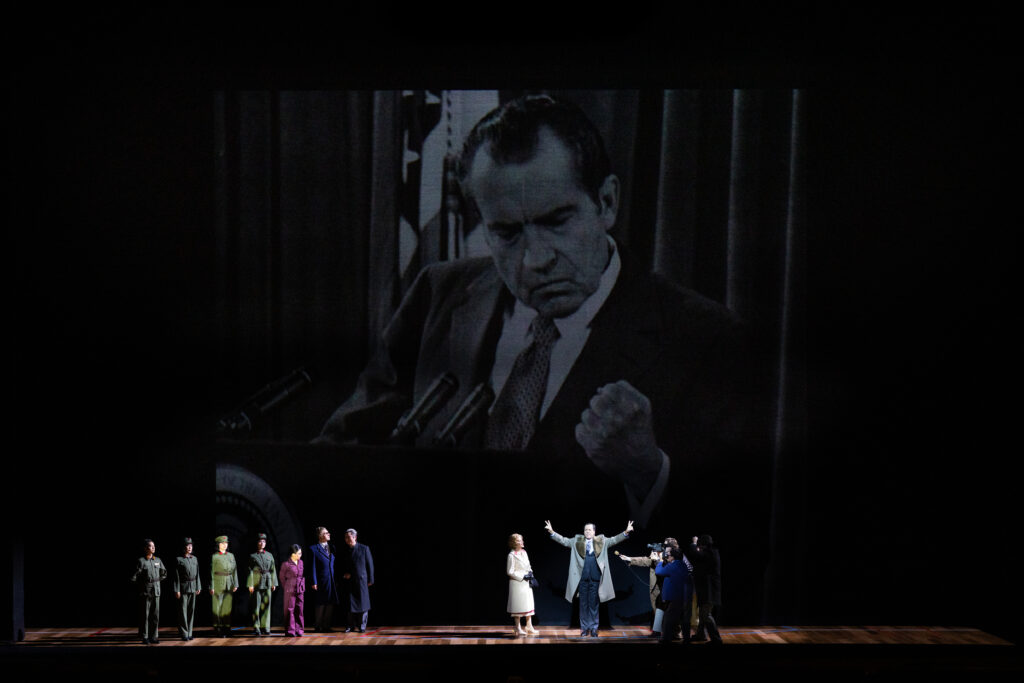
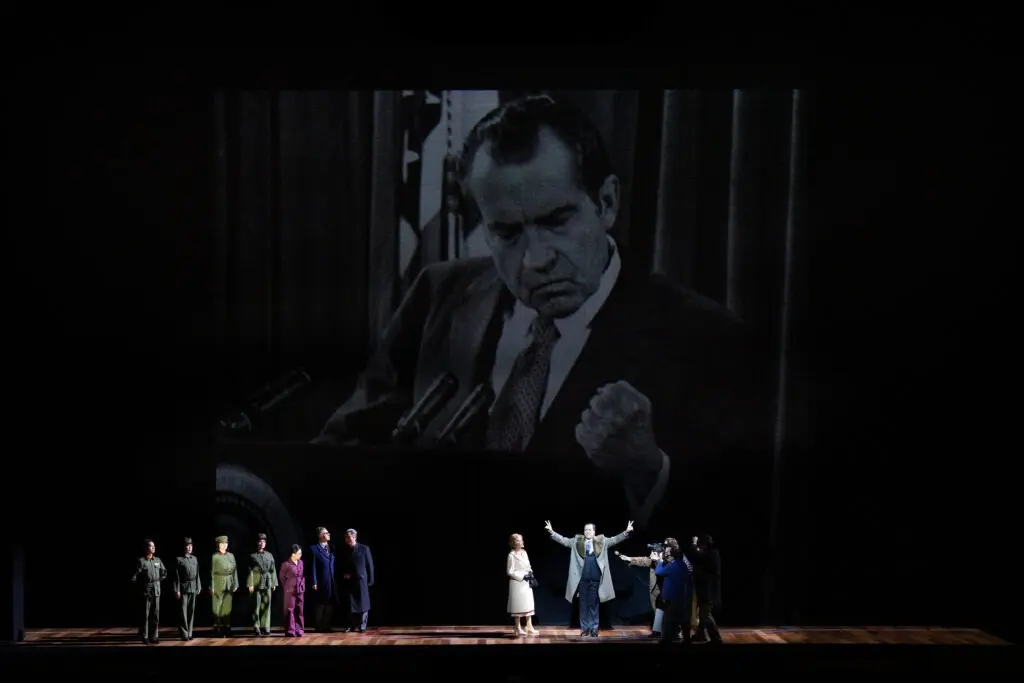
Music critics frequently highlighted how Hampson "veered between suave and angular as Richard Nixon," a duality that mirrors Adams’s score. The music shifts abruptly from propulsive, brass-heavy minimalist grooves to sweeping, neo-Romantic lyricism reminiscent of 19th-century grand opera. Hampson’s rich, resonant baritone bridges these stylistic chasms, anchoring the erratic psychological states of the President.
Global Tour Metrics and Digital Accessibility
While the Washington D.C. engagement serves as the centerpiece of this American return, the production’s broader touring schedule demonstrates the global appetite for this specific artistic pairing. Hampson’s calendar highlights the expansive international reach of the project:
- Washington, D.C. (Constitution Hall): The U.S. premiere of Hampson’s complete portrayal with the Washington National Opera.
- Valencia, Spain (Palau de les Arts): Bringing the psychological intensity of the role to Spanish audiences.
- Milan, Italy (Teatro alla Scala): A historic engagement at the world’s most storied opera house, cementing the production’s canonical status.
- Recital and Excerpt Performances: Targeted symphonic and chamber presentations in cultural hubs such as Dublin, Ireland, and Naples, Florida.
For patrons unable to secure tickets to these live performances, the digital landscape offers a window into the production’s genesis. Operas houses have increasingly leaned into digital archiving; notably, the Paris Opera’s on-demand streaming platform (Paris Opera Play) retains the 2023 production that served as the crucible for Hampson’s interpretation. These recordings allow global audiences to analyze the subtle physical acting, facial expressions, and vocal phrasing that define Hampson’s historic run.
Official Statements and Artistic Insights
The philosophical core of this production is best understood through the reflections of the principal artist himself. In recent interviews and behind-the-scenes features, Hampson has elaborated on the profound themes underpinning Nixon in China.
Reflecting on the nature of the opera and his character’s place within it, Hampson noted:
"The opera is about how history becomes mythologized."
This succinct observation cuts to the heart of what makes Adams and Goodman’s work so enduring. The events of February 1972 were heavily mediated by television, press briefings, and political spin even as they occurred. Decades later, the actual geopolitical maneuverings are overshadowed by the sheer theatricality of the encounter: Nixon climbing down the ramp of the Spirit of ’76, shaking hands with Zhou Enlai, and attending a performance of the revolutionary ballet The Red Detachment of Women.
By approaching Nixon not as a political cartoon, but as a flesh-and-blood participant in his own myth-making, Hampson highlights the meta-theatricality built into the opera’s DNA. The characters are acutely aware that the world is watching them, performing their historical duties even behind closed doors. This self-awareness gives Hampson’s performance an uncanny, magnetic quality—one that resonates deeply in our current era of hyper-mediated political reality.
Future Outlook: The Legacy of Nixon in China in the 21st Century
As Nixon in China solidifies its place in the permanent international operatic canon, its recent revivals point toward a fascinating shift in how contemporary opera is programmed and received.
Long gone are the days when contemporary American opera was viewed as a risky box-office gamble. Works like John Adams’s masterpieces have proven that modern historical subjects possess the emotional resonance, dramatic conflict, and musical complexity required to pack houses from Paris to Milan and Washington, D.C.
The collaboration between Thomas Hampson and institutions like the Washington National Opera sets a high-water mark for how aging masterpieces can be revitalized. By casting seasoned artists who bring decades of dramatic experience and vocal maturity to the table, opera companies are transforming historical revivals into masterclasses in character study.
Looking ahead, as the United States navigates its semiquincentennial celebrations, productions like Nixon in China provide a vital mirror. They remind audiences that American history is not a static monument carved in marble, but a living, breathing drama populated by flawed, ambitious, and ultimately human figures. Through the rich, commanding baritone of Thomas Hampson, the ghosts of 1972 step off the pages of history books and onto the operatic stage, inviting a new generation of theatergoers to witness the moment when politics became myth.