
Executive Overview
For decades, a quiet frustration has persisted within the walls of piano studios around the world. Aspiring musicians spend years—often a decade or more—pouring time, money, and emotional energy into private lessons, scale practice, and repertoire memorization, only to hit a brick wall when confronted with a new, unfamiliar sheet of music. The ability to look at a musical score and play it accurately on the first attempt—known as sight-reading—remains one of the most elusive skills in instrumental music education.
Lara Mirinjian, an accomplished pianist, teacher, and founder of larasmusic.com, knows this struggle intimately. Despite dedicating over ten years to formal piano instruction, Mirinjian famously confesses that she still could not fluently read music from a basic level-one book. Her story is far from unique. It points to a systemic flaw within modern music pedagogy: while piano teachers universally acknowledge sight-reading as an essential musician’s tool, a staggering number of instructors fail to incorporate it into their lesson plans.
This investigative report explores the roots of the "sight-reading crisis," examining academic research into why teachers neglect this vital discipline, the foundational principles required to achieve true fluency, and a step-by-step methodology that is transforming how students across the globe approach the keyboard. By shifting the focus from rote memorization and complex methods to foundational principles, educators and students alike are discovering that musical literacy is not an innate talent reserved for the musical elite, but a learnable, systematic skill.
Detailed Chronology: The Journey from Confusion to Mastery
To understand how the modern approach to teaching sight-reading evolved, one must retrace the historical trajectory of individual musical development. For most pianists, the traditional timeline of learning follows a remarkably consistent, albeit flawed, trajectory.
Phase One: The Decade of Illusion
In traditional piano education, a student begins by learning basic note identification—associating treble and bass clef lines with physical keys. Soon, however, traditional pedagogy pivots heavily toward repertoire acquisition. Students are assigned increasingly difficult pieces. They spend weeks, months, or even a full year polishing three or four recital pieces to perfection.

During this phase, the student does not truly read the music in real-time; instead, they decode it sluggishly, memorize it through sheer repetition and muscle memory, and perform it from memory. To an outside observer, the student appears to be a proficient reader. In reality, the student is operating in a state of advanced decoding disguised as literacy. This illusion often shatters only when the student is handed a simple, unfamiliar piece of music and asked to play it on the spot—at which point progress grinds to a halt.
Phase Two: The Pedagogical Awakening
For Mirinjian, the turning point arrived only after years of floundering. The breakthrough did not come from buying a more advanced method book or practicing harder; it came from finding an instructor who understood the cognitive mechanics of reading music. This new teacher dismantled Mirinjian’s preconceived notions about practice.
The revelation was simple yet radical: sight-reading requires an entirely separate pedagogical framework from repertoire learning. It cannot be treated as a byproduct of playing advanced pieces. Once Mirinjian adopted this principle-driven approach, her own playing—and subsequently the playing of her students—experienced exponential growth.
Phase Three: Codifying the Principles
Realizing that her personal transformation was reproducible, Mirinjian and contemporary sight-reading advocates began codifying the process into a structured, universal discipline. Moving away from rigid, proprietary "methods," they focused instead on immutable musical and cognitive principles. As the philosophical maxim goes—often attributed to Ralph Waldo Emerson—methods are many, but principles are few. Those who grasp principles can successfully select their own methods, while those who rely solely on static methods while ignoring principles are bound to encounter continuous obstacles.
Supporting Context & Metrics: The State of Music Education
The anecdotal experiences of struggling pianists are heavily supported by empirical research within the field of music education. The gap between what teachers know they should be teaching and what they actually implement in the studio reveals a systemic blind spot in professional music training.

The Hardy Study on Piano Pedagogy
A landmark study conducted by Dr. Dianne Hardy, Assistant Professor of Music Education and Piano at Dickinson State University, sheds light on why sight-reading instruction is so frequently omitted from standard piano curricula. In her research examining contemporary teaching methodologies, Dr. Hardy uncovered several startling admissions from surveyed music educators:
- Ignorance of Methodology: The majority of teachers participating in the study admitted that sight-reading was entirely excluded from their structured programs simply because they did not know how to teach it.
- Method Book Deficits: Many instructors cited the absence of instructional guidance within their preferred method book series, assuming that if a book did not explicitly provide lesson plans for sight-reading, it was not their responsibility to invent them.
- The Repertoire Fallacy: A significant portion of educators failed to recognize sight-reading as a distinct, independent cognitive skill. Instead, they held the reductionist view that sight-reading was synonymous with the general acquisition of repertoire, asserting that students would naturally "get better" at reading simply by spending more years taking lessons.
- The Educator’s Own Incompetence: Perhaps most telling, a subset of teachers frankly admitted they would never attempt to teach sight-reading because they themselves were notoriously poor sight-readers.
Psychological and Cognitive Barriers
Beyond pedagogical neglect, students frequently battle internal and external hurdles that impede reading fluency. Conditions such as Attention Deficit Disorder (ADD) or attention-regulation challenges are frequently cited by students as roadblocks. The fast-paced, real-time demand of tracking visual symbols, translating them into spatial motor commands, and executing them rhythmically without pause can overwhelm a neurodivergent or easily distracted mind.
Furthermore, intimidation is a major deterrent. When advanced students are handed a beginner’s book, their ego often rebels. They view simplified exercises as beneath their technical standing, refusing to acknowledge that their reading age is vastly inferior to their playing age. This mismatch creates structural "cracks" in their musicianship that widen over time.
Official Guidelines and Expert Frameworks: The Principle-Driven Methodology
To bridge the gap between technical proficiency and reading fluency, experts have established a rigorous framework based on specific, non-negotiable principles. Whether applied to absolute beginners or advanced collegiate pianists, this methodology relies on simplicity, strict pacing, and cognitive pattern recognition.
The Core Principles of Effective Sight-Reading
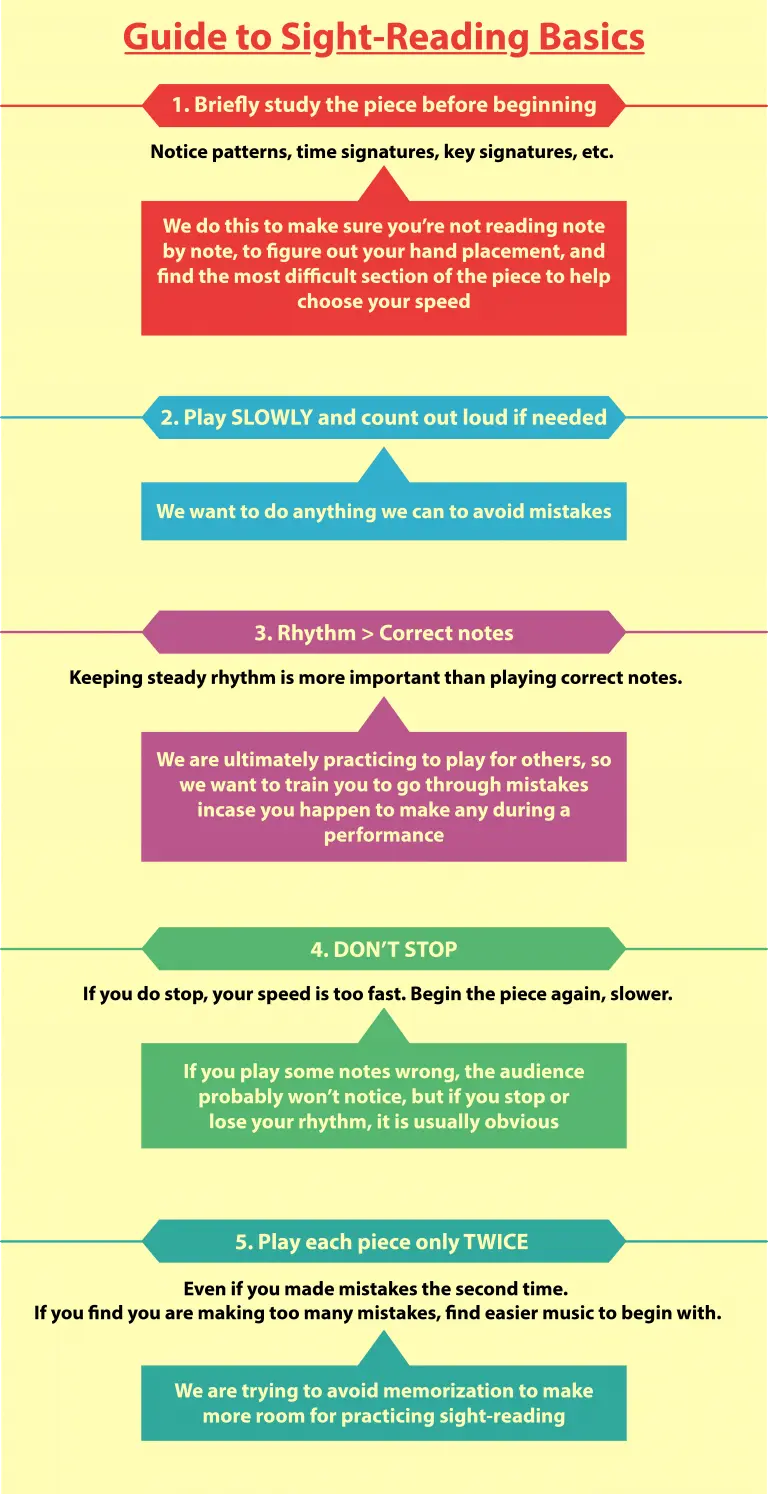
- Start Excessively Simple: Regardless of a student’s actual performance level, sight-reading practice must begin with the simplest music available—often material well below the student’s technical capabilities.
- The Two-Read Limit: Every piece selected for sight-reading practice must be read only twice. Over-practicing a piece turns it into a memory exercise rather than a reading exercise.
- Never Stop (The Rhythm Imperative): The single most destructive habit in sight-reading is stopping to correct a wrong note. Momentum must be maintained at all costs.
The Step-by-Step Practical Application
To operationalize these principles in a daily practice routine, educators utilize a structured, multi-step protocol applicable to any instrument, using piano as the baseline model:

- Preparation and Setup (Step 1 & 2): Secure the sheet music on the stand. Before touching a single key, scan the entire piece. Identify visual and structural patterns—such as repeated notes, stepwise motion, or recurring intervals (e.g., noting that a melody starts on Middle C, repeats twice, steps up to D, and returns).
- Analyze the Meter (Step 3): Examine the time signature and establish an internal pulse. Crucially, count aloud (e.g., "1, 2, 3, 4") to anchor the rhythm in the body before the fingers move.
- Hand Placement (Step 4 & 5): Position the hands correctly over the keyboard with fingers resting on their designated home positions. Mental preparation involves committing to the cardinal rule: Do not stop, even if a mistake is made.
- The First Execution (Step 6): Begin playing at an exceptionally slow, deliberate pace. Count aloud concurrently. If a mistake occurs, let it pass and continue moving forward with the established beat. If the cognitive processing lag forces a complete stop, the piece is too difficult; the student must return to the beginning, slow the tempo down even further, or switch to an easier piece.
- The Second and Final Read (Step 7): Upon reaching the end of the piece, pause briefly, reflect on any mental or physical bottlenecks encountered, and play the piece one final time. Incorporate the lessons learned from the first pass to smooth out minor execution errors.
- Progression (Step 8): Immediately transition to the next piece in the sequence, repeating the analytical cycle.
Future Outlook: Redefining Musical Literacy for the Next Generation
As the music education community continues to reckon with the findings of researchers like Dr. Hardy and the practical innovations championed by modern pedagogues like Lara Mirinjian, the landscape of instrumental instruction is undergoing a quiet revolution.
The future of piano pedagogy points toward a holistic model where sight-reading is no longer treated as an afterthought or a talent bestowed upon the fortunate few. Instead, it is being integrated as the foundational bedrock of musical literacy. Digital learning tools, interactive sight-reading software, and an increased emphasis on cognitive principles in teacher-training programs are gradually dismantling the old paradigms.
For the individual student, the message is clear: fluency is attainable. By swallowing one’s pride, stepping back to the most fundamental levels of music, and embracing a disciplined, non-stop reading routine, decades of frustration can be undone. The elusive puzzle of musical notation is finally being solved, empowering a new generation of musicians to look at a blank score not with anxiety, but with the confidence of fluent speakers reading an open book.