
Executive Overview
In the modern landscape of religious assembly, inclusivity is no longer merely an idealistic goal; it is a fundamental operational imperative. Across the globe, houses of worship strive to create welcoming environments where every attendee can fully participate in services, sermons, and community events. Yet, a silent barrier often persists for millions of congregants: hearing loss. While architectural upgrades like ramps and automatic doors have rightly become standard for physical mobility accommodations, auditory accessibility frequently remains an overlooked frontier.
To bridge this crucial gap, religious organizations are increasingly turning to advanced Assistive Listening Systems (ALS). These technologies are designed to capture the spoken word—whether from a pastor, choir, or multimedia presentation—and transmit it directly to the ears of listeners, bypassing background noise and the acoustic challenges inherent in large, reverberant sanctuaries.
However, purchasing and installing equipment is only the first step. Successfully integrating an Assistive Listening System requires a strategic, multi-phased approach that encompasses congregation assessment, financial planning, comprehensive staff training, and proactive community outreach. This report provides an authoritative, in-depth framework for religious leaders, facility managers, and AV technicians seeking to implement or upgrade assistive listening infrastructure within their worship spaces. By following a structured roadmap—understanding specific needs, evaluating technological options, preparing staff for operational success, and fostering widespread awareness—churches can ensure that their message of faith and inclusion reaches every heart and mind, unhindered by physical impairments.
Detailed Chronology: A Four-Phase Roadmap to Implementation
Implementing an Assistive Listening System is a transformative project that demands careful planning and methodical execution. Drawing from industry best practices and expert recommendations, facility administrators should approach the integration process through four distinct, chronological phases.
Phase 1: Assess and Understand Congregational Needs
Before evaluating hardware specifications or soliciting equipment bids, leadership must conduct a thorough audit of their congregation’s actual auditory needs. Assumptions regarding the extent of hearing loss within a community are frequently inaccurate, leading to misallocated budgets or underutilized technology.
- Deploying Congregational Surveys: The most scientifically valid method for determining assistive listening requirements is to survey the congregation directly. This survey should be distributed via multiple channels—including physical bulletins, email newsletters, and digital announcements—to ensure high participation rates across all demographics.
- Key Data Points to Collect:
- Assess respondents’ overall satisfaction with acoustic clarity during services.
- Determine the percentage of attendees who currently utilize personal hearing aids.
- Inquire whether these hearing aids are equipped with telecoils (t-coils), a critical feature that allows devices to interface directly with loop-based assistive listening systems.
- Analyzing Demographics: Aging populations naturally experience higher rates of presbycusis (age-related hearing loss). Churches with aging memberships must scale their system capacity accordingly, keeping in mind that individuals with mild-to-moderate hearing loss who do not yet wear hearing aids may also benefit significantly from dedicated receivers and lightweight headphones.
Phase 2: Evaluate Options and Formulate Financial Strategies
Once the scope of the congregation’s needs is clearly defined, the next step involves matching those requirements with the appropriate technology and establishing a sustainable budget.
- Technological Landscape: Administrators must evaluate various system types, including FM (Frequency Modulation) systems, Infrared (IR) systems, and Audio Induction Loop systems. Each technology presents unique benefits depending on the sanctuary’s architecture, security requirements, and budget.
- Cost Estimation and Professional Consultation: Estimating the total cost of ownership involves factoring in transmitters, receivers, neckloops, charging stations, and signage. Specialized providers—such as CCI Solutions—offer invaluable assistance during this phase, providing complimentary consultations to help administrative boards navigate complex pricing structures and establish realistic capital budgets.
- Funding and Stewardship: Because capital improvement budgets are often tight, churches frequently look beyond general operational funds. Engaging in targeted fundraising campaigns, securing dedicated memorial gifts, or applying for specialized grants focused on accessibility can effectively offset the initial financial outlay.
Phase 3: Prepare Staff and Volunteers for Operational Success
The finest audio technology in the world will fail if the personnel operating it are inadequately trained. The human element remains the single most critical variable in determining whether an Assistive Listening System achieves high utilization rates.
- Designating "Assistive Listening Ambassadors": Staff members and hospitality volunteers stationed at welcome desks or information booths must be thoroughly educated on the mechanics of the system. These individuals serve as the frontline ambassadors for accessibility.
- Hands-On Training Protocols: When a congregant checks out a receiver, the ambassador should not merely hand over the device. Instead, staff must take a moment to provide a brief, friendly demonstration of how to adjust the volume, secure the neckloop, or interface the device with personal hearing aids.
- Creating Operational Redundancies: To ensure seamless daily operations, facilities should maintain laminated quick-reference guides at the distribution counter. These laminated sheets should feature clear answers to Frequently Asked Questions (FAQs), troubleshooting tips, and step-by-step instructions, empowering any volunteer to troubleshoot minor issues swiftly.
Phase 4: Create Comprehensive Awareness and Community Outreach
An investment in accessibility yields zero return if the intended beneficiaries are unaware that the technology exists. A robust communication campaign is vital to drive adoption.
- Visual Signage and Wayfinding: Clear, internationally recognized accessibility signage must be prominently displayed at all main entrances, ushering guests toward the location where Assisted Listening Devices (ALDs) are distributed.
- Multi-Channel Reminders: Every weekly bulletin, worship guide, and digital presentation should feature a brief, welcoming reminder that ALDs are available upon request.
- Live Educational Demonstrations: To demystify the technology, churches can host a dedicated live training or demonstration session during a fellowship hour. This allows hesitant congregants to test the receivers in a low-pressure environment and experience the acoustic clarity firsthand.
- Community-Wide Advertising: Extending outreach beyond current members is a powerful tool for evangelism. When local disability advocacy groups, senior centers, and community members learn that a church has prioritized inclusive infrastructure, many will visit or return to services, knowing their specific needs will be met with dignity and care.
Supporting Context & Metrics: The Imperative of Auditory Inclusion
To fully appreciate the urgency of implementing Assistive Listening Systems, one must examine the broader socioeconomic and physiological context of hearing loss within modern society.
The Prevalence of Hearing Impairment
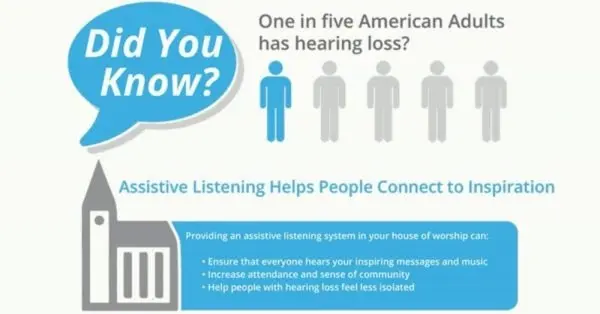
According to data compiled by public health organizations and audiological associations, hearing loss is one of the most common chronic physical conditions affecting adults. Millions of individuals globally experience varying degrees of auditory decline. Within the demographic most commonly associated with regular attendance in traditional houses of worship—adults aged 50 and older—the prevalence climbs sharply.
Despite these high numbers, a significant social stigma often surrounds hearing loss. Many individuals delay seeking medical intervention or assistive devices for years, leading to social isolation, frustration, and a gradual withdrawal from community life. For a house of worship, this dynamic represents a profound pastoral challenge. If congregants cannot understand the spoken sermon, the musical lyrics, or the pastoral prayers, they inevitably feel disconnected, ultimately leading them to stop attending altogether.
Acoustic Challenges in Worship Architecture
Religious architecture historically favors aesthetic grandeur, soaring ceilings, hard reflective surfaces (such as stone, marble, and hardwood), and expansive open spaces. While these architectural choices create majestic environments for choral resonance and pipe organs, they present a nightmare for speech intelligibility.
- Reverberation Time (RT60): In a typical untreated cathedral or large sanctuary, sound waves bounce repeatedly off hard surfaces, creating a lingering echo known as reverberation. When reverberation times exceed 1.5 seconds, speech becomes muddy and indistinct.
- The Distance Factor: As a listener moves further away from the sound source (the pulpit or microphone), the ratio of direct sound to reverberant sound decreases rapidly.
Assistive Listening Systems completely bypass these room-acoustics challenges. By transmitting the pristine audio signal directly from the soundboard to the listener’s ear, the system neutralizes the detrimental effects of room echo and background chatter, delivering a crisp, highly intelligible listening experience regardless of where an attendee is seated.
Economic and Technological Metrics
Modern assistive listening technologies operate primarily across three distinct standards:

- FM Systems: Operating on radio frequencies, these systems offer a broad operational range and can cover large sanctuaries effectively. Receivers are lightweight and can be used with or without hearing aids.
- Infrared (IR) Systems: Utilizing invisible light spectrums, IR systems offer exceptional security (signals cannot pass through walls), making them ideal for facilities concerned with privacy, though they require an unobstructed line of sight between the transmitter and receiver.
- Audio Induction Loops: These systems transmit audio via a copper wire loop installed around the perimeter of the seating area. The magnetic field generated by the loop is picked up directly by the t-coil inside a user’s personal hearing aid or cochlear implant, providing an exceptionally seamless and discreet user experience.
Official Statements and Expert Perspectives
Industry leaders, accessibility advocates, and pastoral counselors consistently emphasize that providing assistive listening is an essential expression of institutional empathy and spiritual duty.
The Theological Argument for Inclusion
Clergy and theologians increasingly frame accessibility not merely as a legal compliance issue (such as adhering to the Americans with Disabilities Act in the United States), but as a core theological mandate.
"Reaching out to those who feel disconnected from your community due to hearing loss is central to sharing the message of inclusion," notes industry guidance from leading audiovisual integration specialists. "Genuinely compassionate service involves being aware of and caring for the needs of everyone, especially those dealing with impairments. Make sure they are able to hear the beauty and emotion of the spoken word in your church by providing them with the equipment they need to stay connected."
When a church invests in high-end audio distribution systems, it sends an unambiguous pastoral message: Every individual is valued, every soul is welcomed, and no barrier is too high to overcome in order to share the message of grace.
Insights from Audiological Professionals
Audiologists frequently report that their patients experience high levels of anxiety when attending public gatherings, specifically due to the unpredictable acoustic environments found in theaters, auditoriums, and churches.
Medical professionals emphasize that even modern, high-end digital hearing aids struggle in spaces with high ambient noise and severe reverberation. When a house of worship installs an ALS, audiologists view it as an extension of the healthcare continuum—a public health accommodation that empowers individuals to remain socially engaged, mentally stimulated, and spiritually nourished.
Future Outlook: The Next Generation of Accessibility in Worship
As audio technology continues to evolve at a rapid pace, the future of assistive listening in houses of worship points toward greater integration, personalization, and wireless ubiquity.
The Rise of Wi-Fi Streaming Audio
While traditional FM and loop systems remain dominant, the advent of Wi-Fi-based assistive listening technology represents a major paradigm shift. Modern systems can now stream ultra-low-latency audio directly to smartphones and smart devices via dedicated applications.
This technological evolution offers several profound advantages for houses of worship:
- Cost Reduction: By leveraging the personal smartphones that congregants already carry in their pockets or purses, churches can significantly reduce the capital expenditure required to purchase and maintain fleets of dedicated hardware receivers.
- Reduced Stigma: Some congregants hesitate to request a dedicated assistive listening device from a welcome desk due to perceived social stigma. Streaming audio directly to a personal smartphone or wireless earbud looks identical to listening to music or a podcast, completely removing any visible marker of disability.
- Hygiene and Maintenance: Post-pandemic sanitization protocols made the handling of shared electronic devices a logistical challenge for volunteers. Smartphone streaming eliminates the need for staff to clean and recharge dozens of physical receivers after every single service.
Integration with Modern Multimedia and Hybrid Worship
The post-2020 landscape permanently altered how religious organizations approach assembly. The rise of hybrid models—where physical services are simultaneously broadcast via live streams, podcasts, and video archives—means that accessibility must now extend seamlessly across both physical sanctuaries and digital platforms.
Future-proofed churches are beginning to tie their assistive listening infrastructure directly into their digital broadcasting pipelines. By ensuring that pristine, processed audio feeds are available both locally within the room (via loops, FM, or Wi-Fi) and globally across digital streams (with closed captioning and enhanced audio tracks), ministries can capture an increasingly broad, geographically diverse, and physically diverse audience.
Conclusion and Call to Action
The integration of an Assistive Listening System is far more than an engineering project or an audio upgrade; it is a profound declaration of pastoral hospitality. By systematically assessing congregational needs, navigating financial options with expert guidance, training staff to become enthusiastic ambassadors, and aggressively raising community awareness, religious organizations can dismantle the invisible walls erected by hearing loss.
Facilities seeking to take the next step in their accessibility journey are encouraged to leverage comprehensive industry resources, such as the Listen Technologies Church Assistive Listening Toolkit, which provides invaluable sample surveys, signage templates, and implementation announcements.
By taking deliberate, compassionate action today, houses of worship can ensure that the beauty, emotion, and life-changing power of the spoken word resound clearly and vibrantly for every single member of their community—leaving no one unheard.