
Executive Overview
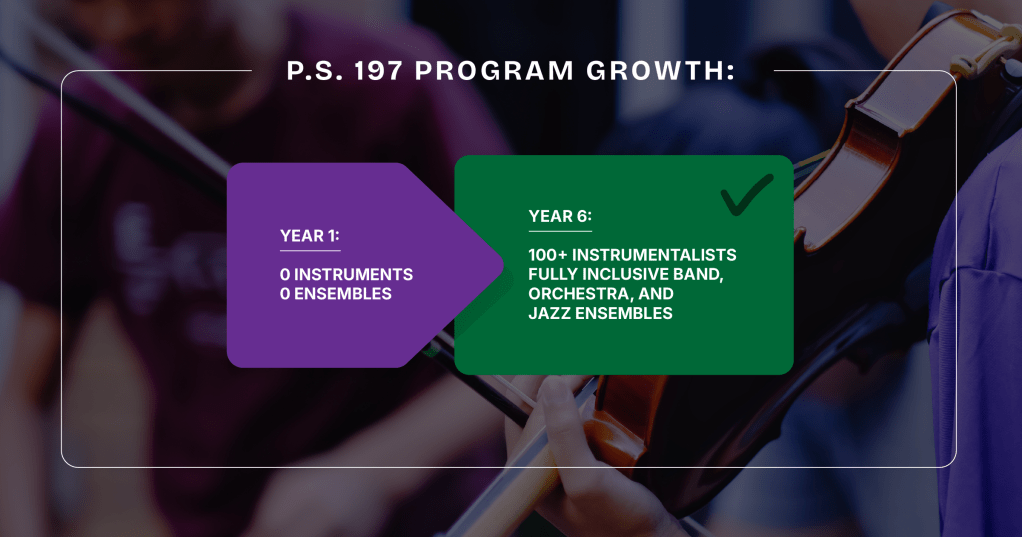
When Kimberly Rosenbaum walked through the doors of P.S. 197, The King’s Highway Academy, in central Brooklyn six years ago, she faced a blank slate in the truest sense of the phrase. The sprawling urban public school—serving a vibrant, multilingual population of roughly 1,200 students spanning early childhood education up to the fifth grade—boasted an ambitious administrative vision: to build a comprehensive instrumental music program entirely from scratch. At the time, the school had no marching band, no concert orchestra, no jazz ensemble, and, crucially, zero instrumental inventory.
Fast forward to today, and the landscape of P.S. 197 has undergone a remarkable transformation. The school now sustains a vibrant, multi-tiered musical ecosystem featuring a dedicated fourth-grade band, a fifth-grade band, a dynamic after-school string orchestra, a thriving jazz band, and an inclusive policy that seamlessly integrates special education students into every facet of performance. Managing more than 100 active instrumentalists within a massive elementary population is no small operational feat. Rosenbaum handles around 15 general music sections while carving out intense, compressed 20-minute small-group rehearsals during lunch and recess periods.
To achieve this level of engagement without burning out, Rosenbaum turned to an unlikely ally: educational technology. By deploying MakeMusic as an automated in-class teaching assistant, she revolutionized how young minds learn physical musicianship. Simultaneously, she mastered the bureaucratic art of New York City Department of Education (NYCDOE) procurement, leveraging sole-source vendor channels to bypass endless administrative bottlenecks. This case study explores how visionary pedagogy, smart technology integration, and unwavering administrative support converged to create a modern blueprint for urban public school music education.
Detailed Chronology: The Evolution of P.S. 197’s Music Program
Year One: Laying the Foundation
In the beginning, Rosenbaum’s primary challenge was physical inventory and baseline engagement. With no instruments in the building, the first months were spent writing grants, communicating with local community partners, and lobbying district leaders for baseline funding. Music education in urban environments often stalls before it begins due to a lack of physical resources. Rosenbaum bypassed these early hurdles by focusing heavily on foundational general music concepts, priming students’ rhythmic and aural skills so that the moment instruments arrived, the transition would be immediate.
Years Two and Three: Expansion and Small-Group Realities
As instruments trickled in—flutes, clarinets, alto saxophones, trumpets, and string instruments—the logistical realities of teaching an elementary ensemble set in. Rosenbaum was tasked with pulling small groups of 8 to 15 beginner students during truncated lunch and recess windows.

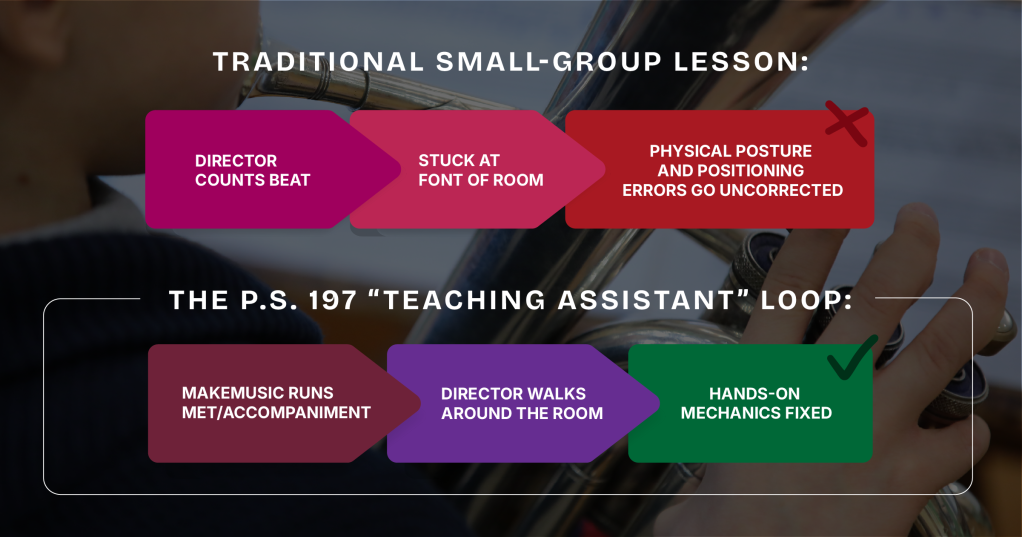
In these micro-sessions, traditional teaching models quickly broke down. An instructor trying to count off an ensemble of beginner brass players while simultaneously managing embouchures, posture, hand positions, and tuning finds themselves stretched impossibly thin. If the director’s eyes are locked on the music stand or they are busy keeping time aloud, individual physical corrections fall by the wayside. Recognizing that her time was her most precious commodity, Rosenbaum began integrating MakeMusic software to serve as a digital metronome, accompanist, and conductor.
Years Four through Six: Scaling to 100+ Instrumentalists and Beyond
By the fourth year, the program had achieved critical mass. Word-of-mouth among students and parents drove unprecedented sign-ups. P.S. 197 expanded its offerings to include specialized tracks:
- The 4th Grade Band: Introducing woodwinds and brass to younger cohorts.
- The 5th Grade Advanced Band: Focusing on multi-part arrangements and concert repertoire.
- The After-School String Orchestra: Fostering classical technique and collaborative listening.
- The Jazz Band: Exploring improvisation, swing rhythms, and contemporary styles.
- Inclusive Ensembles: Welcoming students with diverse learning needs and special education designations into active performance roles.
Supporting Context & Metrics: Overcoming Urban Education Hurdles
Building an instrumental program in a bustling, diverse Brooklyn public school involves navigating layers of administrative complexity, socio-economic variables, and linguistic diversity.
The Logistics of High-Volume Teaching
With 1,200 students enrolled across 3K to 5th grade, Rosenbaum’s schedule is tightly packed. Teaching roughly 15 general music sections daily leaves virtually zero downtime. When instrumental pull-out lessons are restricted to 20-minute lunch and recess slots, every second counts. Traditional instruction often wastes critical minutes on restarting stopped tracks, resetting distracted groups, or establishing a unified tempo.
By utilizing software that automates the count-off and provides synchronized backing tracks, Rosenbaum effectively gained an extra set of hands in the room. "MakeMusic allows me to take a step away from being a conductor and lets me really focus on just being a teacher," she notes. While the software drives the tempo and guides the ensemble through the measures, Rosenbaum walks the room, moving student-by-student to manually adjust hand placements, correct embouchures, and fine-tune instrument postures.
Navigating NYCDOE Procurement (FAMIS / ShopDOE)
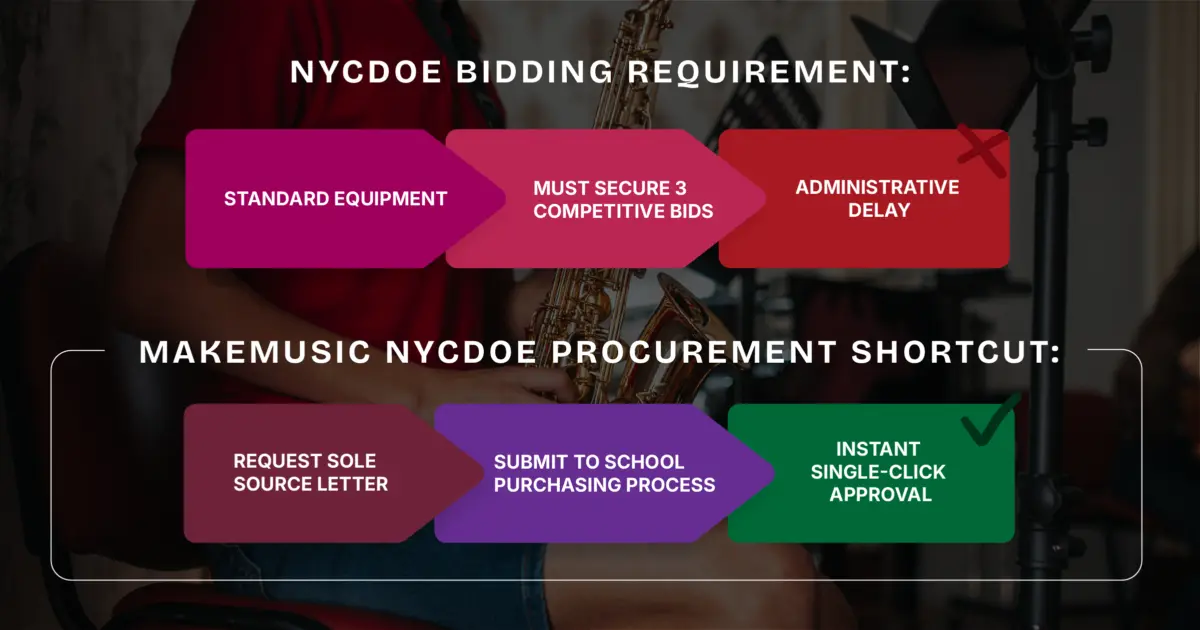
One of the most persistent roadblocks for New York City public school educators is the labyrinthine procurement process. Purchasing educational software or physical assets typically requires securing three competitive bids from different approved vendors. For busy teachers, this bureaucratic mandate can stall digital initiatives for months, often killing momentum entirely.
Rosenbaum uncovered an efficient, replicable workaround: The Sole Source Vendor Letter.
"MakeMusic provides a sole-source letter stating you can’t buy this tool anywhere else," Rosenbaum explains. "You give that letter to your purchasing secretary, and they don’t have to ask for three bids because there’s only one source. It’s one of my easiest purchases of the entire year."
This simple administrative shortcut completely transforms how educators can acquire necessary software licenses through platforms like FAMIS and ShopDOE, turning a multi-month headache into a streamlined, single-day transaction.
Bridging Language and Ability Barriers
P.S. 197 serves a wonderfully rich, multicultural community. A significant portion of the student body consists of multilingual learners and English Language Learners (ELL). Introducing complex musical notation alongside a new language can create an overwhelming cognitive load for young children.
To ensure equitable access, Rosenbaum layered her core curriculum with digital supplemental materials inside the MakeMusic platform. When teaching non-English speaking wind and string students, she deploys Spanish-translated editions of Alfred Music’s Sound Innovations series directly within the software interface. Furthermore, the platform’s visual red/green note feedback engine provides young musicians with an intuitive, non-verbal practice partner at home. Students do not need to speak fluent English to understand when they have successfully matched a pitch or nailed a rhythm; the visual cue communicates instantly.
Official Statements and Pedagogical Philosophy
Kimberly Rosenbaum’s approach to music education is anchored in a philosophy of radical access and student empowerment. Rather than viewing technology as a screen-time distraction or a replacement for human connection, she views it as an equalizer that extends the classroom walls into the home.
"MakeMusic isn’t a rigid curriculum; it’s a flexible tool," Rosenbaum emphasizes. "You’re giving students access to resources they wouldn’t otherwise have. When you give a kid an instrument and the right tools to practice, they just take off with it. Why wouldn’t you give them that opportunity?"
Administrators at P.S. 197 have echoed this sentiment, recognizing that a robust arts program acts as an anchor for school culture, attendance, and social-emotional development. By supporting Rosenbaum’s initiatives—from procuring specialized software through sole-source letters to protecting rehearsal time—the school leadership has helped cultivate a culture where the arts are treated not as an optional elective, but as a core pillar of academic life.
Industry experts point to P.S. 197 as a prime example of scalable urban music education. In districts across the country where funding is tight and teacher-to-student ratios are high, leveraging intelligent practice software allows single-teacher departments to manage large cohorts without sacrificing the quality of individualized instruction.
Future Outlook: The Blueprint for Modern Music Education
As P.S. 197 looks toward the future, Rosenbaum’s blueprint offers a clear roadmap for educators nationwide who are looking to launch, rebuild, or scale their own school music programs.
The convergence of three key elements defines this success story:
- Administrative Alignment: Clear goals set by leadership paired with the freedom for educators to innovate.
- Strategic Resource Management: Utilizing tools like sole-source letters to cut through red tape and acquire technological assistance quickly.
- Equitable Digital Integration: Employing software with multi-language support and visual feedback engines to ensure every child—regardless of linguistic background or learning profile—can participate meaningfully.
For public school music teachers staring down the barrel of oversized classes, limited budgets, and scarce rehearsal time, Rosenbaum’s journey proves that massive growth is entirely possible. By embracing digital teaching assistants to reclaim instructional focus, urban music programs can transition from silence to symphony, opening doors of lifelong artistic expression for hundreds of children who might otherwise never touch an instrument.
Educators interested in learning how MakeMusic can streamline small-group lessons, simplify district procurement, and empower young instrumentalists can explore further resources or initiate a free trial through the official MakeMusic educator portal.