
Executive Overview
As the autumn mist rolled across Larmer Tree Gardens, the End of the Road festival reached a historic milestone, celebrating its twentieth anniversary with an ambitious convergence of avant-garde cinema and visceral live sound design. On Saturday morning, the festival’s iconic Big Top tent played host to one of the most anticipated and critically scrutinized crossover events of the 2025 cultural calendar: a live-scored screening of Rose of Nevada, the latest time-loop drama by BAFTA-winning British filmmaker Mark Jenkin.
Performing the live score was The Cornish Sound Unit—the dynamic, unorthodox creative partnership between Jenkin himself and experimental musician Dion Star. Drawing massive crowds that materialized in droves despite the early hour, the event served as both a triumphant anchor for the festival’s weekend programming and a masterclass in modern cinematic world-building. Featuring stellar lead performances from internationally acclaimed actors Callum Turner and George MacKay, Rose of Nevada was elevated from a traditional film screening into a living, breathing auditory organism.
For an anniversary edition designed to push artistic boundaries, this collaboration encapsulated the ethos of End of the Road: uncompromising, deeply atmospheric, and dedicated to the avant-garde. The performance not only reinforced Jenkin’s status as a visionary auteur of the British folk-horror and indie landscape but also cemented The Cornish Sound Unit as a premier force in contemporary live-to-film soundscaping.
Detailed Chronology: Saturday Morning at the Big Top
The Early-Morning Pilgrimage
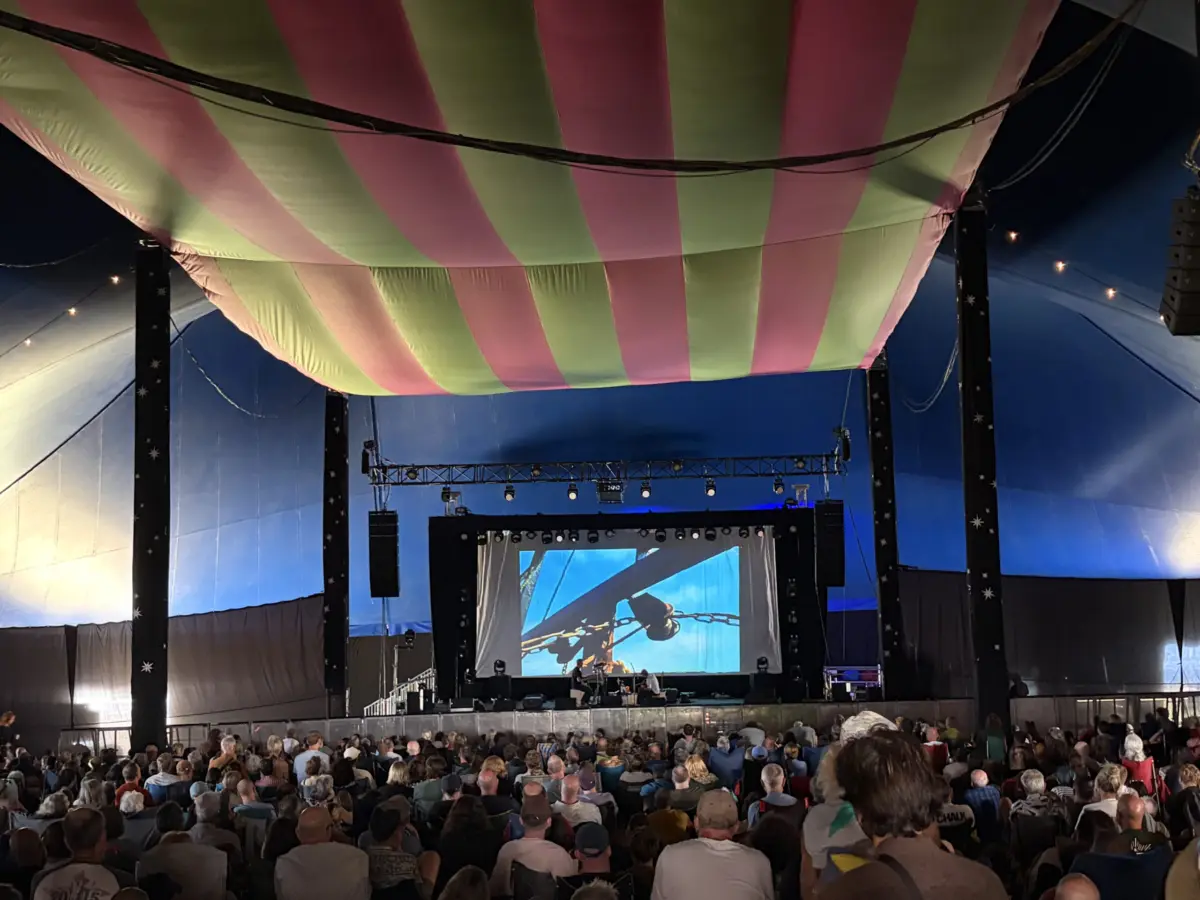
By 10:00 AM on Saturday, the usual sluggish pace of a festival morning had been entirely eclipsed by a palpable sense of anticipation. Queues stretching hundreds of yards formed outside the Big Top. Festival-goers, many nursing the fatigue of a late Friday night, moved with singular purpose toward the tent, driven by word-of-mouth acclaim and the rare pedigree of the talent involved.
The atmosphere inside the Big Top was reverent yet charged. Unlike typical late-night music sets defined by rhythmic bass and communal dancing, this audience sat in rapt, seated silence, the cavernous tent offering an intimate container for an expansive sonic journey.
The Performance of Rose of Nevada
As the houselights dimmed, the screen flickered to life, projecting the stark, textured celluloid imagery characteristic of Jenkin’s aesthetic. Simultaneously, Dion Star and Mark Jenkin took their positions at a stage cluttered with vintage magnetic tape machines, modular synthesizers, and chaotic tangles of patch cables.
Rose of Nevada, a Cornish time-loop drama starring Callum Turner and George MacKay, unfolded on screen with a deliberate, hypnotic cadence. The film’s narrative—dealing with temporal dislocation, isolation, and psychological reckoning—found its perfect mirror in the live audio accompaniment.
Rather than relying on a fixed, pre-recorded orchestral track, The Cornish Sound Unit crafted the soundscape in real-time. Star manipulated tape loops that hissed and groaned with analog decay, while Jenkin injected jagged bursts of improvised frequency modulation and tactile sound design. The result was a symbiotic relationship between picture and sound; every mechanical whir of the projector seemed to bleed into the mechanical hum of the synthesizers.
The live execution introduced a razor-thin margin of tension. Because the score was performed live and allowed to evolve organically, no two screenings are ever structurally identical. This raw, unvarnished approach imbued the film’s looping narrative with an escalating sense of dread and subsequent catharsis, leaving the Saturday morning audience spellbound until the final, haunting frame cut to black.
Supporting Context & Metrics: The Anatomy of an Avant-Garde Collaboration
The Origins and Mechanics of The Cornish Sound Unit
The Cornish Sound Unit is not a traditional band, nor is it a conventional film-scoring collective. It represents a deliberate philosophical return to analogue materiality in an era dominated by digital perfection. The collaboration was formally galvanized when the British Film Institute (BFI) commissioned Star and Jenkin to score Jenkin’s critically acclaimed folk-horror feature, Enys Men.
The creative process behind the Unit relies heavily on tactile media:
- Tape Loops: Manipulating physical strips of magnetic tape to create decaying, repetitive motifs that mirror the thematic loops of the films.
- Analogue Synthesis: Utilizing modular and vintage synthesizers to generate warm, unpredictable frequencies that resonate physically within large tent structures like the Big Top.
- Improvised Sound Design: Integrating field recordings and live-foley elements that respond directly to the pacing of the visual edits on screen.
This methodology strips away the slick production gloss of modern Hollywood scores, favoring a tactile, acoustic grittiness that feels deeply rooted in the rugged landscape of Cornwall.
Cultural Significance at the End of the Road Festival
Marking its twentieth year, End of the Road has carved out a distinct niche within the crowded European festival circuit. While major commercial festivals chase chart-topping pop acts and predictable legacy headliners, End of the Road has consistently championed the idiosyncratic, the experimental, and the boldly independent.
The inclusion of Rose of Nevada with a live score underscored this curatorial vision. In festival metrics, Saturday morning slots are traditionally low-traffic recovery periods; however, the overwhelming attendance numbers for The Cornish Sound Unit proved that modern festival audiences are hungry for intellectually stimulating, multidisciplinary art. The performance bridged the gap between cinephiles and music aficionados, creating a rare intersection where film culture and live gig culture merged seamlessly.
Official Statements and Industry Perspective
While formal press statements from the artists remain closely guarded in favor of letting the work speak for itself, insiders and cultural commentators have been vocal about the importance of Jenkin and Star’s collaborative output.
Reflecting on the philosophy of live scoring, Dion Star has frequently emphasized the improvisational freedom required to breathe new life into cinematic works. In previous discussions surrounding their BFI-backed work, Star noted that the objective is never to dictate how an audience should feel about a scene, but rather to construct an ambient emotional architecture that viewers can inhabit.
Mark Jenkin, whose minimalist approach to filmmaking (shooting on 16mm film, processing his own stock, and utilizing diegetic sound) has revolutionized British independent cinema, views sound as an equal narrative partner to the visual frame. Speaking on the integration of live instrumentation with his directorial style, Jenkin has highlighted the urgency that live performance brings to static celluloid. When the sound is generated live in the room, the film itself feels vulnerable, shifting with the acoustics of the space and the collective energy of the audience.
Industry analysts tracking the reception of Rose of Nevada note that the casting of Callum Turner and George MacKay—two of Britain’s most versatile and sought-after dramatic actors—elevates the project’s commercial viability without sacrificing its art-house integrity. The pairing of their intense, grounded performances with the erratic, volatile soundscapes of The Cornish Sound Unit creates a striking tension that positions the film as one of the most anticipated cinematic releases of the coming year.
Future Outlook: The Evolution of Live Cinema
As the twentieth-anniversary edition of End of the Road marched forward into its Saturday evening lineup—showcasing avant-garde and left-field musical acts such as Bassvictim, PVA, and Kelly Lee Owens—the reverberations of the morning’s cinematic experiment lingered across the festival grounds.
The success of Rose of Nevada’s live-scored presentation points toward a broader, highly promising trajectory for modern cinema and live performance. In an age where digital streaming has atomized the communal film-watching experience, events like the one witnessed at the Big Top demonstrate an insatiable public appetite for collective, eventized viewing.
For The Cornish Sound Unit, the End of the Road performance marks a triumphant continuation of their touring return, signaling that their unique brand of analogue alchemy is ready for wider international stages. As Rose of Nevada prepares for its broader theatrical and festival rollout ahead of its 2025 release, the bar has been set exceptionally high.
The collaboration between Jenkin, Star, Turner, and MacKay has proven that when boundaries between disciplines dissolve, the resulting art is not merely consumed—it is profoundly experienced. For the lucky crowds packed into the Big Top on that crisp Saturday morning, the experience was nothing short of a revelation, cementing a milestone moment in the storied history of the End of the Road festival.