
Executive Overview
In an era defined by rapid technological innovation, houses of worship continually strive to create welcoming, immersive environments for their congregations. Yet, despite advancements in acoustic design, digital mixing consoles, and line-array loudspeaker systems, a significant demographic remains structurally marginalized: individuals experiencing hearing loss. For millions of congregants globally, the profound spiritual and emotional resonance of a Sunday sermon, the soaring harmonies of a choir, and the intimate shared moments of communal prayer are frequently obscured by acoustic interference, reverberation, and distance.
Addressing this critical pastoral and technical challenge requires more than simply turning up the main volume. High-volume amplification often exacerbates acoustic distortion, making speech unintelligible for those with hearing impairments while alienating those with sensitive hearing. The definitive solution lies in the intentional integration of Assistive Listening Systems (ALS).
Implementing an ALS is not merely a compliance measure or an afterthought; it is a profound theological and practical commitment to radical hospitality. When a house of worship ensures that every individual can clearly hear the spoken and sung word, it tears down invisible barriers to fellowship. However, the procurement, deployment, and ongoing management of such technology demand a rigorous, methodical approach.
This comprehensive report provides a deep investigative dive into the strategic framework required for successfully introducing an Assistive Listening System to a faith-based community. Drawing upon industry expertise, operational blueprints from premier audio integrators like CCI Solutions, and technological insights from manufacturers such as Listen Technologies, this article outlines a four-phase implementation strategy. Designed for church leadership teams, audio-visual (AV) directors, and ministry coordinators, this guide explores needs assessment, budgetary planning, staff and volunteer enablement, and community-wide awareness campaigns to ensure your investment bears enduring fruit.
Detailed Chronology: The Four-Phase Implementation Roadmap
Successfully deploying an Assistive Listening System requires a structured, multi-stage methodology. Skipping steps often leads to underutilized equipment, frustrated users, and wasted financial resources. Below is the chronological blueprint for operationalizing an ALS within any worship facility.
[Phase 1: Assessment] ➔ [Phase 2: Procurement] ➔ [Phase 3: Operationalization] ➔ [Phase 4: Promotion]Phase 1: Understanding Your Congregation’s Unique Needs
The foundational error many facility managers commit is purchasing off-the-shelf audio assistive hardware based solely on room square footage or seating capacity, without first consulting the end-users. An effective deployment begins with rigorous data collection.
To accurately map the acoustic and assistive needs of your community, church leadership should deploy a comprehensive congregation-wide survey. This survey must move beyond general inquiries and target specific metrics:
- Current Experience: Ask respondents to evaluate their ability to comprehend the spoken liturgy, scripture readings, and musical performances during standard worship services.
- Device Utilization: Inquire whether congregants currently wear hearing aids or cochlear implants.
- Compatibility Metrics: Crucially, ask if these hearing devices are equipped with telecoils (t-coils). Understanding the prevalence of t-coil technology dictates whether your facility should invest heavily in hearing loop systems (induction loops) or complementary frequency-based transmitters (such as RF, Wi-Fi, or Infrared systems).
By aggregating this data, the AV committee can establish a baseline demographic profile of hearing-impaired attendees, ensuring that the chosen technology directly serves the specific medical and auditory realities of the congregation.
Phase 2: Fully Understanding Your Technical and Financial Options
Once the congregation’s needs are clearly mapped, the next critical phase involves matching those needs with the appropriate technology and financial framework. Navigating the myriad of options—ranging from FM radio frequency systems and Infrared (IR) setups to advanced Wi-Fi streaming architectures and direct-to-hearing-aid induction loops—can overwhelm even seasoned technical directors.
This is where strategic partnerships become invaluable. Organizations such as CCI Solutions offer specialized assistance, providing expert guidance and complimentary consultations designed to help church leadership navigate equipment costs, spatial constraints, and budgetary boundaries.
When formulating the financial strategy, facilities must look beyond the initial purchase price of transmitters, receivers, neck loops, and signage. Budgetary planning should account for:
- Infrastructure Integration: Potential costs associated with interfacing the ALS directly into the existing digital mixing console or sound reinforcement matrix.
- Maintenance and Upkeep: Battery replacements, sanitary wipe stations for ear speakers, and secure storage charging docks.
- Capital Offsets: Exploring dedicated fundraising campaigns specifically earmarked for accessibility upgrades. Often, donors respond with profound generosity when they understand their contributions directly enable hearing-impaired community members to re-engage with the life of the church.
Phase 3: Preparing for Operational Success and Staff Readiness
The finest audio engineering in the world will fail if the personnel operating the deployment front-end are inadequately trained. The success of an Assisted Listening System depends heavily on the frontline staff and hospitality volunteers who manage the distribution of receivers.
Think of these individuals not merely as ushers, but as Assisted Listening Ambassadors. Their posture, knowledge, and attentiveness set the tone for the user’s experience. Key operational protocols for this phase include:

- Comprehensive Training Workshops: Conduct mandatory training sessions for all welcome teams, ushers, and AV volunteers. Staff must understand how to power on the units, adjust volume levels, pair neck loops, and troubleshoot minor connectivity issues.
- Guided Distribution: When a congregant requests a device, ambassadors should take the extra moment to provide a friendly, patient orientation regarding the device’s functions and controls. Never simply hand over a piece of technology without a brief demonstration.
- Visual Reference Aids: To alleviate anxiety and reduce human error at busy welcome desks, maintain a laminated, high-visibility reference sheet containing answers to Frequently Asked Questions (FAQs) directly at the distribution counter. This ensures that even newer volunteers can troubleshoot confidently during high-traffic Sunday mornings.
Phase 4: Creating Comprehensive Awareness and Community Outreach
An invisible system is an unused system. Even the most sophisticated assistive listening technology will fail if the congregation does not know it exists. Launching an ALS requires an aggressive, multi-channel communication campaign.
- Strategic Signage: Display professional, ADA-compliant signage at all primary entrances, welcome desks, and within the sanctuary itself. These signs must clearly indicate that Assisted Listening Devices are available and direct individuals precisely where to retrieve them.
- Print and Digital Reminders: Embed permanent, recurring reminders within weekly printed bulletins, digital slide presentations prior to service, and mobile church apps. A brief note stating, "Assisted Listening Devices are available at the Welcome Center—please ask an usher," normalizes usage and prompts awareness.
- Interactive Demonstrations: Consider hosting a dedicated live training session or informational workshop during a fellowship hour. Allowing congregants to test the technology in a relaxed, non-service environment demystifies the equipment and encourages hesitant members to try it.
- External Community Outreach: Do not restrict your marketing to current members. Broadcast your commitment to total accessibility across your church’s website and local social media channels. Many individuals with hearing loss have abandoned traditional religious services entirely because past experiences left them isolated. Hearing that your facility has invested in inclusive audio technology can serve as a powerful catalyst for them to visit—or return to—your community.
Supporting Context & Metrics: The Imperative of Hearing Accessibility
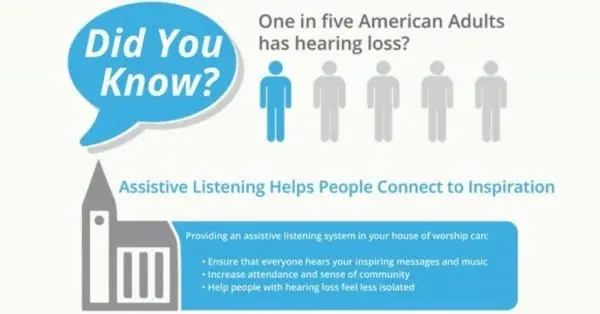
To understand the urgency of implementing Assistive Listening Systems, one must examine the broader public health landscape regarding hearing loss. According to demographic data from organizations like the Hearing Loss Association of America (HLAA) and the World Health Organization (WHO), hearing loss is one of the most prevalent chronic physical conditions affecting adults today.
- Demographic Prevalence: Approximately 48 million Americans (nearly 15% of the population) experience some degree of hearing loss. This statistic scales dramatically within demographic groups most commonly associated with traditional house of worship attendance.
- The Social Cost of Isolation: Untreated hearing loss is directly correlated with social withdrawal, clinical depression, cognitive decline, and anxiety. When individuals find themselves unable to comprehend speech in large, reverberant spaces like traditional sanctuaries, they quietly stop attending, seeking isolation over the embarrassment of strained listening.
- Legal and Ethical Standards: While many places of worship are granted certain exemptions under foundational civil rights legislation such as the Americans with Disabilities Act (ADA), the ethical mandate far supersedes legal compliance. True pastoral care demands the removal of stumbling blocks to communication.
Comparative Technological Matrix
When designing an ALS deployment, facilities generally evaluate four primary technologies. Understanding their operational metrics ensures informed procurement:
| Technology Type | Primary Mechanism | Pros | Cons | Best Suited For |
|---|---|---|---|---|
| Audio Induction Loop (Hearing Loop) | Electromagnetic field broadcasted via copper wire perimeter. | Directly couples to t-coil hearing aids; no extra receiver required for most users. | High installation cost; potential interference from electrical wiring. | Permanent installations in traditional sanctuaries with dedicated seating zones. |
| RF (Radio Frequency) | Transmits audio via radio waves to portable pocket receivers. | Cost-effective; wide coverage area; highly reliable signal propagation. | Requires users to wear physical receivers and headphones/neck loops. | Multi-room facilities, gymnasiums, and portable church plants. |
| Wi-Fi Streaming | Broadcasts audio via local wireless network directly to user smartphones via an app. | Utilizes devices patrons already own (smartphones); high fidelity. | Introduces latency (audio delay); requires users to have smartphones and headphones. | Tech-forward congregations and youth-centric spaces. |
| Infrared (IR) | Transmits audio via invisible light waves within a contained room. | Secure transmission; immune to radio frequency interference. | Line-of-sight required; easily blocked; unusable in direct sunlight. | Specialized rooms requiring privacy or multi-language translation. |
Official Statements and Industry Insights
Industry leaders emphasize that assistive listening is a vital ministry tool rather than an isolated technical upgrade. Experts from leading audio-visual integrators and acoustic technology manufacturers underscore the transformative impact of these systems.
Representatives from CCI Solutions regularly highlight the pastoral importance of foundational acoustic planning during consultations:
"When a church invests in an Assistive Listening System, they are making a profound statement. They are saying to every single person walking through their doors: ‘You belong here, your presence matters, and we refuse to let physical impairments hinder your spiritual journey.’ Technical excellence and deep compassion must always walk hand in hand."
Furthermore, insights derived from the comprehensive Listen Technologies Church Assistive Listening Toolkit emphasize the importance of holistic integration:
"Procuring hardware is only twenty percent of the battle. The true success of an assistive listening deployment is measured by how seamlessly the technology is woven into the human elements of hospitality, training, and continuous communication. When your greeters, sound engineers, and pastoral staff champion accessibility together, the entire congregation experiences a renewed sense of connection."
Future Outlook: The Horizon of Inclusive Worship
As audio-visual engineering continues to evolve, the future of assistive listening within houses of worship points toward even greater integration, personalization, and seamless user experiences.
We are rapidly moving toward an era where traditional barriers between hearing aids, room acoustics, and personal mobile devices will completely dissolve. Emerging protocols in Bluetooth Low Energy (BLE) audio and Auracast broadcast technologies promise to revolutionize how multi-channel audio is distributed in public spaces. In the near future, congregants will be able to tune their personal hearing aids or wireless earbuds directly into the church’s main audio feed with pristine, zero-latency digital clarity, all managed via a simple smartphone interface or automatic proximity pairing.
However, regardless of how advanced the underlying silicon and software become, the human core of the mission remains entirely unchanged. Technology serves merely as the conduit; the true objective is the cultivation of a deeply compassionate, radically inclusive spiritual community.
Houses of worship that proactively embrace assistive listening technology today are positioning themselves as beacons of empathy and intentional hospitality. By ensuring that every congregant—regardless of auditory ability—can fully absorb the beauty, nuance, and emotion of the spoken and sung word, faith communities fulfill their highest calling: connecting every human heart to the message of grace.
Additional Resources & Actionable Tools
For facility directors, AV teams, and pastoral staff seeking to operationalize these strategies immediately, comprehensive downloadable tools are readily available:
- Access the complete Listen Technologies Church Assistive Listening Toolkit to review sample congregation surveys, signage templates, and bulletin announcements.
- Contact specialized integrators like CCI Solutions to request a customized, obligation-free consultation regarding your facility’s specific acoustic dimensions, budgetary parameters, and assistive listening requirements.