
Executive Overview
In an era where modern houses of worship heavily invest in multi-thousand-watt line-array sound reinforcement systems, dazzling visual projection mapping, and acoustically treated sanctuaries, a profound accessibility paradox persists. For millions of congregants grappling with age-related or congenital hearing loss, the Sunday morning worship experience remains an exercise in frustration. Despite pristine audio mixing consoles and high-end microphones, architectural acoustics, reverberation, and ambient room noise often conspire to turn sermons, prayers, and choral arrangements into an unintelligible blur.
Addressing this silent barrier is no longer merely a matter of institutional preference or basic compliance; it is a vital imperative of radical hospitality and spiritual inclusion. At the heart of this operational evolution is the deployment of Assistive Listening Systems (ALS)—sophisticated technological frameworks designed to bridge the acoustic gap between the pulpit and the pew.
However, procuring and installing an ALS is rarely a simple "plug-and-play" endeavor. Navigating the complex ecosystem of radio frequency (RF) systems, infrared (IR) transmitters, and audio induction loops requires strategic foresight, careful financial planning, and a culture of intentional ministry. Furthermore, purchasing hardware is only half the battle. Congregational adoption hinges on operational factors: how staff members distribute devices, how effectively the technology is marketed to potential users, and whether leadership has accurately diagnosed the specific auditory challenges of its community.
This investigative report provides a comprehensive, four-step blueprint for houses of worship looking to implement or upgrade an Assistive Listening System. Drawing on industry insights, accessibility data, and operational guidelines, this article outlines how religious organizations can transition from passive spaces into fully inclusive communities of faith. By meticulously analyzing congregation needs, evaluating financial and technological options, training dedicated support staff, and executing robust awareness campaigns, leadership teams can ensure that every member of their flock can hear the spoken word with absolute clarity.
Detailed Chronology: The Four-Step Implementation Framework
Successfully deploying an Assistive Listening System requires a disciplined, methodical approach. Ramping up technology without first understanding the congregation often leads to low adoption rates and wasted capital. Conversely, following a structured chronological rollout ensures seamless integration into existing operational workflows.
Phase 1: Diagnostic Assessment and Audience Profiling
The foundational step in any successful audio accessibility project is an objective, data-driven assessment of the congregation’s true listening needs. Too often, facility managers or audio-visual (AV) technicians guess what hardware is required based on anecdotal feedback. A systematic approach requires direct engagement with the community.
Houses of worship should begin by distributing a comprehensive survey to all regular attendees. This diagnostic tool must go beyond a simple "Can you hear?" inquiry. It should explicitly ask respondents to evaluate their overall auditory experience during services, identify specific pain points (e.g., during congregational singing versus spoken-word announcements), and disclose whether they currently utilize hearing aids. Crucially, the survey must determine if those hearing aids are equipped with telecoils (t-coils), as this dictates whether a hearing loop infrastructure is viable or if personal receiver packs (RF or Wi-Fi) are mandatory.
[Audience Profiling Survey]
       │
       ├──> Evaluate service auditory experience (Sermon vs. Music)
       ├──> Quantify hearing aid adoption rates
       └──> Assess t-coil compatibility in existing hearing aids
       │
       ▼
[Data-Driven Technology Selection (RF, IR, or Induction Loop)]
By aggregating this data, the worship facility’s leadership can accurately quantify the scale of the hearing impairment demographic within their walls, allowing them to purchase the exact quantity and type of equipment needed without overspending.
Phase 2: Technical Evaluation and Financial Strategy
Once the congregation’s needs are mapped, leadership must evaluate the technical and financial landscape. This phase involves estimating the total cost of ownership for various ALS platforms—ranging from traditional FM radio frequency systems and infrared transmitters to modern audio-over-Wi-Fi solutions and perimeter induction loops.
Because budgetary constraints are a universal reality for non-profits and religious institutions, partnering with specialized AV integration firms is often a critical success factor. Organizations such as CCI Solutions offer vital advisory services, including free consultations tailored specifically to expense tracking, capital forecasting, and acoustic engineering assessments.
Furthermore, forward-thinking houses of worship do not rely solely on general operating budgets to fund accessibility upgrades. Phase 2 often incorporates targeted fundraising campaigns, grant applications directed at disability advocacy foundations, and memorial gift designations. By framing the purchase of an ALS as a sacred investment in community-wide fellowship, administrators frequently find that donors respond with extraordinary generosity.
Phase 3: Operational Readiness and Staff Training
The best assistive listening technology on the market is rendered useless if staff members and ministry volunteers do not know how to operate it, troubleshoot minor glitches, or comfortably distribute the units. Phase 3 focuses on transforming church personnel into "Assisted Listening Ambassadors."
Operational preparedness requires hands-on training workshops for ushers, welcome desk attendants, and sound booth engineers. When a congregant requests a device, the interaction should not be a cold, transactional handoff. Volunteers must be trained to briefly instruct users on device functionality, volume adjustments, and hygienic earpiece selection.
To maintain consistency and minimize friction during high-traffic Sunday mornings, facilities should implement clear procedural safeguards. A best practice is to keep a laminated, highly legible FAQ sheet at the distribution desk, answering common troubleshooting questions instantly. Additionally, charging stations must be systematically integrated into the reception desk workflow to guarantee that every receiver battery is at 100% capacity before the first service begins.
Phase 4: Marketing, Signage, and Community Awareness
Even a flawlessly installed and operated ALS will fail if the congregation and the surrounding neighborhood are unaware of its existence. Phase 4 centers on comprehensive, multi-channel communication campaigns designed to normalize the use of assistive technology and invite those with hearing loss back into active participation.
Awareness begins at the physical threshold of the building. Standardized, universally recognized international symbols for accessibility must be prominently displayed at all main entrances, directing visitors precisely to the desk or kiosk where Assisted Listening Devices (ADLs) are checked out.
[Awareness Multi-Channel Strategy]
       ├──> Physical: High-visibility universal accessibility signage at entrances
       ├──> Print: Weekly bulletin callouts and QR codes
       ├──> Digital: Multi-media slide decks and website landing pages
       └──> Community: Local outreach to senior centers and audiology clinics
Beyond physical signage, redundancy is key. Every printed weekly bulletin, digital slide deck, and live-streaming announcement should feature a recurring reminder that assistive listening devices are available. Progressive houses of worship even host dedicated live training moments during service introductions, allowing entire multi-generational families to familiarize themselves with the technology. Finally, community outreach campaigns directed at local senior centers, retirement communities, and audiology clinics can signal to the wider geographical area that the church is a safe, fully inclusive spiritual home.

Supporting Context & Metrics: The Scale of Hearing Loss in Worship
To understand why investing in an Assistive Listening System is a paramount ministry objective, one must examine the socio-demographic realities of hearing impairment, particularly within faith communities where older demographics are heavily represented.
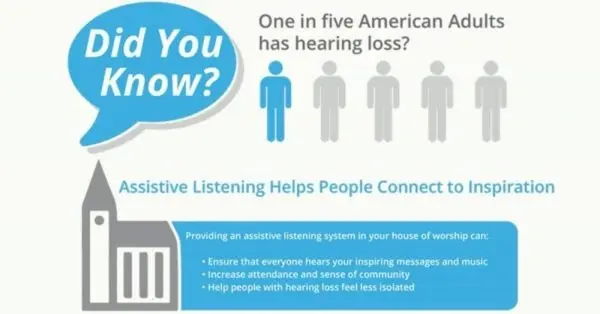
According to data compiled by public health agencies and audiological associations, hearing loss is one of the most prevalent chronic health conditions in modern society. In the United States alone, approximately 48 million individuals experience some degree of hearing loss. Statistically, this means that in virtually any mid-to-large-sized congregation, a significant percentage of attendees are struggling to comprehend spoken dialogue during religious services.
| Demographic Metric | Statistical Prevalence / Impact |
|---|---|
| General Population Impact | ~48 million Americans affected by hearing loss |
| Age-Related Factor | Prevalence doubles every decade past age 50 |
| Psychological Cost | High correlation with social isolation and church disengagement |
| Acoustic Challenge | High reverberation times (RT60) in traditional sanctuaries degrade speech intelligibility |
| Regulatory Mandate | Compliance with ADA Title III for places of public accommodation |
The consequences of unaddressed hearing loss extend far beyond mere physical inconvenience. Audiological research consistently links untreated hearing impairment to social isolation, depression, cognitive fatigue, and—crucially for religious institutions—gradual withdrawal from community life. When congregants can no longer comprehend the sermon, they often quietly stop attending, feeling alienated from a body of believers they may have belonged to for decades.
Furthermore, acoustical engineers point out that traditional church architecture—characterized by vaulted ceilings, hard reflective surfaces, stained glass, and marble pillars—creates severe acoustic reverberation. This long reverberation time (RT60) blurs consonants and muddies speech. Even individuals with normal hearing can struggle in such environments; for those with sensorineural hearing loss, the space becomes completely unintelligible.
From a regulatory standpoint, places of worship historically enjoyed sweeping exemptions under certain civil rights statutes; however, the legal and ethical consensus has shifted dramatically. Title III of the Americans with Disabilities Act (ADA) mandates that places of public accommodation ensure effective communication with individuals with disabilities. Implementing an ALS is not merely a charitable gesture; it is an alignment with the highest standards of civic and moral responsibility.
Official Statements & Industry Insights
Industry leaders and ministry accessibility advocates have long championed the integration of assistive technologies as a litmus test for authentic community care.
In a joint whitepaper on house of worship audio design, accessibility engineers note:
"A sound system is only as good as its final delivery to the human ear. If a worship space pumps 100 decibels of crystal-clear music through the mains, yet fails to deliver intelligible, noise-free speech to the hearing-impaired congregant sitting in row fifteen, the system has failed its core objective. Inclusion is not achieved by high-volume amplification; it is achieved by precision delivery."
Pastoral leadership experts echo this sentiment, emphasizing the theological mandate of hospitality. As noted in guidance accompanying the Listen Technologies Church Assistive Listening Toolkit:
"Reaching out to those who feel disconnected from your community due to hearing loss is central to sharing the message of inclusion. Genuinely compassionate service involves being aware of and caring for the needs of everyone, especially those dealing with impairments. Make sure they are able to hear the beauty and emotion of the spoken word in your church by providing them with the equipment they need to stay connected."
AV integration specialists continually stress that technology selection must be matched to architectural realities. Whether utilizing a radio frequency (RF) system that broadcasts over radio waves, an infrared (IR) system bounded by line-of-sight walls, or an induction loop system that transmits magnetic signals directly to hearing aids, the goal remains singular: zero-latency, high-fidelity auditory engagement. Organizations are encouraged to leverage comprehensive resources, such as downloading the official Listen Technologies Church Assistive Listening Toolkit, which supplies turnkey sample surveys, signage vectors, and bulletin announcements designed to fast-track operational success.
Future Outlook: The Next Generation of Acoustic Accessibility
Looking toward the horizon, the landscape of assistive listening in houses of worship is undergoing a rapid digital transformation. As audio technology converges with personal consumer electronics, the future of accessibility will move away from bulky, dedicated receiver packs and toward personal smartphone integration and advanced wireless protocols.
One of the most promising developments is the proliferation of Audio-over-Wi-Fi systems. These platforms allow congregants to download a dedicated mobile application on their own smartphones, connect to a secure, ultra-low-latency local Wi-Fi network provided by the church, and stream the pristine audio feed directly to their personal earbuds, headphones, or Bluetooth-enabled hearing aids. This approach virtually eliminates the hardware management, battery maintenance, and sanitization overhead traditionally associated with physical receiver packs.
Concurrently, the rapid adoption of Bluetooth Low Energy (LE) Audio and Auracast broadcast technology promises to revolutionize how public spaces transmit audio. Auracast will enable houses of worship to broadcast high-quality audio streams directly to an unlimited number of compatible hearing aids, cochlear implants, and consumer wireless earbuds simultaneously within a given radius. Congregants will simply select the church’s audio stream from their phone’s native Bluetooth menu, exactly as they would connect to public Wi-Fi.
However, even as technology evolves toward smartphone-centric paradigms, the human elements of the four-step framework—understanding needs, financial stewardship, staff training, and intentional awareness campaigns—will remain immutable. Technology is merely the conduit; the true measure of a house of worship’s success lies in its unwavering commitment to ensuring that no soul is left straining to hear the message of grace.
As religious institutions plan their capital improvement budgets and acoustic upgrades for the years ahead, prioritizing Assistive Listening Systems will separate exclusionary spaces from truly welcoming spiritual homes. By embracing both modern engineering marvels and compassionate operational practices, houses of worship can finally fulfill the ancient, vital call: "Let anyone with ears to hear listen."