
Executive Overview
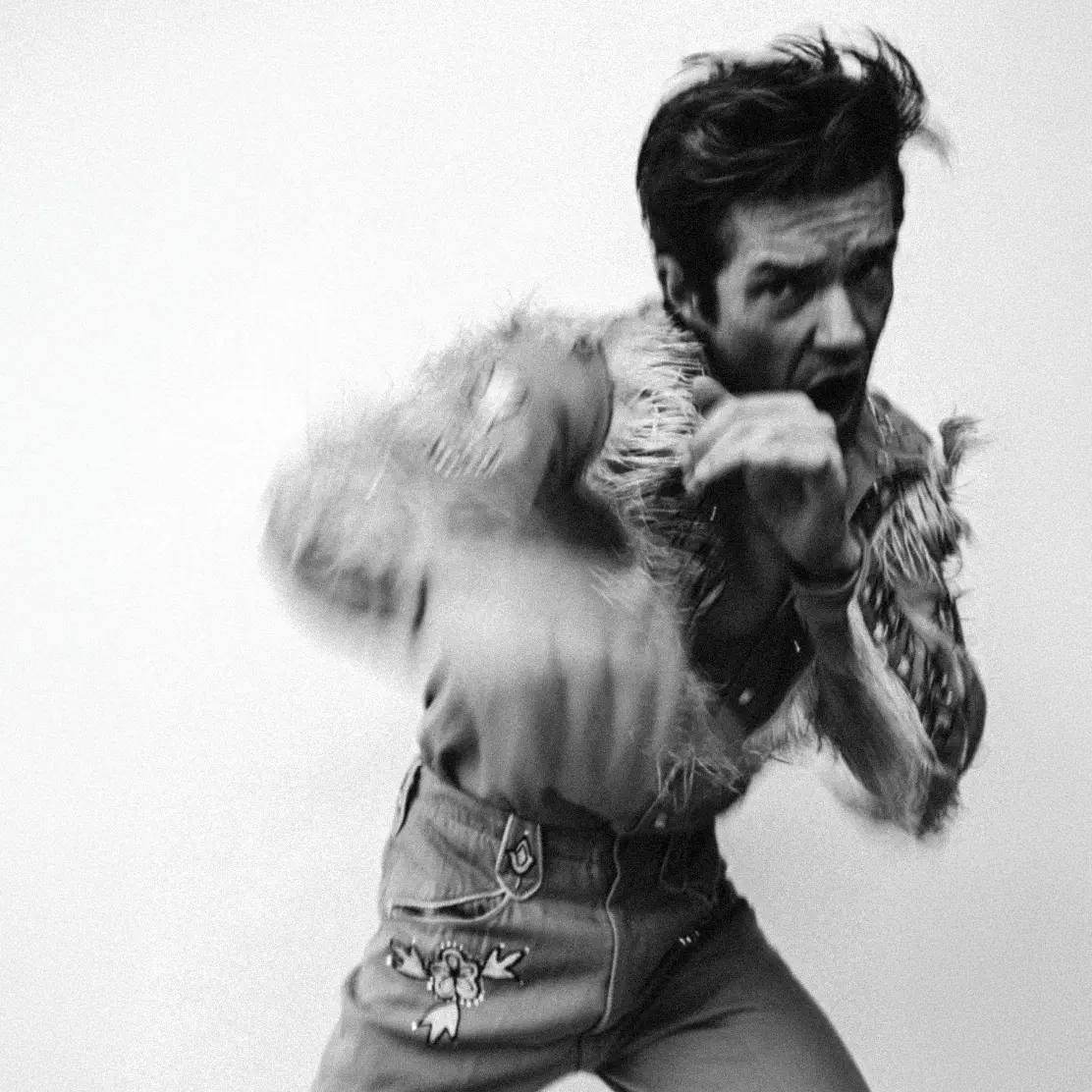
For over two decades, Brandon Flowers has stood at the helm of The Killers, steering one of modern rock’s most reliable and enduringly theatrical acts. From the neon-soaked, synthesizer-driven anthems of their landmark 2004 debut, Hot Fuss, to the dusty, small-town Americana of 2021’s Pressure Machine, Flowers has consistently mapped the intersection of earthly ambition and heavenly longing. Yet, his latest artistic pivot represents a profound departure from stadium-sized bombast.
With his new solo album, Thrasher, recorded at the historic RCA Studio A in Nashville and slated for release on August 21, Flowers delivers a deeply personal, country-western-infused record. Steeped in rhinestones, sawdust, biblical imagery, and a surreal, hallucinatory encounter with the King of Rock and Roll, the album stands as a masterclass in genre-blurring storytelling.
More than just a stylistic detour, Thrasher forces a broader cultural conversation about faith, art, and the porous boundaries between the secular music industry and spiritual expression. Released under the banner of contemporary Christian music commentary, the album challenges traditional industry silos. It asks listeners a provocative question: What happens when an unapologetic Latter-day Saint rock icon strips away the digital sheen of modern studio production to record raw, live-band country music saturated with the language of grace, redemption, and Christ?
Detailed Chronology: The Making of Thrasher
The genesis of Thrasher stretches back to Flowers’ childhood in Nephi, Utah, and his complicated, deeply formative relationship with the music of his father. While Flowers built his reputation on the driving post-punk revivals of the early 2000s, his earliest acoustic memories were rooted in classic country storytelling and rock-and-roll theatricality—two forces that he views not as competing genres, but as different tracks on the same cassette tape.
The Nashville Sessions and RCA Studio A
Seeking a radical break from the polished precision of contemporary pop and rock production, Flowers relocated temporarily to Nashville. He booked time at the legendary RCA Studio A, deliberately choosing to track the album with a live ensemble of seasoned Music City session musicians playing together in the same room.
This approach marked a deliberate homecoming to a methodology Flowers had not utilized since tracking The Killers’ critically acclaimed 2006 sophomore record, Sam’s Town. The resulting sonic texture is starkly immediate, refreshingly organic, and occasionally jarring to modern ears conditioned by the compressed perfection of digital mixing. The instruments breathe; the room itself feels like a physical presence on the record.
From Small-Town Utah to the Las Vegas Strip
Lyrically, Thrasher functions as a thematic bridge, synthesizing the dusty, blue-collar vignettes of Pressure Machine with the glitz, gamblers, and dreamers of Las Vegas.
- “Does It Ever Cross Your Mind?”: The album opens with an effortless, swinging waltz that feels as though it was pulled straight from the stage of the Grand Ole Opry. Delivered with the world-weary authority of an aging country legend, the track lulls the listener into an immediate sense of comforting familiarity before subverting expectations with complex emotional undercurrents.
- “Paradise”: Exploding out of the speakers with relentless energy, this track dives headfirst into the exhausting, melancholic reality of an aging Las Vegas casino valet, capturing the desperate pursuit of the American dream against a backdrop of neon and broken promises.
- “Miss America”: Easily one of the most arresting and emotionally harrowing compositions of Flowers’ career, this song was directly inspired by his sister’s harrowing experiences with the cycle of abuse. Eschewing metaphor for stark emotional clarity, the track examines domestic trauma before ultimately imagining a redemptive horizon where a "Mormon boy" treats his sister with the dignity of a queen.
The Final Vision: "An American Dream"
The album culminates in its final track, "An American Dream," a psychedelic meditation on mortality. In the song’s narrative, Flowers envisions nearing the end of his life, interacting with a Tesla vehicle, and ultimately coming face-to-face with Elvis Presley. Rather than treating Presley as a cheap pop-culture trope, Flowers frames the King as a profound spiritual predecessor—a monumental artist raised in church, perpetually torn between the sacred and the spectacular, passing a final torch down to his creative progeny. The album closes on a staggering collision of theological and cultural imagery: “Gold and Silver, God and Glitter.” As Elvis hands Flowers the keys, he offers a final, indelible piece of advice: "Put it on Jesus."
Supporting Context & Metrics: Faith, Rock Culture, and Industry Categorization
To understand Thrasher, one must grapple with Brandon Flowers’ lifelong, unashamed engagement with his faith. As a member of The Church of Jesus Christ of Latter-day Saints, Flowers spent much of his early career as an outlier within an indie-rock ecosystem that frequently viewed traditional religious devotion with cynicism or indifference.
An Adult Reckoning with Faith
In recent interviews with prominent cultural critics, Flowers has been remarkably candid about how his spiritual identity has evolved from childhood indoctrination into a deliberate, adult conviction. Speaking with The Observer, he reflected:
"Well, I have discovered you can be Mormon and cool. But it’s been a real journey. I was so young when we started. I was indoctrinated into this church, I understand that. But at some point, you’ve got to decide if it’s going to be your faith or not. That’s where the rubber meets the road. And I deepened my faith once I really committed to that road. I don’t find it nearly as difficult now to decide what choices I’m going to make."
This commitment is further illuminated by his reflections on his father’s conversion when Flowers was just six years old—a seismic domestic shift marked by the disappearance of alcohol and cigarettes from the home and the emergence of a renewed paternal stability, as he noted in an interview with The Times.
The Paradox of Mainstream vs. Christian Music
For audiences accustomed to neatly curated genre boundaries, Thrasher blurs the lines of what constitutes "faith-based" art. While Flowers’ theological framework differs significantly from standard evangelical paradigms—distinctions that Christian music publications must accurately and respectfully acknowledge—his catalog consistently exhibits a higher degree of explicit biblical imagery and spiritual inquiry than many releases marketed strictly to Christian retail spaces.
Consider Flowers’ broader body of work:
- "When You Were Young" (The Killers): Explicitly cautions listeners against a deceptive devil who "doesn’t look like Jesus."
- "Dying Breed" (The Killers): Celebrates the counter-cultural, sustaining power and sanctity of a lifelong marriage.
- "Fire in Bone" (The Killers): Retells the emotional and spiritual arc of the Prodigal Son.
Flowers has never treated faith as a decorative accessory or a marketing gimmick; it is foundational to the architecture of his songwriting.
Official Statements and Editorial Framework
The decision to cover Thrasher within publications historically dedicated to Christian music and culture signals a calculated evolution in how media organizations evaluate spiritually resonant art.
Expanding the Cultural Conversation
Industry analysts and editorial boards note that reviewing a mainstream release like Thrasher is not an attempt to erase distinct theological differences or issue a blanket endorsement of every facet of an artist’s personal worldview. Rather, it represents a commitment to recognizing that spiritually meaningful art has never been exclusively confined to industrial Christian subcultures.
Consulting with legacy figures in faith-based journalism helps contextualize this shift. Reflecting on the earliest days of industry reporting, foundational figures like CCM founder John Styll noted:
"We did not make a distinction between mainstream releases and Christian-market releases. We only reviewed mainstream albums when we thought there was a reason our audience would be—or should be—interested."
This guiding philosophy underpins the modern pivot toward selective, discerning coverage of secular releases. The objective is to equip audiences to engage critically with art that wrestles with ultimate questions, even when packaged within mainstream rock or country-western aesthetics.
Content Warnings for Families
While Thrasher contains profound spiritual reflections, parents and families should approach the album with discernment. The project features mild profanity and deals unflinchingly with heavy themes, including violence, systemic abuse, and trauma. These elements are not utilized for sensationalism, but rather serve as narrative tools within Flowers’ exploration of broken human lives searching for redemption.
Future Outlook
As the August 21 release date for Thrasher approaches, the album is positioned to be one of the most critically scrutinized and culturally fascinating releases of the year.
For Brandon Flowers, the project proves that artistic longevity does not require resting on laurels or recycling past stadium formulas. By stripping away synthesizers in favor of live-room country instrumentation, Flowers has completed a radical soul-searching exercise that connects his childhood roots in Nephi, Utah, with the neon lights of Las Vegas and the historic halls of Nashville.
More broadly, Thrasher serves as a test case for how modern audiences and media outlets consume art. It challenges listeners to look past rigid corporate marketing categories and engage directly with the messy, beautiful collision of faith, fame, doubt, and grace. Whether fans encounter the record through the lens of rock history, country storytelling, or personal spiritual reflection, Thrasher cements Brandon Flowers’ status as one of contemporary music’s most daring and unapologetic spiritual chroniclers.