
Executive Overview
As the winter chill sets in and households around the globe begin preparing for the holiday season, music stands ready to capture the warmth, nostalgia, and reverence of the festivities. Among the rich tapestry of traditional holiday compositions, "The First Noel" (frequently spelled and styled as "The First Nowell") holds a cherished, timeless place. Originating as a traditional Cornish Christmas carol, this profound piece narrates the miraculous events of the Nativity, tracing the journey of the humble shepherds, the guiding light of the celestial star, and the eventual arrival of the three wise men bearing gifts for the newborn King.
To help musicians of varying skill levels bring this classic masterpiece to life on the keyboard, Ben Dunnett LRSM—founder of the Music Theory Academy, experienced music educator, composer, and examiner with over two decades of professional experience in music education—has curated and released a comprehensive, three-tiered piano learning package. Designed to cater to everyone from enthusiastic beginners to seasoned virtuosos, this initiative features three distinct, meticulously crafted piano arrangements: an accessible Easy Version, a harmonically enriched Intermediate Version, and a sophisticated, concert-ready Advanced Version pulled directly from Dunnett’s acclaimed holiday album, 10 Christmas Carols.
This publication serves as an exhaustive resource for pianists, educators, and music enthusiasts looking to deepen their holiday repertoire. Below, we explore the historical roots of the composition, analyze the technical demands and pedagogical merits of each difficulty tier, examine the lyrical narrative that has captivated audiences for centuries, and review the broader cultural footprint of a carol that continues to inspire artists worldwide.
Detailed Chronology: The Evolution of "The First Noel"
To fully appreciate the technical nuances of Dunnett’s piano arrangements, one must first understand the historical and musical lineage of "The First Noel." The song’s history is a fascinating journey through centuries of oral tradition, regional folklore, and eventual publication.
Origins and Early Transmission
Etymologically and historically rooted in the West Country of England—specifically Cornwall—"The First Noel" is widely regarded as a traditional English carol, though its exact origins remain shrouded in the mists of pre-Victorian folk history. Unlike many hymns penned by known clergy in the 18th or 19th centuries, "The First Noel" began life as folk poetry, passed down orally from generation to generation among rural communities, carolers, and church congregations.
The word "Noel" itself derives from the French word noël, which traces its roots back to the Latin natalis (meaning "birth"). Historically, the term was used across Europe as a joyful shout or refrain to celebrate the birth of Jesus Christ. In Cornwall, where community singing and choral traditions run deep, the carol evolved distinct musical characteristics, including a haunting, modal melody and a recurring refrain that emphasizes corporate worship and communal joy.
Publication and Standardization
For generations, the tune existed in numerous local variants, with different villages singing slightly altered melodies and lyrical verses. The earliest definitive print appearance of the carol occurred in 1823, when it was published in Christmas Carols Ancient and Modern, edited by William Sandys. Sandys’ collection was instrumental in preserving many traditional English carols that might otherwise have been lost to industrialization and shifting cultural tastes.
Later in the 19th century, composer and editor Sir John Stainer helped cement the modern harmonization of "The First Noel" in his landmark 1871 publication, Christmas Carols New and Old. Stainer’s version introduced the steady, driving chordal accompaniment that modern listeners instantly recognize. However, contemporary arrangers like Ben Dunnett continue to find fresh expressive potential within the timeless tune, stripping away predictable harmonies to offer modern pianists innovative interpretations that respect the piece’s folk origins while challenging contemporary technical standards.
Supporting Context & Metrics: Pedagogical Breakdown of the Three Arrangements
Ben Dunnett’s three-tiered arrangement strategy addresses a fundamental challenge in music education: how to make a classic, universally beloved piece accessible to novices while retaining enough complexity to stimulate advanced practitioners. Below is an exhaustive breakdown of each tier, its technical requirements, and its pedagogical objectives.
+-----------------------------------------------------------------+
|                  BEN DUNNETT'S PIANO TIERS                      |
+-----------------------------------------------------------------+
          |                                       |
          v                                       v
    [ EASY VERSION ]                     [ INTERMEDIATE VERSION ]
  - Melody in Right Hand                - Enriched Right-Hand Harmonies
  - Simple Bass Line                    - Spread Chord Challenge (Left Hand)
  - Explicit Fingering Marks            - Blank Fingering (Independent Study)
          |
          v
    [ ADVANCED VERSION ]
  - Sourced from "10 Christmas Carols" Album
  - Concert-Level Virtuosity
  - Sophisticated Voice Leading & Dynamic Range
1. The Easy Version: Building Foundational Mechanics
- Target Audience: Absolute beginners, late-elementary students, and pianists returning to the instrument after an extended hiatus.
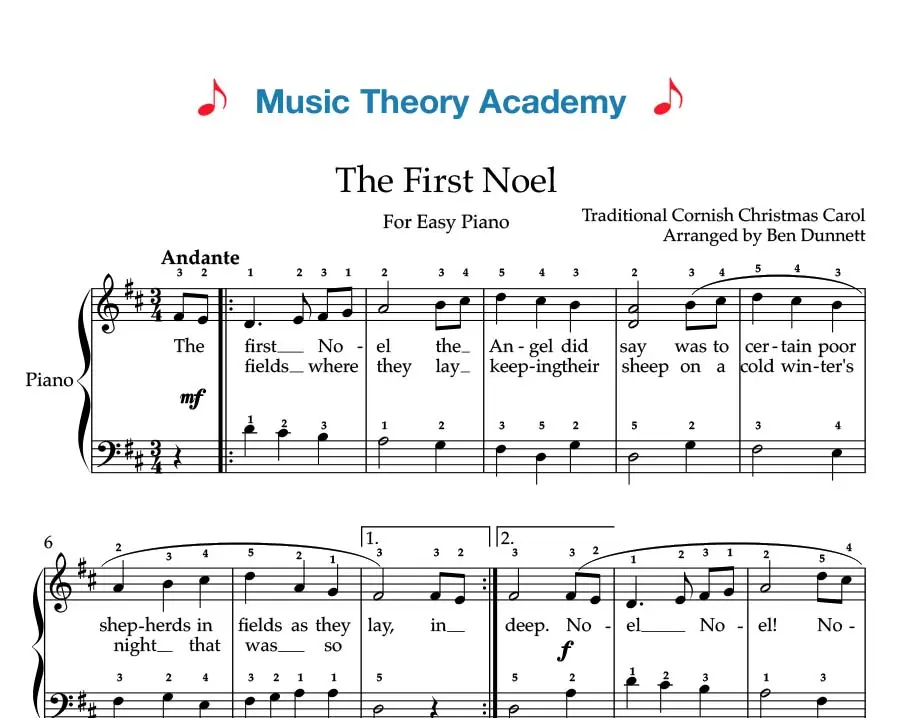
- Structural Design: The easy arrangement centers entirely on a clear, unembellished melody line assigned to the right hand, underpinned by a sparse, accessible bass line in the left hand.
- Pedagogical Focus: Scalic passages and finger independence. Because "The First Noel" features extended melodic steps that mimic vocal lines, players must navigate several scalic runs. Dunnett has thoughtfully provided explicit fingering annotations throughout this score. Beginners are strongly advised to pay close attention to these markings—particularly the mechanics of tucking the thumb under during scalic passages—as developing correct fingering habits early prevents physical tension and builds smooth, fluid execution.
2. The Intermediate Version: Expanding Harmonic Awareness
- Target Audience: Intermediate players (typically grades 3–5 equivalent) seeking to upgrade their sight-reading and chordal control.
- Structural Design: This arrangement elevates the complexity by introducing extra notes into the right hand, effectively weaving richer harmonies and fuller chordal textures beneath the primary melody. Furthermore, the left hand is introduced to more demanding movements, culminating in a striking spread chord near the conclusion of the piece.
- Pedagogical Focus: Harmonic voicing and independent problem-solving. Uniquely, Dunnett leaves the fingering blank on the intermediate score. This is an intentional pedagogical choice designed to encourage intermediate students to analyze the keyboard topography independently, determine the most ergonomic hand shapes, and cultivate critical thinking regarding fingering logistics.
3. The Advanced Version: Concert-Level Artistry
- Target Audience: Advanced pianists (grades 6 and above), diploma students, and professional performers looking for a sophisticated holiday showpiece.
- Structural Design: Taken directly from Ben Dunnett’s professional holiday piano album, 10 Christmas Carols, this arrangement represents a masterclass in modern carol interpretation. It utilizes advanced voice leading, intricate counterpoint, dynamic contrast, and sweeping keyboard textures.
- Pedagogical Focus: Interpretive depth, tone production, and stylistic polish. Dunnett recommends that advanced pianists study the sheet music while simultaneously listening to his recorded performance (available via YouTube and streaming platforms). This dual sensory approach allows students to capture the subtle rubato, phrasing nuances, and emotional gravity intended by the composer.
Official Statements & Expert Insights
As a seasoned educator, Ben Dunnett’s pedagogical philosophy emphasizes that technical mastery should always serve musical expression. In commentary accompanying the release of these sheet music tiers, Dunnett highlights the importance of matching the right arrangement to the student’s current developmental stage to foster a lifelong love for playing.
"When arranging traditional carols like ‘The First Noel,’ the primary objective is to honor the inherent beauty of the melody while offering the performer room to grow," Dunnett explains. "Whether a student is playing their very first simplified octave scale or tackling lush, advanced harmonies drawn from my album, the goal is always to connect the pianist deeply to the story and emotion of the music."
Music education experts frequently praise multi-tiered publishing models like Dunnett’s. By providing scaled versions of the same canonical piece, teachers can utilize "The First Noel" across mixed-ability studio recitals, enabling students of different ages and grades to collaborate, appreciate varied interpretations of the same thematic material, and understand how musical arrangements evolve from barebones melodies to complex, textured compositions.

Cultural Impact and Modern Repertoire
While traditional carols like "The First Noel" are deeply rooted in sacred holiday traditions, their cultural footprint extends far beyond church walls into contemporary pop culture, jazz, and mainstream media. The song’s soaring, majestic architecture has made it a favorite vehicle for vocal powerhouses across generations.
Iconic Recordings and Pop Culture Adaptation
Over the decades, "The First Noel" has been recorded by an extraordinary roster of global superstars. Landmark contemporary renditions include:
- Whitney Houston: Known for her soul-stirring gospel-inflected vocals, Houston’s interpretations of holiday classics brought unmatched vocal agility and emotional intensity to traditional carols.
- Mariah Carey: As the undisputed queen of modern Christmas music, Carey has incorporated elements of traditional carol styling into her celebrated holiday catalog, influencing how contemporary listeners consume seasonal standards.
- The Cast of Glee: Bringing choral arrangements to prime-time television, the ensemble cast introduced classic carols like "The First Noel" to a vibrant, younger demographic, proving the enduring relevance of centuries-old melodies in modern media.
Complete Lyrical Narrative
To assist pianists in phrasing their performances expressively, it is essential to understand the poetic narrative encoded within the music. Below is the complete traditional text of the carol:
The first Noel the angel did say
Was to certain poor shepherds in fields as they lay;
In fields where they lay, keeping their sheep,
On a cold winter’s night that was so deep:
Refrain:
Nowell, Nowell, Nowell, Nowell,
Born is the King of Israel.They looked up and saw a star
Shining in the east beyond them far;
And to the earth it gave great light,
And so it continued both day and night.
RefrainAnd by the light of that same star
Three wise men came from country far;
To seek for a king was their intent,
And to follow the star wherever it went.
RefrainThis star drew nigh to the northwest;
O’er Bethlehem it took its rest,
And there it did both stop and stay,
Right over the place where Jesus lay.
RefrainThen entered in those wise men three,
Full reverently upon their knee,
And offered there in his presence
Their gold, and myrrh, and frankincense.
RefrainThen let us all with one accord
Sing praises to our heavenly Lord,
That hath made heaven and earth of nought,
And with his blood our life hath bought.
Refrain
Future Outlook: Holiday Piano Education in the Digital Age
As music education continues to evolve through the integration of digital platforms, high-definition video tutorials, and instant PDF sheet music distribution, initiatives like Ben Dunnett’s Music Theory Academy represent the future of accessible instrumental learning.
Looking ahead, online pedagogy is shifting toward hybrid learning models where students can instantly pair visual sheet music downloads with auditory reference guides (such as embedded YouTube performances and Spotify tracks). This multi-modal approach accelerates skill acquisition, deepens interpretive understanding, and empowers self-directed learners across the globe.
For pianists eager to enrich their seasonal repertoire this winter, downloading these graded arrangements of "The First Noel" offers an ideal pathway to artistic growth. Whether mastering the thumb-tucks of the easy version, exploring chordal voicing in the intermediate score, or conquering the virtuosic demands of the advanced album arrangement, performers are invited to connect with a centuries-old musical tradition in a deeply personal, creatively fulfilling way.