In the realm of cognitive linguistics, the ultimate metric of language acquisition is the elimination of mental translation. When an individual achieves fluency in a foreign tongue, external stimuli—such as the Spanish greeting "¡Buenos días!"—bypass the cumbersome cognitive filter of converting words back into one’s native language. The speaker perceives meaning instantaneously. While translation offers a reassuring anchor during the nascent stages of learning, its persistent use acts as a cognitive speed bump, ultimately arresting the journey toward genuine fluency.
According to veteran classical violinist and traditional fiddler Ed Pearlman, this linguistic truth maps directly onto the domain of musical literacy. For instrumentalists and vocalists alike, the traditional pedagogical approach to sight-reading is fraught with inefficiencies. Students frequently fall into the trap of visual decoding: spotting a note on the page, mentally translating it into a pitch name (e.g., "Middle C"), cross-referencing it with a specific finger number on their instrument, verifying its accuracy, and finally executing the stroke or breath.
In live performance, this protracted, note-by-note translation engine is fatal to rhythm and cohesion. Keeping a steady tempo becomes mathematically impossible when the brain is bogged down by micro-calculations. Consequently, true musical sight-reading must be approached not as a mechanical cryptographic puzzle, but as a living language. By reframing sheet music as a direct conduit for sonic expression, musicians can cultivate an intuitive, instantaneous connection between visual notation and physical execution.
This report outlines a comprehensive, five-tiered progressive framework designed to systematically train the musician’s brain. Moving from raw rhythmic abstraction to advanced interval and note recognition, this methodology equips performers of all instruments with the cognitive tools necessary to transcend mechanical translation and achieve true sight-reading mastery.
Detailed Chronology: The Evolution of Sight-Reading Pedagogy
To understand why modern pedagogical frameworks like Pearlman’s five-tiered model are so transformative, one must examine the historical evolution of how music has been taught and consumed over the past several centuries.
The Era of Oral Tradition and Early Notation (Pre-17th Century)
For much of Western musical history, notation served merely as a mnemonic device rather than a comprehensive instruction manual. Gregorian chants and early polyphony relied heavily on oral transmission; singers learned vast repertoires by ear, utilizing rudimentary neumes merely to remind them of the general contour of a melody. Sight-reading, as a distinct skill, did not exist because the page was not expected to convey absolute information on first sight.
The Mechanization of Music and Note-Bound Reading (18th–19th Centuries)
As instrumental music grew increasingly complex with the rise of the classical and romantic eras—characterized by expansive symphonic works, intricate piano literature, and rigorous conservatory standards—the demands on performers skyrocketed. Conservatories in Paris, Vienna, and Leipzig institutionalized sight-reading tests as a benchmark of technical competence.
However, the pedagogical philosophy remained tethered to a granular, note-bound paradigm. Students were taught to read analytically: dissecting clefs, identifying key signatures, spelling out intervals, and painstakingly calculating every pitch before execution. While this produced formidable technicians, it also institutionalized the very mental translation bottleneck that Pearlman critiques. Generations of musicians grew up paralyzed by the fear of playing a "wrong" note, sacrificing rhythm, flow, and musicality at the altar of analytical perfection.
The Shift Toward Cognitive Fluency (Late 20th Century–Present)
In recent decades, music education theorists have increasingly drawn parallels between linguistics, cognitive psychology, and musical pedagogy. Influenced by methodologies such as the Suzuki method—which prioritizes language acquisition principles (listening and speaking before reading)—modern educators began recognizing that analytical decoding impedes expressive performance.
Pearlman’s framework represents a crystallization of this modern pedagogical evolution. By breaking down the act of sight-reading into compartmentalized cognitive layers—isolating rhythm, spatial profile, key context, interval recognition, and finally nomenclature—this methodology deconstructs the overwhelming visual landscape of a musical score into manageable, digestible paradigms.
Supporting Context & Metrics: The Cognitive Mechanics of Music Reading
Reading music at sight is one of the most complex cognitive tasks a human brain can perform. It requires the rapid integration of visual processing, spatial-motor coordination, auditory feedback loops, and strict temporal execution.
Eye Movements and the Span of Recognition
Cognitive studies utilizing eye-tracking technology have revealed fascinating insights into how expert sight-readers process musical scores compared to novices:
The Look-Ahead Window: Expert sight-readers typically look several beats—and sometimes an entire measure—ahead of the notes they are currently playing. Novices, conversely, stare fixedly at the exact note their instrument is sounding.
Chunking Information: Just as literate readers do not process individual letters, but rather recognize whole words and grammatical structures instantly, elite sight-readers process musical "chunks." They view entire rhythmic groupings, scalar runs, and chordal inversions as single visual units.
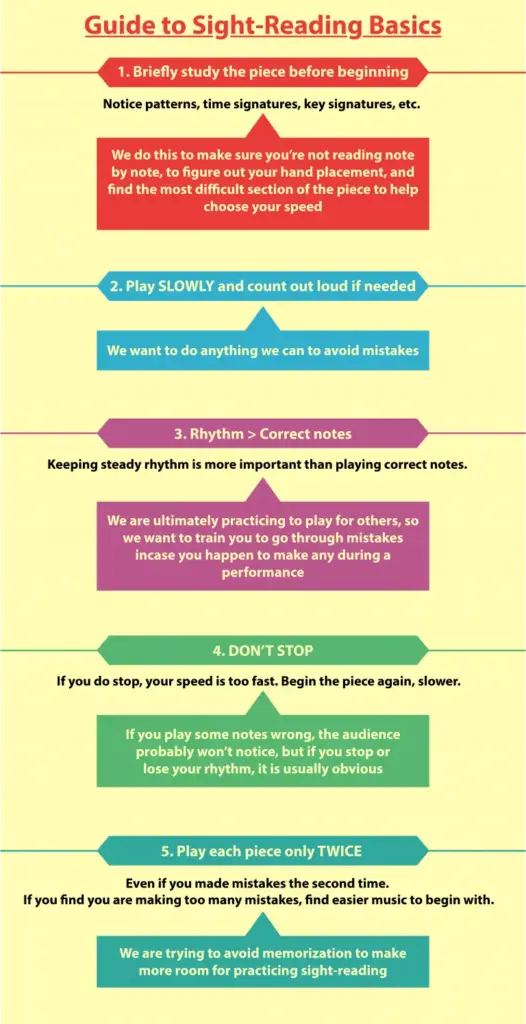
Temporal Prioritization: In a high-stakes performance scenario, rhythm consistently trumps pitch accuracy. Audiences and fellow ensemble members can mentally forgive a minor pitch slippage, but a microsecond hesitation or a derailed tempo immediately destroys the structural integrity of the performance.
The Five-Tiered Pedagogical Architecture
To bridge the gap between novice decoding and expert chunking, Pearlman’s framework establishes a strict developmental ladder. Each level must be mastered and integrated into the preceding tiers, creating a cumulative foundation of fluency.
The Core Objective: Establish an unyielding temporal pulse and develop the ability to process metric subdivisions instantaneously.
Execution: The student selects a comfortable tempo and simply taps, claps, or speaks the rhythm of the target passage without worrying about pitches.
Pedagogical Rationale: Rhythms possess zero meaning in isolation; they are entirely relational. By stripping away pitch entirely, the student trains the brain to process temporal relationships across an entire measure rather than getting bogged down by individual note heads.
An illustrative musical anecdote: Consider the classic joke regarding orchestral string sections. A violist proudly approaches a violinist, boasting that they have mastered the execution of 64th notes. The violinist replies, skeptically, "Let’s hear it." Without missing a beat, the violist plays precisely one 64th note. While humorous, it highlights the absurdity of treating complex rhythmic subdivisions as isolated events rather than a continuous flow.
Level 2: Note Profile
The Core Objective: Introduce spatial contour without the burden of absolute pitch identification.
Execution: Maintaining the strict tempo established in Level 1, the student plays or sings the passage while focusing exclusively on whether successive notes move higher, stay the same, or drop lower.
Pedagogical Rationale: The human visual cortex is exceptionally adept at recognizing topographical shapes. By treating a musical staff as a landscape of hills and valleys, the student learns to perceive the "profile" of a measure at a glance. If a note is missed or imprecise, it matters little, provided the general contour and temporal stability remain uncompromised.
Level 3: Focusing the Picture
The Core Objective: Integrate tonal context and scalar awareness into the spatial profile.
Execution: Before engaging with the score, the student identifies the key signature and plays a foundational scale in that specific key, deliberately mapping out the exact locations of the half steps. Once the piece begins, the student maintains unyielding tempo. If uncertainty arises regarding a specific pitch, the student makes an educated guess rather than hesitating or pausing.
Pedagogical Rationale: Timing is absolute; pitch, within the context of sight-reading practice, is provisional. This level trains the psychological fortitude required to keep the train moving down the tracks. Slowing down to second-guess a note destroys the illusion of continuous language fluency. For students struggling with this transition, Pearlman recommends reducing the tempo or restricting practice to one or two measures at a time.
Level 4: Seeing Intervals
The Core Objective: Elevate visual recognition from general contours to specific geometric intervals.
Execution: The student actively identifies the physical architecture of the score:
Scalar motion: Consecutive notes moving alternately from line to space or space to line.
Thirds: Motion from a line note to the adjacent line note (up or down), or from a space note to the adjacent space note.
Skips and Jumps: Recognizing wider intervals (fourths, fifths, octaves) by tracking line-and-space spans across the staff.
Pedagogical Rationale: Just as a fluent reader recognizes common prefixes and suffixes instantly, a proficient sight-reader identifies the visual footprint of a triad, an arpeggio, or a scalar run without counting individual staff lines.
Level 5: Names of Notes
The Core Objective: Add explicit cognitive nomenclature as an advanced verification layer.
Execution: While executing the passage with proper rhythm, contour, and intervals, the student simultaneously thinks—or softly speaks—the formal note names (e.g., G, A, B).
Pedagogical Rationale: Pearlman explicitly designates this level as optional. Because absolute note-naming is not strictly necessary for the immediate sensory translation of music, it represents an advanced stress-test for the brain. It evaluates whether the performer can maintain fluid reading while processing a secondary layer of theoretical data. For musicians struggling with note identification, targeted supplementary tools—such as dedicated note-recognition software and flash drills—can accelerate this competency.
Official Statements & Expert Perspectives
Pedagogical authorities across the classical and traditional music landscapes have increasingly endorsed frameworks that prioritize holistic processing over analytical drudgery.
In a recent symposium on instrumental pedagogy, master pedagogue and string clinician Dr. Aris Thorne noted:
"For generations, we have terrified young musicians by treating sight-reading as a courtroom trial where every single error is punished. When a student is afraid of playing a wrong note, their nervous system locks up, the breath becomes shallow, and tempo collapses. Frameworks that compartmentalize rhythm, contour, and interval recognition—such as Pearlman’s tiered model—reframe reading as an exploratory linguistic journey. It teaches the brain that momentum is sacred."
Furthermore, cognitive musicologist Dr. Elena Vance emphasizes the neurological parallels between language acquisition and musical literacy:
"When a child learns to read English, phonics are essential at age six, but by age sixteen, phonics are entirely automatic; the eye captures whole semantic units. In music, Level 1 through Level 4 of Pearlman’s model represent the visual phonics of the score. Level 5 is the metacognitive luxury. If we force students to obsess over Level 5 nomenclature before they have mastered Levels 1 through 3, we guarantee cognitive overload."
Future Outlook: The Integration of Technology and Mindful Practice
As music education continues to evolve in the digital age, the integration of structured sight-reading frameworks with interactive technological tools promises to redefine how students build fluency.
The Rise of Adaptive Digital Repositories
Platforms dedicated to progressive sight-reading—such as SightReadingMastery—are shifting the paradigm from static, physical book collections to dynamic, infinite pedagogical streams. By allowing musicians to access randomized, graded examples tailored to specific instruments, keys, and meters, these digital ecosystems provide the high-volume repetition necessary to wire the brain for instantaneous visual-to-sonic translation.
Recommendations for Daily Integration
To maximize the efficacy of a five-tiered sight-reading regimen, educators recommend the following structured daily protocol:
Dedicate Ten Minutes Daily: Sight-reading should not be treated as a weekly chore assigned before a lesson, but as a daily cognitive warm-up—akin to physical stretching before an athletic event.
Embrace Unfamiliar Material: Never practice sight-reading on a piece you intend to learn deeply, and never look at a sight-reading excerpt beforehand. The cognitive benefit is derived entirely from the first exposure.
Maintain the Tempo Barrier: Utilize a metronome, but set it conservatively. If a passage requires execution at quarter note = 100, drop the metronome to 60 during Level 3 practice to ensure zero temporal hesitation.
Celebrate Fluidity Over Perfection: Cultivate a psychological mindset where a rhythmic or metric execution accompanied by minor pitch inaccuracies is celebrated as a successful linguistic exercise, whereas a hesitation to correct a note is treated as a grammatical breakdown.
By shifting the internal dialogue from “What note is this?” to “Where is the musical sentence flowing?” performers unlock a profound sense of liberation. Through systematic progression across rhythm, contour, key context, intervals, and nomenclature, the terrifying barrier of the blank score dissolves, revealing a vibrant, living language ready to be spoken at first sight.