
(Vancouver, B.C.) — Giacomo Puccini’s Tosca has always been an opera uniquely tethered to the pulse of political unrest. Set against the backdrop of Rome in 1800—a fragile political landscape where the Kingdom of Naples’ control was violently threatened by Napoleon’s Italian invasion—the 1900 masterpiece explores the volatile intersection of tyranny, lust, revolution, and art.
Today, with political polarization and civil unrest echoing from the streets of Paris to Tel Aviv, and against the backdrop of a seismic provincial election that swept an ultra-right Conservative party into power in British Columbia, the timing for a Tosca revival could not be more electric.
Yet, timing is not everything. Vancouver Opera’s much-anticipated production, which opened on October 24th, arrived on the heels of a turbulent few months for the opera world. Most notably, it followed a dramatic controversy at Calgary Opera, where bass singer Gabriel Sanchez Ortega—ironically cast as the political prisoner Cesare Angelotti—was summarily fired for unfurling a Palestinian flag during his opening-night curtain call, sparking intense protests by closing night. With political passions running at a fever pitch globally, the stage was set for a blistering, urgently relevant theatrical reckoning.
Instead, under the direction of Brenna Corner, Artistic Director of Pacific Opera Victoria, the co-production largely meandered into a state of languid melancholy. While boasting undeniable vocal triumphs and breathtaking visual aesthetics, the production ultimately failed to rise to the historical and actual moment, offering a polite, introspective glimpse of tyranny rather than a clarion call against it.
Executive Overview: A Missed Opportunity for Modern Relevance
The core tension of any modern staging of Tosca lies in its adaptability. The narrative is inherently political: a despotic police chief, Baron Scarpia, uses state power, torture, and sexual coercion to crush a nascent political resistance and entrap a celebrated diva, Floria Tosca.
In an era defined by resurgent authoritarianism, surveillance states, and polarized populism, the parallels to contemporary governance are glaring. Scarpia-type villains abound in the 21st-century geopolitical landscape. However, Vancouver Opera’s production chose a safer, more historically traditional route—a choice that delighted purists of nineteenth-century staging but left those hungering for a theatrical mirror to modern socio-political anxieties wanting.
Comparisons are inevitable. Just months prior, this reviewer experienced Ted Hoffman’s searing production of Tosca at Glyndebourne in the United Kingdom. Performed precisely as a right-wing march in nearby Brighton was disrupted by an antifascist carnival and international peace negotiations flickered in the Middle East, the Glyndebourne staging was an impassioned, hyper-relevant cry against fascism. Inspired by Roberto Rossellini’s neorealist landmark Roma città aperta (Rome, Open City) and set during Mussolini’s fascist Italy, that production gripped audiences with tight pacing, unrelenting choreography, and a fierce urgency that never missed a beat.
By contrast, Vancouver Opera’s mounting—while initially promising in Act I—lost its momentum, devolving into a dramatic stupor in Acts II and III. It presented a kinder, gentler Canadian Tosca, where red-hot revolutionary passion was smothered by polite introspection.
Detailed Chronology: Act-by-Act Breakdown
Act I: A Promising Foundation
The production’s first act offered genuine cause for optimism. Designer Kevin Knight delivered stunning, historically accurate sets and costumes that immediately transported the audience to the church of Sant’Andrea della Valle.
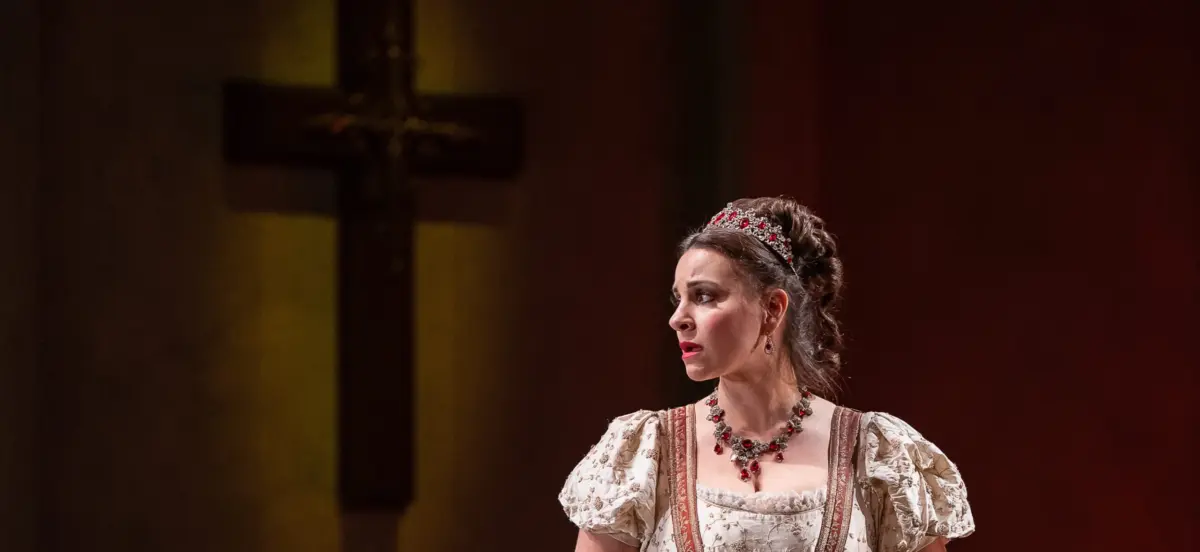
Vocally, the evening belonged firmly to Lebanese-Canadian soprano Joyce El-Khoury in the title role. Fresh off her triumphant 2022 win as "Maria Callas Debut Artist of the Year" for her portrayal of Léïla in Bizet’s The Pearl Fishers at Dallas Opera, El-Khoury brought both a thrilling lyric soprano and formidable dramatic chops to the stage. Her Tosca was no mere ornamental diva, but a complex woman transitioning from a peace-loving artist into an unexpected resistance fighter. Her chemistry with tenor David Pomeroy—cast as her lover, the revolutionary painter Mario Cavaradossi—found its footing quickly, particularly in their playful, flirtatious exchanges regarding kissing in front of the Madonna.
Gregory Dahl entered the fray as Baron Scarpia, proving to be an exceptionally chilling villain. Dahl’s full-throated baritone exposed the dark, predatory nature of his character while retaining moments of psychological nuance. His twisted rationalization of sexual violence and the thrill of the chase evoked a distinct, modern authoritarian chill, while his theatrical pretense of joining the chorus in prayer ("Tosca, you make me forget even God") was executed with chilling hypocrisy.
Furthermore, Act I benefited immensely from Scott Reid’s striking set and video design—utilizing larger-than-life shadows to foreshadow doom—and Michael Walton’s atmospheric lighting, paired with a compelling performance by a local children’s choir.
Act II: The Avenging Madonna vs. The Feminist Heroine
It was in the second act that the production’s dramatic momentum began to stall. Director Brenna Corner had noted in local pre-show interviews that she envisioned Tosca as a feminist heroine—a "woman [who] is more powerful than her world lets her be." Yet, on stage, this vision was blunted.
When El-Khoury’s Tosca fatally stabbed Scarpia, she did not embody the fierce, unyielding fury of a trapped animal striking back at systemic oppression. Instead, she knelt to pray over his body, coming across less as a liberator and more as an avenging, yet sanctimonious, Madonna. While El-Khoury’s vocal delivery remained magnificent—her performance of the iconic "Vissi d’arte" was soaring and poignantly phrased—the staging robbed the murder of its raw, visceral shock value.
Similarly, the shadow images depicting Cavaradossi’s torture in the adjacent room offered a timid nod toward making the audience complicit voyeurs of violence—a clever, modern reference to digital doom-scrolling—yet the concept was left half-realized, trailing off into mere suggestion rather than a biting commentary on state-sponsored brutality.
Act III: A Tragic Climax That Ends with a Whimper
The final act opened with the pristine, clear-toned performance of the shepherd’s song, setting a pastoral yet melancholic mood. This led directly into David Pomeroy’s standout vocal moment: "E lucevan le stelle." Pomeroy’s expressive tenor expertly conveyed Cavaradossi’s heartbreaking memories of love and his fierce, desperate joy of being alive.
The subsequent duet between Cavaradossi and Tosca, filled with shared dreams of love and liberty, was vocally lovely. However, the musical pacing once again dragged, sapping the scene of its necessary theatrical urgency.
The ultimate tragedy—Tosca flings herself from the parapet crying out, "O Scarpia, avanti a Dio!" (O Scarpia, we shall meet before God!)—was similarly subdued. Rather than unfolding as a passionate act of defiance against a dying regime, the climax was smothered in a blanket of theatrical hesitation. For an opera fundamentally built on the pillars of violence, lust, political revolution, and idealism, the evening concluded with a whimper rather than a bang.
Supporting Context & Metrics: The Production Blueprint
To understand the artistic choices behind Vancouver Opera’s Tosca, it is helpful to examine the institutional and technical parameters of the mounting:
- Co-Production Framework: A collaborative effort between Vancouver Opera and Pacific Opera Victoria, designed to pool resources for lavish historical set and costume designs.
- Design Team:
- Set & Video Design: Scott Reid (utilizing expressionistic shadow-work).
- Costume & Traditional Set Design: Kevin Knight.
- Lighting Design: Michael Walton (noted for evocative rose-hued palettes).
- Musical Direction: Conducted by Jacques Lacombe, whose expert baton ensured that the orchestra remained the evening’s most consistently thrilling component.
- Geopolitical Timing: Premiered on October 24, 2024, intersecting with the B.C. provincial election cycle that unseated the incumbent government in favor of an ultra-right Conservative resurgence, throwing future arts funding into public debate.
Official Statements and Artistic Vision
Speaking prior to opening night, director Brenna Corner emphasized her desire to humanize the title character beyond traditional operatic tropes:
"Tosca is often flattened into a caricature of a jealous, hysterical diva," Corner noted in an interview with regional media. "I wanted to find the woman underneath—a woman who is more powerful than her world lets her be, navigating a terrifying patriarchal and political machine."
While the theoretical framework aimed to position Tosca as an early feminist archetype, critics noted a disconnect between this conceptual ambition and the execution. The physical staging often reverted to traditional blocking, subduing the very rebellion Corner sought to highlight.
Vancouver Opera’s General Director and administrative team framed the mounting as a celebration of grand opera traditions, emphasizing the sheer scale of Puccini’s orchestration and the prestige of securing international-caliber talent like El-Khoury, Pomeroy, and Dahl.
Future Outlook: Art, Politics, and Survival
As the curtain fell on Vancouver Opera’s Tosca, the evening left behind a complex legacy. On one hand, audiences were treated to world-class vocalism: Joyce El-Khoury’s luminous soprano, David Pomeroy’s deeply moving tenor, and Gregory Dahl’s commanding baritone ensured that musically, the production was a resounding success. The lush orchestration led by Jacques Lacombe and the gorgeous physical aesthetics crafted by Kevin Knight and Scott Reid proved that the company retains its capacity for high-end visual spectacle.
On the other hand, the missed dramatic opportunities point to a broader anxiety within contemporary regional opera. As arts organizations face increasingly volatile economic realities—coupled with shifting political landscapes, such as British Columbia’s newly elected conservative regime threatening potential arts-funding cuts—companies often retreat into safe, traditional interpretations rather than court controversy with overtly radical stagings.
Yet, Tosca has always demanded bravery. When Floria Tosca declares, "Vissi d’arte, vissi d’amore" ("I lived for art, I lived for love"), her words carry an existential weight that extends far beyond the footlights. In an era where freedom of expression is increasingly contested inside and outside the opera house—from fired singers in Calgary to polarized streets across the globe—opera companies must decide whether they will use the art form as a mirror to reflect urgent modern realities or merely as a museum piece to comfort the status quo.
Vancouver Opera’s Tosca was undeniably pretty, beautifully sung, and technically proficient. But in a world screaming out for revolution, one cannot help wishing it had bitten a little harder.