
Executive Overview
The festive season invariably ushers in a rich tapestry of auditory traditions, chief among them the centuries-old carols that bridge historical epochs and modern celebrations. Among these, Ding Dong Merrily on High stands as a perennial favorite, universally recognized for its cascading melodies and celebratory spirit. Recently, the musical community welcomed a fresh contribution to the canon of holiday piano literature: a technically demanding, highly inventive piano arrangement in a "theme and variations" format crafted by experienced pianist, composer, and educator Ben Dunnett LRSM, founder of the Music Theory Academy.
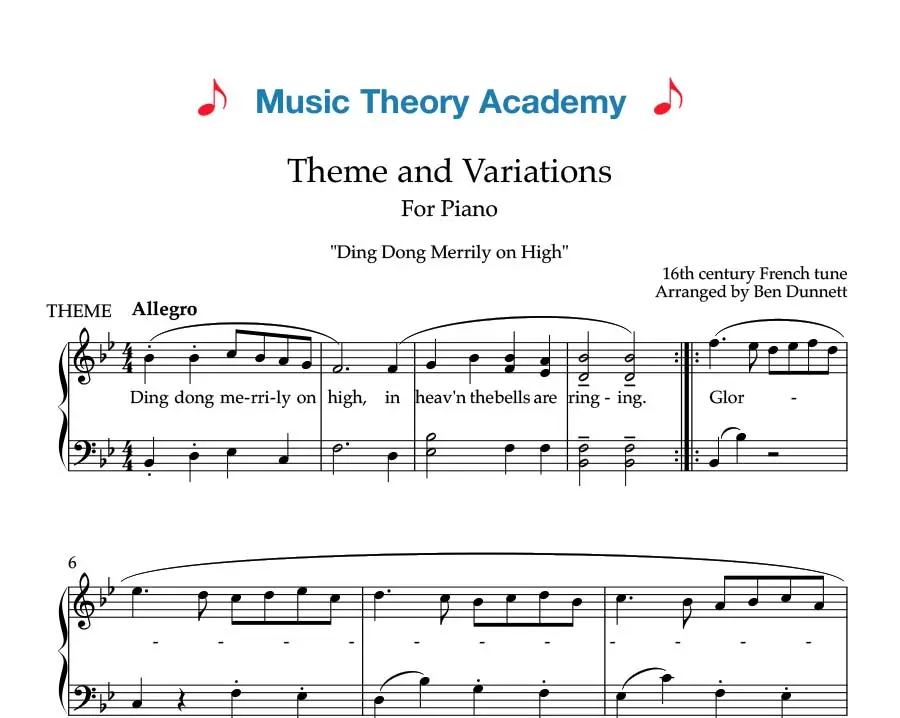
This newly released arrangement breathes fresh life into a 16th-century French tune that has enchanted listeners for generations. However, beneath its joyful facade lies a sophisticated and challenging piece of pianistic architecture. Set in the key of B-flat major and characterized by a brisk, sparkling tempo, the arrangement pushes intermediate to advanced pianists to refine their technical dexterity. Featuring intricate left-hand patterns, rapid right-hand scalic runs mirroring the choral cries of "Gloria," and a delicate interplay of staccato articulations, this composition is designed not merely for passive listening, but as a rigorous pedagogical tool.
This report provides an exhaustive examination of the new arrangement, tracing its structural anatomy, historical lineage, technical challenges, and pedagogical value. By synthesizing musicological context with practical performance guidance, this article serves as the definitive guide for pianists, educators, and music enthusiasts seeking to master this contemporary holiday classic.
Detailed Chronology: From 16th-Century Dance Tune to Modern Masterpiece
To fully appreciate the scope and ambition of Ben Dunnett’s new piano arrangement, one must trace the winding historical trajectory of Ding Dong Merrily on High—a journey spanning more than four centuries of adaptation, poetic invention, and choral evolution.
The Renaissance Origin: Jehan Tabourot’s Orchésographie
The foundational melody of Ding Dong Merrily on High did not begin its life within the sacred walls of a cathedral, but rather upon the lively floor of a Renaissance dance hall. The tune originates from a secular French dance tune titled Bransle de l’Official. It was first documented in 1588 within the groundbreaking treatise Orchésographie, written by Jehan Tabourot under the anagrammatic pseudonym Thoinot Arbeau.
Arbeau’s treatise was a comprehensive guide to social dance, music, and military drumming in 16th-century France. The bransle (or brawl) was a popular circle dance characterized by side-to-side movements, widely enjoyed by both rural peasants and nobility alike. The specific tune that would later become Ding Dong was sprightly, rhythmic, and inherently secular, designed to keep dancers light on their feet. For centuries, this lively modal tune remained an obscure historical artifact of early music scholarship, divorced entirely from the festive Christmas association it holds today.
The 20th-Century Transformation: George Ratcliffe Woodward’s Poetic Intervention
The metamorphosis of a Renaissance dance tune into an English Christmas carol occurred in the early 20th century, largely thanks to the efforts of the English priest, poet, and composer George Ratcliffe Woodward (1848–1934). Woodward was an eccentric and passionate antiquarian who spent decades unearthing and rehabilitating forgotten European hymnody and folk melodies.
Fascinated by the sprightly energy of Arbeau’s Bransle de l’Official, Woodward set out to pair the dance tune with newly written English lyrics that captured the joyous, bell-ringing atmosphere of Christmastide. Published in 1924 in his seminal collection The Cowley Carol Book, Woodward’s lyrics introduced the iconic onomatopoeic refrains and the soaring Latin bursts of "Gloria, hosanna in excelsis!"
Woodward’s collaboration with the accomplished musician Charles Wood—who harmonized the tune—cemented the piece’s place in the Anglican choral tradition. Wood’s brilliant harmonization preserved the modal, dance-like bounce of the original French tune while granting it a majestic, ecclesiastical weight.
The Contemporary Era: Ben Dunnett’s 2022 Piano Reimagining
For nearly a century, Ding Dong Merrily on High remained primarily a vocal and choral staple, occasionally appearing in simplified piano reductions for beginners or accompaniment tracks. However, in late 2022, pianist and educator Ben Dunnett sought to elevate the tune into a standalone concert and pedagogical piano work.
Released through the Music Theory Academy platform, Dunnett’s arrangement departs from standard chordal accompaniments by adopting the classical "theme and variations" form. By subjecting the historic 16th-century melody to a series of progressive transformations, Dunnett bridges the gap between historical reverence and contemporary pianistic technique. The release included freely accessible digital sheet music and a performance video, instantly positioning the piece as a modern staple for intermediate and advanced pianists looking to enrich their seasonal repertoire.
Supporting Context & Metrics: Structural Analysis and Technical Specifications
Ben Dunnett’s arrangement is a masterclass in economy of material paired with maximum technical and artistic yield. Below is a detailed breakdown of the composition’s structural metrics, tonal framework, and physical execution requirements.

Form and Architecture: Theme and Variations
The "theme and variations" structure is a time-honored classical form—utilized masterfully by composers from Mozart and Beethoven to Rachmaninoff—wherein a primary musical idea is stated plainly before undergoing a series of structural, harmonic, and rhythmic mutations.
- The Statement of the Theme: The piece opens with a clean, unadorned presentation of Woodward and Wood’s iconic melody. Listeners immediately recognize the foundational tune, established firmly within its historical and harmonic context.
- The Variations: As the piece progresses through successive variations, Dunnett introduces rhythmic displacement, harmonic coloring, countermelodies, and shifting textural densities. Each variation highlights a different facet of the piano’s capabilities while keeping the underlying framework of the 16th-century dance tune intact.
Key Signature and Harmonic Landscape
- Key: B-flat Major ($2$ flats: $Bflat$ and $Eflat$).
- Harmonic Implications: While B-flat major is generally considered a comfortable, resonant key on the piano due to the natural hand shapes it accommodates, the fast tempo of this arrangement transforms the key signature into a crucible of digital agility. Pianists must navigate frequent black-key configurations, requiring precise finger placement and forearm rotation.
Technical Metrics & Performance Challenges
| Technical Element | Description & Location in Sheet Music | Pedagogical Objective |
|---|---|---|
| Tempo & Flow | Rapid, sparkling tempo throughout the variations. | Maintaining rhythmic momentum without rushing or blurring textures. |
| Left-Hand Independence | Rapid figuration and harmonic support in the bass register. | Developing clean articulation, stamina, and rhythmic anchoring via slow practice. |
| Right-Hand Scalic Runs | Dazzling runs mirroring the vocal "Gloria" melismas. | Cultivating a seamless, legato melodic line at high speeds. |
| Articulation & Phrasing | Frequent staccato markings juxtaposed with legato lines. | Achieving the "light touch" essential for mimicking shimmering bells. |
Official Statements and Pedagogical Insights
To understand the artistic intent behind the arrangement, one must look to the creator himself. Ben Dunnett LRSM—bringing over two decades of experience as a music teacher, examiner, composer, and pianist—has provided specific performance notes designed to guide students through the pitfalls of the score.
Insights from Composer and Educator Ben Dunnett LRSM
When discussing the technical demands of his arrangement, Dunnett emphasizes that the piece’s apparent joyfulness should not mask its underlying rigor.
"This piano arrangement of Ding Dong Merrily on High is quite challenging due to the fast tempo of the piece and the key of B-flat major," Dunnett notes in his official pedagogical commentary. "Some slow practice of the left hand movement will be particularly helpful when learning the piece, as it forms the rhythmic heartbeat that supports the structural variations."
Furthermore, Dunnett offers crucial technical advice regarding the right-hand figuration:
"The right-hand scalic runs—where the lyric ‘Gloria’ is sung in the choral carol—will benefit from slow practice before speeding them up. It is important to try to create a sense of flow in this melodic line, ensuring that the pyrotechnics do not overshadow the vocal origins of the tune."
Finally, Dunnett highlights the importance of micro-articulation in capturing the imagery of physical bells:
"There are quite a number of articulation and phrasing marks on the sheet music to look for. The staccato notes are crucial to providing the light touch needed throughout the piece. Without them, the texture risks becoming heavy and losing that sparkling, bell-like resonance."
Future Outlook: The Enduring Legacy of Holiday Piano Arrangements
As the landscape of music education continues to evolve, the demand for high-quality, engaging pedagogical literature that bridges classical history with contemporary accessibility has never been higher. Works like Ben Dunnett’s Ding Dong Merrily on High point toward a promising future for seasonal piano repertoire.
Pedagogical Utility in Modern Studios
Traditional piano education has long wrestled with student engagement during the holiday season, often relying on overly simplified, uninspired arrangements of classic carols that fail to challenge advanced or intermediate students. Dunnett’s work successfully bridges this gap. By utilizing a sophisticated classical form—theme and variations—alongside genuine technical hurdles (rapid scalic runs, left-hand independence, and precise staccato control), the arrangement serves as an ideal vehicle for teaching advanced finger mechanics disguised as festive cheer.
Digital Accessibility and Global Reach
The distribution model utilized for this arrangement—combining YouTube performance demonstrations, high-resolution digital previews, and downloadable PDF scores via the Music Theory Academy—exemplifies the future of music publishing. Educators and students across the globe can instantly access professional-grade performance materials, fostering a borderless community of learners who can share interpretations, overcome technical hurdles together, and bring fresh life to centuries-old musical traditions.
Conclusion
Ding Dong Merrily on High has traveled a remarkable path: from a 16th-century French dance tune recorded by Thoinot Arbeau, to a beloved 20th-century English choral masterwork penned by George Ratcliffe Woodward, and now to a sparkling, virtuosic piano variation piece crafted by Ben Dunnett. For pianists willing to put in the hours of slow, deliberate practice required to master its B-flat major soundscapes, rapid left-hand patterns, and bell-like staccatos, this arrangement offers a deeply rewarding musical experience. It is a shining example of how contemporary composition can honor historical roots while pushing performers toward new heights of technical and expressive artistry.