
Executive Overview
In an era where artificial intelligence is rewriting the rules of creative production—from generative text to synthetic video—the world of vocal pedagogy is facing its own digital disruption. Once considered an exclusive, highly personalized craft passed down through generations of human masters, singing instruction is increasingly being mediated by algorithms. At the center of this transition is the emergence of "AI vocal coaches," software applications that promise to analyze, correct, and train the human voice in real-time.
But do these digital tutors actually work, or are they merely sophisticated pitch meters wrapped in marketing hype?
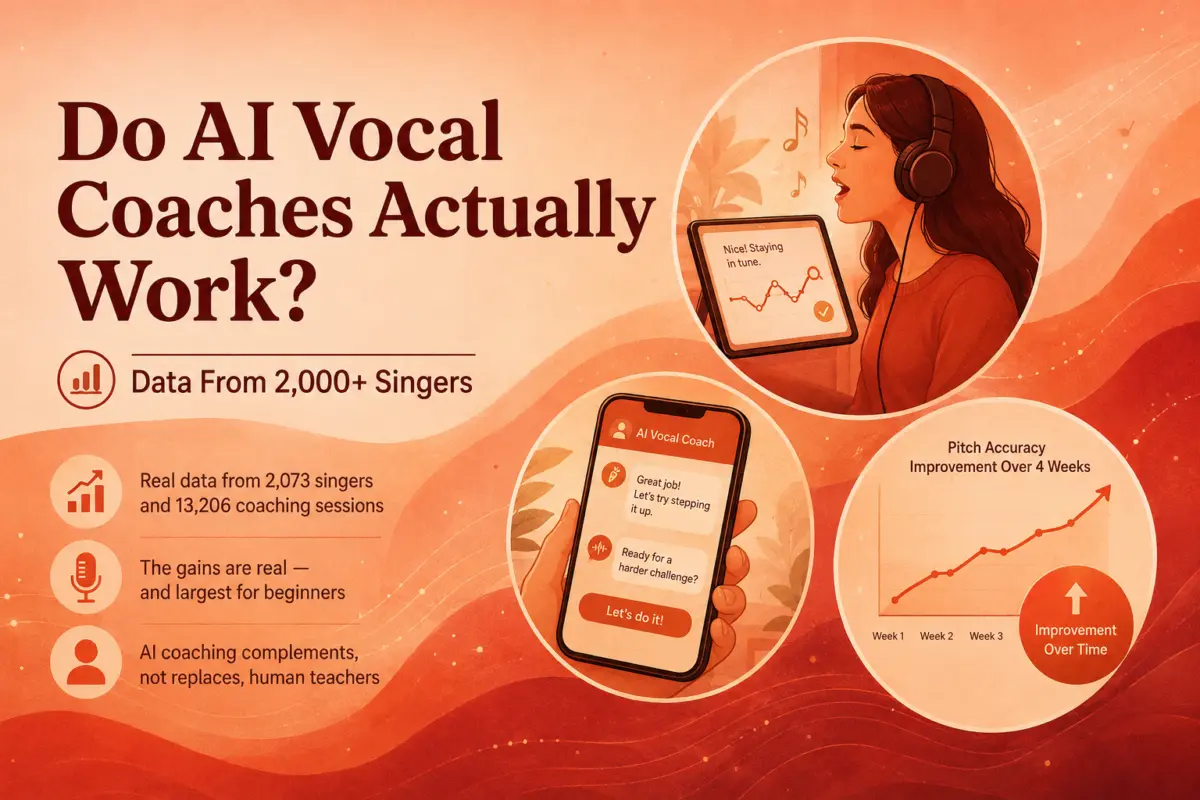
To answer this question, researchers and developers have begun analyzing large-scale empirical datasets. The most comprehensive study to date comes from the digital training platform Singing Carrots, which tracked 2,073 singers across 13,206 individual coaching sessions over a seven-month period. The findings present a nuanced picture: while an AI vocal coach cannot replace the artistic nuance of a human instructor, it delivers measurable, lasting improvements in foundational mechanics—specifically pitch accuracy and vocal range.
According to the data, users achieved an average pitch accuracy improvement of +5.9 percentage points within four weeks. Most strikingly, the technology proved highly effective for absolute beginners, who saw their accuracy jump by +16.5 percentage points.
This investigative report examines the mechanics behind these algorithmic tools, evaluates the historical and academic research supporting real-time visual feedback, analyzes the limitations of the data, and explores how the relationship between human vocal coaches and AI will evolve.
Detailed Chronology: From Analog Laboratories to Algorithmic Apps
The concept of using technology to train the human voice is not a product of the current Silicon Valley boom. Instead, it is the culmination of nearly four decades of evolution in acoustic science, software engineering, and cognitive psychology.
+-----------------------------------------------------------------------------+
|                                  TIMELINE                                   |
|                                                                             |
|  1989: Welch, Howard, & Rush prove visual pitch feedback beats traditional  |
|        methods for pitch accuracy.                                          |
|                                                                             |
|  2012: Hutchins & Peretz discover "poor singing" is primarily a motor-      |
|        coordination issue, not a perceptual hearing deficit.                |
|                                                                             |
|  2015: Paney & Kay demonstrate concurrent-feedback software successfully     |
|        improves pitch-matching in classroom settings.                       |
|                                                                             |
|  Present: Singing Carrots releases 7-month dataset of 2,073 singers,        |
|           proving AI-driven adaptive practice scales these benefits.        |
+-----------------------------------------------------------------------------+
The Foundations of Visual Feedback (1989)
In 1989, researchers Graham Welch, David Howard, and Cynthia Rush published a landmark study in the journal Psychology of Music [1]. Their research investigated whether real-time visual displays of pitch could accelerate the development of vocal pitch accuracy in singers. The study compared students who received traditional auditory feedback with those who could see their pitch plotted on a screen in real-time. The results were clear: visual feedback significantly accelerated learning, and more importantly, the improvements transferred to singing without visual aids after practice. This laid the theoretical foundation for modern vocal training apps.
The Cognitive Shift: Motor-Coordination vs. Tone Deafness (2012)
For decades, the prevailing cultural myth was that people who could not sing were "tone deaf." In 2012, cognitive scientists Sean Hutchins and Isabelle Peretz published a study in the Journal of Experimental Psychology that debunked this assumption [3]. They demonstrated that the vast majority of poor singers do not suffer from a perceptual hearing deficit; they can hear pitch differences perfectly fine. Instead, their struggle is one of motor-coordination. They lack the established neural pathways—the "ear-to-larynx" connection—needed to translate the pitch they hear into the physical adjustment of their vocal folds. This discovery shifted the focus of vocal tech from ear training to targeted, real-time motor-feedback training.
Classroom Integration and Gamification (2015)
As personal computers and mobile devices became ubiquitous, academic researchers began testing visual feedback software in classrooms. A 2015 study by Andrew S. Paney and Amy C. Kay published in Update: Applications of Research in Music Education analyzed the effect of concurrent-feedback computer games on third-grade students [2]. The study confirmed that software-guided pitch-matching games measurably improved children’s singing abilities compared to conventional classroom instruction alone, proving that gamified feedback could scale basic vocal training.
The Era of Adaptive AI Coaching (Present)
Today, the integration of advanced pitch-detection algorithms and machine learning has transformed static visual pitch meters into dynamic, adaptive coaches. Platforms like Singing Carrots now use algorithms to analyze a singer’s vocal range, detect their comfortable tessitura, adjust exercise difficulty on the fly, and provide structured training programs. The release of their seven-month dataset marks the first large-scale, real-world validation of these automated systems.
Supporting Context & Metrics: Deconstructing the Data
To understand the efficacy of AI vocal coaching, we must look closely at the metrics. The Singing Carrots dataset provides a detailed view of how real-world users interact with and improve through automated training.
Singing Carrots Pitch Accuracy Improvement (4-Week Cohort)

All Singers:     +5.9%  [=======]
Beginners:       +16.5% [====================]
Advanced:        +0.5%  [=]
1. The Core Performance Metrics
The primary metric used to evaluate singers in the study was pitch accuracy, defined as the percentage of time a singer’s vocal frequency matched the target note within a set tolerance.
- Overall Improvement: Across a paired analysis of 358 trackable singers over a four-week period, pitch accuracy improved by an average of +5.9 percentage points.
- Replication and Consistency: This result closely mirrors a previous four-month analysis with a smaller sample size, which showed a +6.1 percentage point improvement. The stability of this metric as the sample size doubled suggests that the observed improvement is a consistent effect rather than a statistical fluke.
- Long-Term Retention: Among a cohort of 94 singers tracked for three months or longer, the gains remained stable, showing a +6.1 percentage point improvement over their baseline week. This suggests that the skills acquired through the app are durable and do not fade once the initial novelty of the platform wears off.
2. The Beginner’s Advantage
The data reveals a stark gradient in improvement based on the singer’s starting skill level. This gradient provides crucial insight into who benefits most from AI-guided training:
| Initial Skill Level (Baseline Pitch Accuracy) | Average Improvement (4 Weeks) | Primary Training Benefit |
|---|---|---|
| Beginners (< 75% accuracy) | +16.5 percentage points | Rapid development of ear-to-larynx motor coordination. |
| Intermediates (75% – 90% accuracy) | +4.2 percentage points | Refinement of consistency and vocal control. |
| Advanced (> 92% accuracy) | Minimal to zero change | Transition to non-measurable skills (timbre, artistry). |
This distribution aligns perfectly with Hutchins and Peretz’s motor-coordination theory [3]. Beginners, who struggle most with the physical coordination of pitch-matching, benefit immensely from the high-frequency, low-stakes loop of real-time visual feedback. Conversely, advanced singers have already mastered basic motor coordination; their remaining growth areas lie in stylistic expression, vocal health, and emotional interpretation—areas that simple pitch-tracking algorithms cannot measure or teach.
3. Inside the Algorithm: How the AI Coach Adapts
A common criticism of music education software is that "AI" is often used as a marketing buzzword for simple, static pitch meters. However, the Singing Carrots data outlines a dynamic, responsive system. Across an analysis of approximately 349,000 vocal exercises, the system demonstrated several key adaptive behaviors:
- Range Customization: The algorithm placed 91.5% of all exercises within each user’s demonstrated comfortable vocal range, preventing vocal strain and ensuring safe practice.
- Dynamic Difficulty Adjustment: Rather than following a rigid, linear curriculum, the software dynamically adjusts difficulty based on performance. Following a successfully executed exercise, the algorithm made the subsequent exercise more challenging 31.5% of the time. Conversely, following a failed attempt, the difficulty was increased only 3.0% of the time. This tenfold difference in adaptation rate demonstrates a responsive, feedback-driven training model.
Algorithm Difficulty Progression Logic:

User Succeeds ----> 31.5% Chance of Harder Next Exercise
User Struggles ---> 3.0% Chance of Harder Next Exercise (10x reduction)
4. Critical Methodological Limitations
A truly rigorous, journalistic examination of these metrics requires addressing the limitations of the data. The developers of the platform openly acknowledge several factors that prevent these findings from being read as definitive scientific proof:
- Lack of a Control Group: The study tracked users who utilized the app, but it did not compare them to a control group of singers who practiced for the same amount of time without the app. Therefore, some portion of the improvement must be attributed to simple practice volume rather than the specific interventions of the AI.
- Self-Selection Bias: The data on long-term retention and engagement is inherently biased toward motivated users. Those who found the app unhelpful likely dropped out early, meaning the three-month data represents a self-selected group of committed practitioners.
- Regression to the Mean: Extremely low baseline scores have a natural statistical tendency to move toward the average over time. While the parallel improvement in vocal range metrics suggests the beginner gains are real, some portion of the +16.5 percentage point jump may be attributed to regression to the mean.
Official Statements & Pedagogical Perspectives
The rise of AI in music education has sparked a lively debate between technology developers, vocal scientists, and traditional educators.
The Developer’s Case: Scalability and Democratic Access
In statements accompanying their data release, the creators of Singing Carrots emphasize that their tool is designed to democratize vocal education rather than replace human expertise:
"Every claim we make about our results is rooted in published data, and we are explicit about our limitations. Our goal is not to declare human teachers obsolete. Rather, we want to provide an accessible, science-backed starting point. For millions of people who believe they are tone deaf, or who cannot afford private lessons, an AI coach offers a low-cost, low-stakes entry point into the joy of singing."
The Vocal Scientist’s View: Correcting the Laryngeal Connection
Vocal scientists point to decades of research on congenital amusia (true tone deafness) to validate the role of automated tools. According to research by Isabelle Peretz and Dominique T. Vuvan, true amusia affects only about 1.5% of the population [4].
This means that 98.5% of people have the biological capacity to sing on pitch. Academic experts agree that real-time visual feedback is one of the most effective ways to bridge the gap between pitch perception and vocal production, helping the brain build the necessary neuromuscular pathways.
The Traditional Pedagogue’s Warning: The Limits of the Screen
Despite the positive data, traditional vocal coaches urge caution. Experienced human instructors point out the critical elements of singing that an app cannot evaluate:
- Vocal Health and Tension: An app can tell you if you are singing the correct frequency, but it cannot detect if you are straining your throat, constricting your jaw, or utilizing improper breath support. This can lead to vocal fatigue or, in severe cases, vocal nodules.
- Posture and Alignment: Singing is a whole-body physical activity. An AI coach cannot see if a student is slouching, tensing their shoulders, or tilting their head in a way that restricts the vocal tract.
- Artistic Expression: Great singing is defined by its imperfections, emotional delivery, phrasing, and stylistic choices. An algorithm optimized solely for perfect pitch accuracy risks sanitizing a performance, stripping it of the unique character that makes it art.
Future Outlook: The Hybridization of Vocal Pedagogy
As artificial intelligence continues to advance, the relationship between human teachers and digital tools is shifting from competition to collaboration. The future of vocal training is not a binary choice between an app and a teacher, but rather a hybrid model that leverages the strengths of both.
+-------------------------------------------------------------------------+
|                    THE HYBRID VOCAL TRAINING MODEL                      |
|                                                                         |
|  +---------------------------+       +-------------------------------+  |
|  |     AI VOCAL COACH        |       |         HUMAN TEACHER         |  |
|  |                           |       |                               |  |
|  |  * Daily Pitch Practice   |  ==>  |  * Artistic Interpretation    |  |
|  |  * Range Expansion        |  <==  |  * Vocal Health Monitoring    |  |
|  |  * Immediate Feedback     |       |  * Performance Coaching       |  |
|  +---------------------------+       +-------------------------------+  |
+-------------------------------------------------------------------------+
1. Computer Vision and Posture Analysis
The next frontier for AI vocal coaches is the integration of computer vision. By utilizing the front-facing cameras on smartphones and tablets, future training applications will not only listen to the singer’s voice but also analyze their physical posture, jaw alignment, and breathing patterns. This will address one of the most significant safety concerns raised by human vocal teachers.
2. Timbre and Resonance Tracking
While current apps focus primarily on pitch and range, emerging machine learning models are being trained to analyze vocal timbre, resonance, and vowel placement. By assessing the harmonic profile of a singer’s voice, AI will soon be able to offer guidance on achieving a warmer, brighter, or more balanced tone.
3. The "Flipped Classroom" of Voice Lessons
Just as digital platforms revolutionized language learning and mathematics, they are poised to restructure vocal lessons. In this hybrid paradigm, students will use AI vocal coaches at home to handle the repetitive, quantitative aspects of practice—such as scale drills, pitch-matching exercises, and range building.
This frees up valuable, expensive face-to-face time with human teachers, allowing them to focus on artistic interpretation, stage presence, emotional connection, and complex stylistic techniques.
Ultimately, the data surrounding AI vocal coaching validates its role as a powerful tool for developing fundamental musical skills. For the beginner struggling to match a pitch, the algorithm provides a patient, non-judgmental, and highly effective guide. For the advanced artist, it serves as a reliable daily tuner. By understanding and respecting these boundaries, both students and educators can harness the power of technology to unlock the human voice.
References
- [1] Welch, G. F., Howard, D. M., & Rush, C. (1989). Real-time visual feedback in the development of vocal pitch accuracy in singing. Psychology of Music, 17(2), 146–157.
- [2] Paney, A. S., & Kay, A. C. (2015). Developing singing in third-grade music classrooms: The effect of a concurrent-feedback computer game on pitch-matching skills. Update: Applications of Research in Music Education, 34(1), 42–49.
- [3] Hutchins, S., & Peretz, I. (2012). A frog in your throat or in your ear? Searching for the causes of poor singing. Journal of Experimental Psychology: General, 141(1), 76–97.
- [4] Peretz, I., & Vuvan, D. T. (2017). Prevalence of congenital amusia. European Journal of Human Genetics, 25(5), 625–630.