
By Ian DeNolfo, Executive Director, The Voice Foundation
Executive Overview
Voice science stands at a definitive, historic inflection point. Today, artificial intelligence (AI) and advanced machine learning are fundamentally reshaping how researchers conduct investigations, how medical professionals analyze clinical data, and how speech-language pathologists care for patients. This technological revolution, while accelerating at a breathtaking pace, is not an overnight phenomenon born of modern generative tools; rather, it is the culmination of decades of interdisciplinary dedication, rigorous peer review, and visionary scientific leadership.
For over half a century, The Voice Foundation and its premier peer-reviewed publication, the Journal of Voice, have served as the intellectual epicenter of this field. From early computational neural networks introduced in the mid-1990s to sophisticated deep learning models capable of diagnosing pathologies and tracking systemic health biomarkers today, the integration of AI into voice science has transformed from a fringe experimental pursuit into a cornerstone of modern medicine. As the volume of AI-driven literature experiences exponential growth—with more than 60 percent of all historical AI papers published by the journal in just the last three years—the medical and scientific community is forced to reckon with both the unprecedented diagnostic capabilities of these technologies and the profound ethical responsibilities required to govern them.
A Legacy of Innovation: Bridging Art and Science
To understand the magnitude of the current AI-driven transformation, one must look back at the rich heritage upon which it is built. In 1969, Dr. Wilbur James Gould founded The Voice Foundation in New York City. At a time when interdisciplinary care for the human voice was virtually non-existent, Dr. Gould possessed the groundbreaking foresight to bring together groups of professionals who historically operated in professional silos: physicians, scientists, speech-language pathologists, performing artists, and vocal pedagogues. His mission was to create a collaborative ecosystem dedicated to sharing knowledge and advancing the care of the professional voice user.

This vision materialized rapidly. In 1972, the Foundation hosted its first Annual Symposium—Care of the Professional Voice—followed closely by its inaugural Gala (later renamed Voices of Summer) in 1973. For over five decades, the organization has successfully built bridges between art and science, and between the clinical laboratory and the theatrical stage.
Since 1989, the Foundation has been led by Dr. Robert Thayer Sataloff, an internationally renowned otolaryngologist who is simultaneously a professional singer and conductor. Having authored more than 1,200 publications, including 79 textbooks, Dr. Sataloff steered the Foundation through a period of immense growth following its relocation to Philadelphia. Under his stewardship, the annual Philadelphia symposium has expanded into a global magnet, drawing hundreds of medical doctors, scientists, academics, speech-language pathologists, and performing artists from every corner of the globe. Concurrently, the Journal of Voice has cemented its status as the definitive, peer-reviewed authority on voice science and medicine.
Three Decades of AI Research: A Chronological Evolution
While public awareness of artificial intelligence has surged only recently, the Journal of Voice has been charting the intersection of computation and voice science for over thirty years.
The historical timeline of AI integration in the journal tells a fascinating story of gradual exploration followed by vertical acceleration:
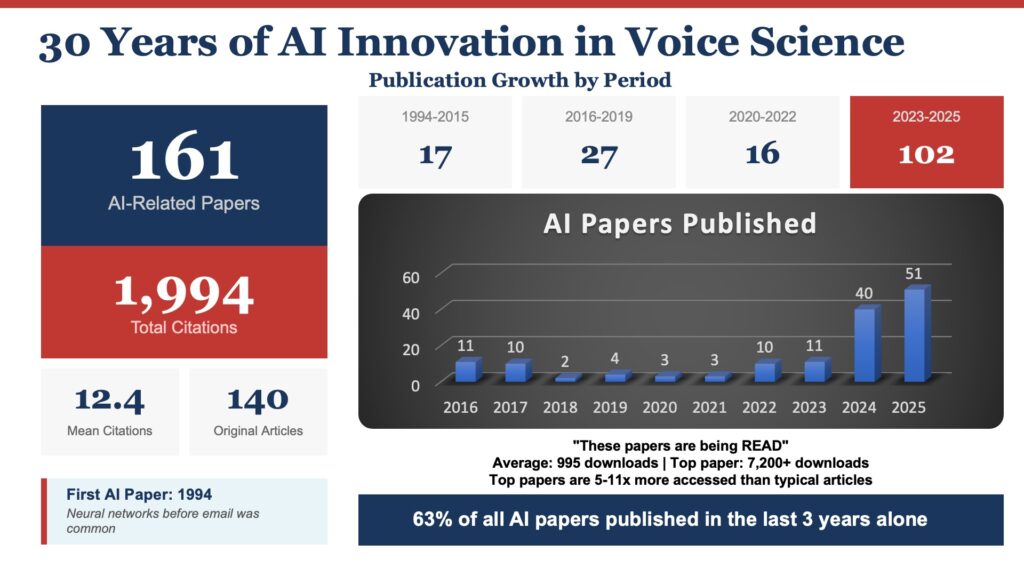
- 1994–2015: 17 papers published
- 2016–2019: 27 papers published
- 2020–2022: 16 papers published
- 2023–2025: 102 papers published
The foundational spark occurred in 1994—thirty-one years ago—when the journal published a paper by Rihkanen and colleagues titled "Spectral Pattern Recognition of Improved Voice Quality." Utilizing nascent neural networks to analyze voice data, that paper appeared during the exact year the World Wide Web was first entering public consciousness. Voice researchers were exploring neural networks before most professionals had ever sent an electronic mail message.
However, the true inflection point has occurred in the post-2020 era. Out of 161 total AI-related papers published in the journal’s history, an astonishing 102 papers (63 percent) were published between 2023 and 2025. In the single year of 2025, the journal published 51 AI-related papers—surpassing the total output of the first twenty years of digital AI research combined. This trajectory represents a structural transformation of the discipline.
Beyond Citations: Real-World Impact and Access Metrics
Academic publications are frequently evaluated by citation counts, but the true value of the Journal of Voice‘s AI portfolio lies in its real-world utility. Clinicians, speech-language pathologists, and biomedical engineers are actively downloading, reading, and implementing these studies into daily practice.
Usage metrics underscore this profound reach:
- The average AI-related paper in the journal has been downloaded nearly 1,000 times.
- The single most-accessed AI paper—a landmark study examining machine learning applications for COVID-19 detection—has amassed over 7,200 downloads, outperforming the median article in its issue by a factor of eleven.
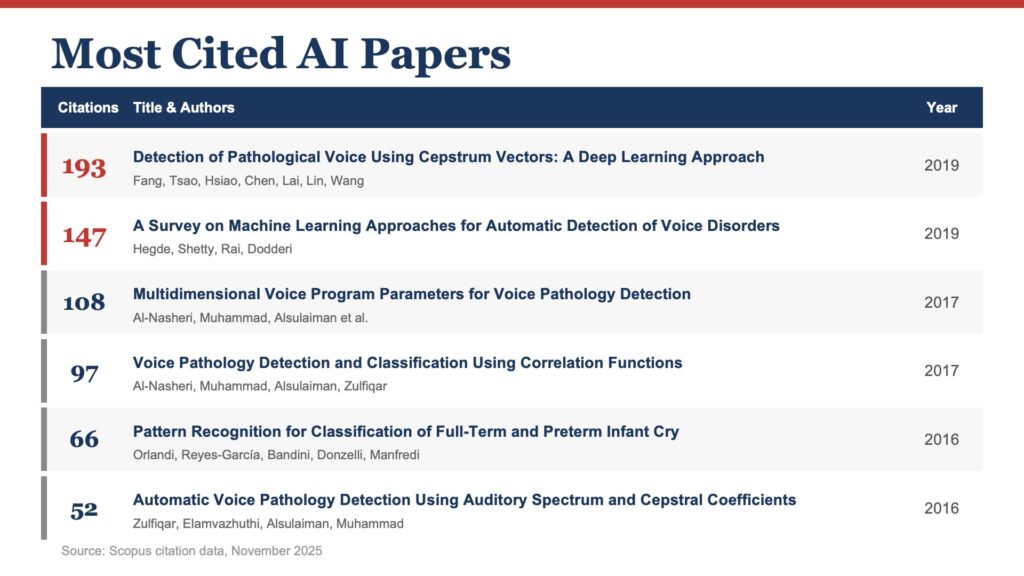
- The two most-cited papers in the journal’s history, authored by Fang et al. (a deep learning study with 193 citations) and Hegde et al. (a machine learning survey with 147 citations), have each been downloaded nearly 5,000 times, securing positions among the top three most-accessed articles in their respective publication issues.
These figures indicate that the readership is not merely academic; it is composed of frontline practitioners searching for actionable diagnostic tools to elevate patient outcomes.
Landmark Research Reshaping the Field
Deep Learning for Voice Pathology Detection
The technological breakthroughs underpinning modern voice diagnostics are rooted in advanced neural network architectures. Published in 2019, Fang and colleagues’ study, "Detection of Pathological Voice Using Cepstrum Vectors: A Deep Learning Approach," stands as the most-cited AI paper in the journal’s history with 193 citations. This research proved definitively that deep neural networks could identify pathological conditions in human vocal folds with astonishing accuracy by analyzing acoustic features entirely imperceptible to the human ear.
This foundational work was complemented by Hegde and colleagues’ comprehensive "Survey on Machine Learning Approaches for Automatic Detection of Voice Disorders" (147 citations), which provided a critical roadmap of machine learning models for incoming researchers. Other foundational milestones include Al-Nasheri et al.’s work on Multidimensional Voice Program parameters, Chen and Chen’s deep neural networks for voice classification, Fujimura’s one-dimensional convolutional neural networks, and Cho and Choi’s comparative analyses of CNN models applied to laryngoscopic imaging.
Voice as a Digital Biomarker
Perhaps the most conceptually revolutionary shift in modern medicine is the recognition of the human voice as a digital biomarker—a non-invasive, accessible window into systemic physiological and neurological health.

Recent literature highlights the efficacy of voice analysis in detecting and monitoring neurodegenerative diseases such as Parkinson’s disease. Hemmerling and Wójcik-Pędziwiatr’s 2022 paper on predicting Parkinson’s severity via voice signals quickly garnered 29 citations within three years, spearheading a movement toward clinical deployment.
Beyond neurology, systematic reviews published in the journal have begun exploring voice quality as a digital biomarker for affective disorders, including major depression and bipolar disorder. The societal implications are staggering: routine acoustic profiling could soon allow primary care providers to detect early mental health fluctuations, enabling timely interventions and alleviating burdens on overextended psychiatric care infrastructures. Similar advancements have been charted in respiratory health, where machine learning models evaluate acoustic properties to flag respiratory compromise.
AI Chatbots in Clinical Practice
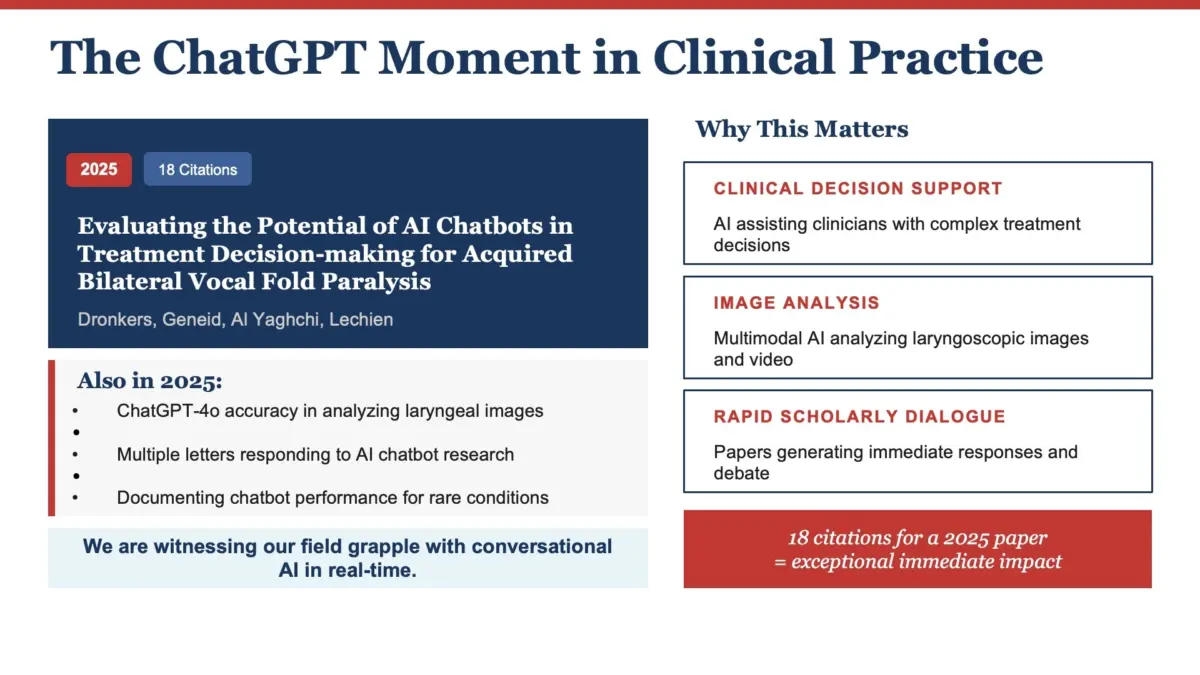
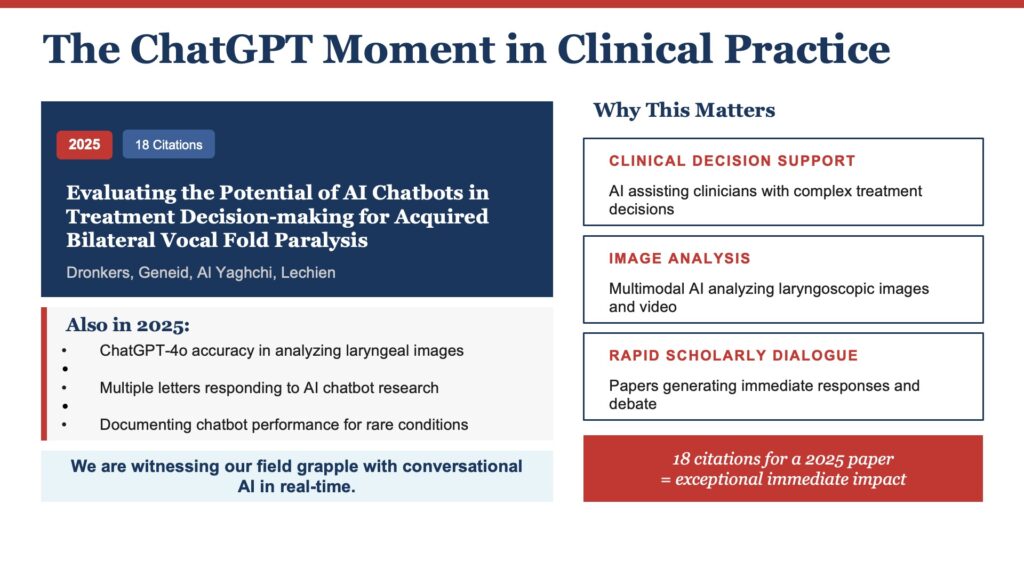
The year 2025 introduced an entirely new category of literature: the evaluation of conversational AI and large language models (LLMs) in direct clinical decision-making. Dronkers and colleagues published a landmark paper entitled "Evaluating the Potential of AI Chatbots in Treatment Decision-making for Acquired Bilateral Vocal Fold Paralysis," which accumulated 18 citations almost immediately.
Spurring multiple letters to the editor and follow-up studies regarding ChatGPT-4o’s precision in evaluating complex laryngeal images, this body of work demonstrates how rapidly the clinical community is engaging with conversational intelligence at the bedside and in the operating room.
Expert Perspectives on AI in Voice Science
Dr. Mark Berardi: Managing Biological Complexity
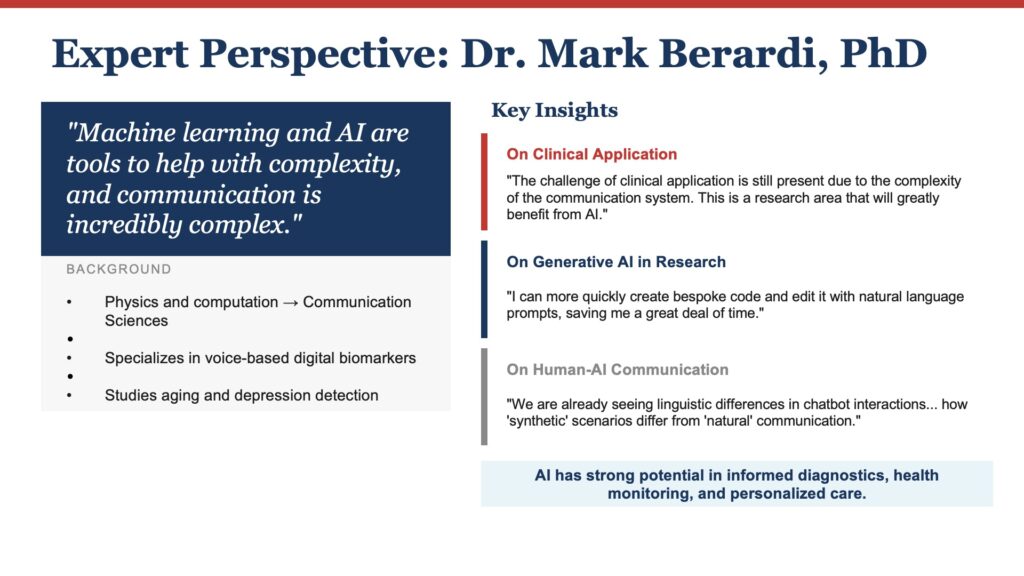
Dr. Mark Berardi, whose academic roots bridge physics and computation, views artificial intelligence primarily as an indispensable instrument for managing vast complexity.
"Machine learning and AI are tools to help with complexity, and communication is incredibly complex in its neurobiological and physiological processes. So I think the application is warranted," Dr. Berardi observes.
Focusing his research on voice-based digital biomarkers for aging and depression, Dr. Berardi notes that while acquiring high-fidelity speech signals has become remarkably simple, interpreting the underlying biological mechanics remains difficult—making AI an ideal analytical partner. Regarding generative AI, he adopts a pragmatic stance, emphasizing its utility in overcoming traditional research bottlenecks. By using natural language prompts to write and refine bespoke data-processing code, researchers can bypass tedious programming hurdles.
Furthermore, Dr. Berardi is pioneering investigations into human-AI communication itself. As society transitions toward synthetic communication environments—ranging from structured chatbot interfaces to ubiquitous video conferencing—linguistic adaptation is shifting. Understanding how humans modify their vocal production when interacting with synthetic systems represents an expanding frontier for voice science.
Dr. Eric Hunter: Embracing Change with Ethical Clarity
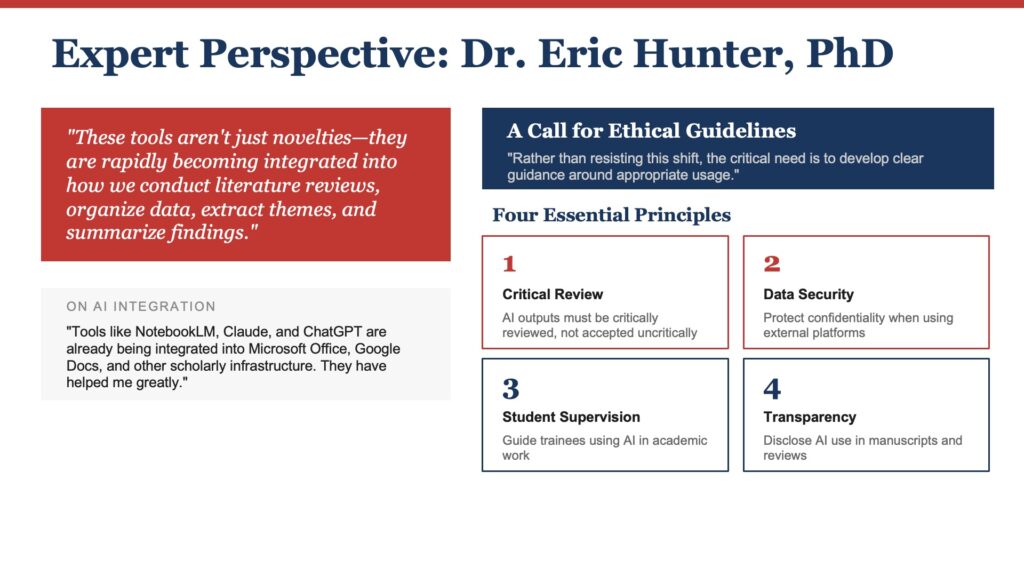
Dr. Eric Hunter focuses his insights on the institutional and academic realities of the AI revolution. He warns that generative platforms and large language models can no longer be treated as mere novelties.
"These tools aren’t just novelties," Dr. Hunter stresses. "They are rapidly becoming integrated into how we conduct literature reviews, organize data, extract themes from large bodies of text, and even summarize findings."
As scholarly infrastructure—including Microsoft Office, Google Docs, and dedicated AI research copilots like NotebookLM and Claude—becomes natively embedded with LLMs, the academic workflow is changing irrevocably. Rather than attempting to resist this tide, Dr. Hunter issues a definitive call to action: the immediate creation of transparent, standardized ethical guidelines for both authors and peer reviewers.
To maintain scientific integrity, the academic ecosystem must establish clear protocols ensuring that AI supports human intellect without compromising data provenance, transparency, or authorship accountability.
A Global Research Community
The rapid ascent of AI in voice science is sustained by an extensive, international coalition of scholars. Key contributors shaping the pages of the Journal of Voice include prolific researchers such as Jérôme René Lechien, Dimitar Deliyski, Stephanie Zacharias, Ahmed Yousef, Paavo Alku, Leonardo Wanderley Lopes, and Maryam Naghibolhosseini. Hailing from institutions spanning every inhabited continent, these investigators demonstrate that the digital transformation of voice science is a collective, global enterprise driven by shared curiosity and a dedication to healing.
The Path Forward: Challenges and Collective Action
As the Journal of Voice charts its course through the coming decade, it remains committed to upholding uncompromising standards of scientific rigor while championing methodological innovation. However, realizing the full potential of AI requires confronting three core challenges:
- Mindful Engagement: Researchers and clinicians must master AI instruments not as oracles, but as sophisticated tools designed to manage data complexity, augment professional expertise, and amplify human clinical judgment.
- Ethical Frameworks: The development of robust, transparent guidelines for AI utilization in manuscript preparation, data curation, and peer review must become a collaborative, cross-institutional priority.
- Continuous Knowledge Sharing: The 161 published AI papers represent only the foundation. Clinicians, engineers, and educators must continue to bring their empirical discoveries to light, ensuring that the fruits of technological progress are shared globally.
An Extraordinary Moment
For hundreds of thousands of years, the human voice has served as our primary instrument of connection, emotional resonance, and personal identity. It encodes our histories, mirrors our neurological health, and broadcasts our deepest physical states in ways that no other biological signal can replicate.
Now, for the first time in human history, humanity possesses computational tools sophisticated enough to decode that complexity—tools that extend the diagnostic reach of expert clinicians, detect subtle pathologies before they manifest as severe medical crises, and democratize access to high-quality voice care across the globe.

We stand at an extraordinary historical crossroads, and The Voice Foundation alongside the Journal of Voice remains firmly at the center of this revolution. The next decade promises discoveries that will redefine the boundaries of medicine and art alike.